|

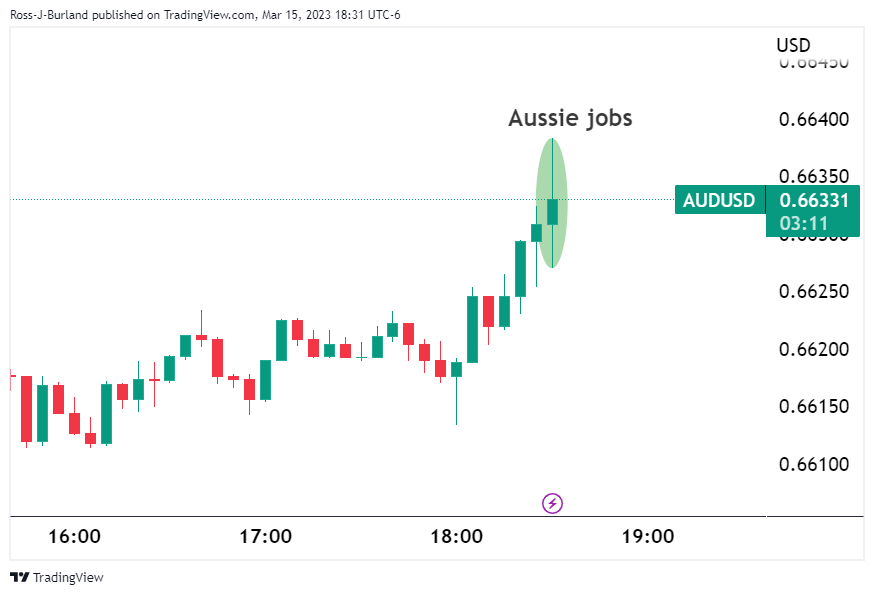
Breaking: AUD/USD rescued on positive Aussie jobs report

Breaking: AUD/USD rescued on positive Aussie jobs report

The Employment data for Australia has been released by the Australian Bureau of Statistics as follows:

  • Australia Employment Change Feb: 64.6K (est 50.0K; prev -11.5K; prevR 10.9K).
  • Unemployment Rate Feb: 3.5% (est 3.6%; prev 3.7%) .
  • Participation Rate Feb: 66.6% (est 66.6%; prev 66.5%).
  • Full-time employment change Feb: 74.9k (prev -43.3k; prevr -42.4k).
  • Part-time employment change Feb: -10.3k (prev 31.8k; prevr 31.5k).

AUD/USD update

The Australian and New Zealand dollars were on the defensive on Thursday following the NZ Gross Domestic Product miss and due to the fears for the global banking system.

This data for Australia is a lifeline for the currency that is rallying on the outcome:
About the Employment Change

The Employment Change released by the Australian Bureau of Statistics is a measure of the change in the number of employed people in Australia. Generally speaking, a rise in this indicator has positive implications for consumer spending which stimulates economic growth. Therefore, a high reading is seen as positive (or bullish) for the AUD, while a low reading is seen as negative (or bearish).

Author

FXStreet Team

Composed of a group of economic journalists and FX experts, the FXStreet content team produces and oversees all content published on FXStreet. It provides a purely journalistic approach to the Forex market.


More from FXStreet Team
Share:

Editor's Picks

AUD/USD remains depressed below 0.6750 after RBA minutes

AUD/USD treads water below 0.6750 in Asia on Tuesday, struggling near ten-month lows. The pair fails to find any inspiration from RBA Governor Bullock’s hawkish remarks. Moreover, Minutes from the November RBA meeting also had little impact on the Australian Dollar amid a bullish US Dollar undertone, bolstered by firming Fed hike bets and geopolitical uncertainties.

USD/JPY holds steady around 156.50 as 'Yentervention' risks loom

USD/JPY is consolidating around mid-156.00s in the Asian session on Tuesday as traders stay on high alert amid speculation that authorities will step in to support the Japanese Yen. Meanwhile, the US Dollar holds its recent gains at a 19-month high, amid firming Fed rate-hike bets and geopolitical uncertainty. This, along with the wide US-Japan rate differential, acts as a tailwind for the pair.


Gold bulls seem hesitant below $3,900 as Fed rate hike bets offset softer USD

Gold clings to modest intraday recovery gains, though it remains below the $3,900 mark through the early European session, and near its lowest level since October 2025, which it touched the previous day. The US Dollar pulls back slightly following the recent strong rally to a 19-month peak, offering some support to the commodity. However, firming US Fed rate-hike expectations and geopolitical uncertainties could limit any meaningful USD fall. This caps the precious metal, warranting some caution for bullish traders.

Pi Network sinks to record low of $0.0551 as bears dominate

Pi Network extends its losing streak, hitting a new all-time low of $0.0551 on Tuesday as bearish pressure intensifies. Weakening derivatives metrics suggest bears remain in control. In addition, deteriorating technical indicators point to elevated downside risk, despite oversold conditions that could trigger a short-term relief bounce.

The week ahead: Questions for the new Nvidia CEO, Anthropic’s IPO and economic data dump
The tech stock rout does not look to be over, and could be broadening as we start a new week. Nvidia’s stock price is lower by another 2% in the pre market, and its rivals, that had benefited from the chip giant’s initial demise, are also playing catch up this morning. AMD’s share price is lower by 4.2% in early trading, even though it eked out a gain last week.
Gold isn't being sold for thew reason most people think
Gold (XAU/USD) remains under heavy selling pressure on Monday, hitting its lowest level in 13 months. The precious metal is struggling to recover despite escalating geopolitical tensions in the Middle East, a backdrop that would normally encourage investors to seek protection in safe-haven assets. However, the main driver behind Gold's decline is not the geopolitical uncertainty itself.















