Boeing stock sinks as union resists proposed deal from management
- Boeing stock opened about 3% lower on Wednesday.
- Late Tuesday, management withdrew their September 23 pay hike offer.
- Hurricane Milton is expected to hit Florida late Wednesday.
- Dow Jones advances, leading other indices despite impending storm.

Boeing (BA) stock continues to languish on Wednesday as the aeronautics company deals with further setbacks from its ongoing worker strike. The company’s BA stock has fallen as much as 3% in the middle of the week after management withdrew a pay hike offer to its union, who were unreceptive over the past two weeks.
In contrast, the Dow Jones Industrial Average (DJIA), an index in which Boeing is included, is leading the US equity market higher. At the time of writing, the Dow is up 0.3%, while the NASDAQ gains 0.1%. The DJIA also advanced on Tuesday.
The market is bracing for Hurricane Milton to make landfall late Wednesday near Tampa, Florida. Meteorologists expect the storm to lead to a 15-foot storm surge that may flood lower-lying areas of Western Florida and say wind gusts should reach between 100 and 140 miles per hour.
On the low side, RBC Capital Markets expect insurance companies to get hit with a $60 billion loss from the storm, similar to Hurricane Ian in 2022. However, Fed Watch Advisors estimates that insured losses could range from $100 billion on the low end to $175 billion.
Boeing stock news: When it rains, it pours
Boeing shareholders are used to the bad headlines by this point. Boeing stock has been in a downtrend since February 2019, so the latest news is just more of the same.
On September 23, Boeing offered a 30% pay raise and a performance bonus. However, it withdrew that offer late Wednesday, saying that the International Association of Machinists & Aerospace Workers union wasn’t budging.
That union, which comprises some 33,000 Boeing employees, is holding strong to its demand of a 40% pay raise and, more importantly, a defined-benefit pension. It seems to be the pension that Boeing management is most strongly against.
Boeing Commercial Airplanes CEO Stephanie Pope called the union’s demands “non-negotiable”.
Ratings agency S&P followed up the withdrawn offer with notice of a possible credit rating downgrade, saying that Boeing could be headed for junk status. That could make it more difficult to raise debt and thus force the aerospace firm to dilute shareholders by issuing new equity to the market.
S&P estimates that Boeing is losing $1 billion per month due to the strike and will likely burn through $10 billion in cash in 2024. In addition, S&P analysts don’t think it likely that Boeing will reach its goal of 38 completed 737 MAX airplanes per month until mid-2025. Boeing delivered seven fewer planes in September than August due to workers going on strike on September 13.
Speaking of the 737, the US Federal Aviation Administration issued a safety alert on Tuesday for the plane due to jammed or limited movement on some plane rudders. Pilots were told to use a specific safety checklist before flying. When it rains, it pours.
Boeing stock forecast
Boeing stock is in a tailspin. Shares of BA are down over 42% this year alone. The weekly chart below shows that the only real support sits down at $120, nearly 20% below current price action. That $120 level delivered a foundation of support back in 2022 on two primary occasions.
To find relief, the market needs to push Boeing stock back above the $160 to $164 range where prior support existed earlier in the year. For now, most technical traders will notice the red histogram bars on the Moving Average Convergence Divergence (MACD), which is in a bearish crossover pattern, and steer clear.
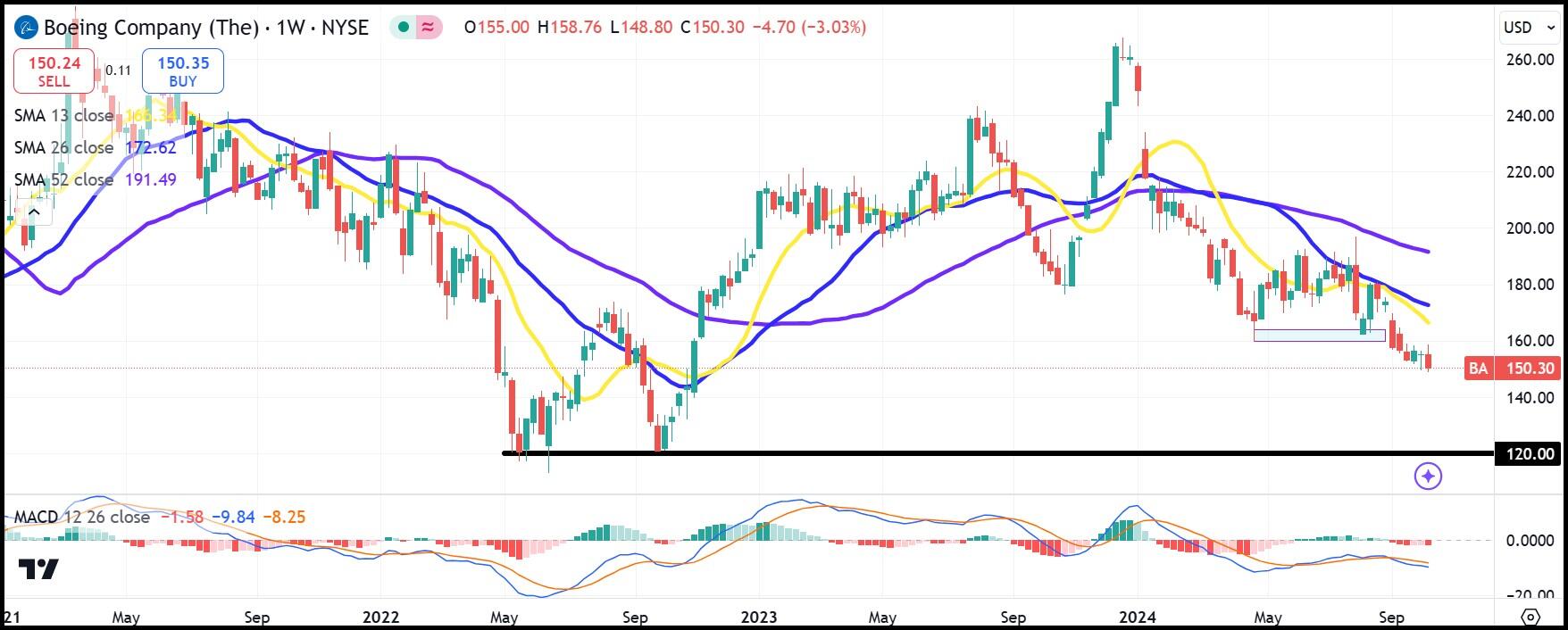
BA weekly stock chart
Author

Clay Webster
FXStreet
Clay Webster grew up in the US outside Buffalo, New York and Lancaster, Pennsylvania. He began investing after college following the 2008 financial crisis.