BoC's Governor Macklem: Core inflation is easing as expected

Governor Tiff Maclem holds a press conference in conjunction with the release of the Bank of Canada's Monetary Policy Report (MPR).
Key Takeaways
Data and bank surveys suggest we are back to low inflation; this is good news for Canadians.
The focus now is to maintain low, stable inflation; we need to stick to the landing.
The bank cut by 50 bps because inflation is back to the 2% target and the goal is to keep it there.
The aim is to see growth strengthen, and today's cut should contribute to a pickup in demand.
Growth in residential investment is also expected to rise.
The increased GDP forecast reflects the net effect of a gradual pick-up in consumer spending per person and slower population growth.
Upward and downward forces on inflation need to balance out.
Going forward, some monthly fluctuations in inflation can be expected.
We are focused on inflation when considering this cut; core inflation is easing as expected.
Shelter price inflation has started to come off, increasing our confidence that it will gradually continue to ease.
The Governing Council had clear consensus for 50 bps cut.
This section below was published after the Bank of Canada (BoC) interest rate decision at 13:45 GMT
The Bank of Canada (BoC) aligned with market expectations by implementing a 50-basis-point interest rate cut at its Wednesday meeting, lowering the policy rate from 4.25% to 3.75%.
From the bank's statement, it expects inflation to stay near the target over the projection horizon, with upward and downward pressures roughly balancing each other out. Officials noted that the overall economy continues to operate with excess supply.
The central bank left its 2024 growth forecast unchanged at 1.2%, 2.1% in 2025 (also unchanged from the July Monetary Policy Report), and slightly adjusted the 2026 forecast to 2.3% (from 2.4%).
Inflation is projected to average 2.5% in 2024 (down from 2.6% in July), 2.2% in 2025 (lowered from 2.4%), and 2.0% in 2026, which remains unchanged.
The BoC also highlighted that the labour market remains soft.
Market reaction
The Canadian Dollar weakened further following the BoC's decision to cut its policy rate by 50 bps at its meeting, motivating USD/CAD to flirt with recent peaks near 1.3850.
Canadian Dollar PRICE Today
The table below shows the percentage change of Canadian Dollar (CAD) against listed major currencies today. Canadian Dollar was the strongest against the Japanese Yen.
| USD | EUR | GBP | JPY | CAD | AUD | NZD | CHF | |
|---|---|---|---|---|---|---|---|---|
| USD | 0.20% | 0.21% | 1.30% | 0.19% | 0.63% | 0.55% | 0.19% | |
| EUR | -0.20% | 0.03% | 1.11% | 0.00% | 0.45% | 0.36% | -0.00% | |
| GBP | -0.21% | -0.03% | 1.07% | -0.05% | 0.42% | 0.34% | 0.02% | |
| JPY | -1.30% | -1.11% | -1.07% | -1.09% | -0.66% | -0.73% | -1.04% | |
| CAD | -0.19% | -0.00% | 0.05% | 1.09% | 0.45% | 0.38% | 0.06% | |
| AUD | -0.63% | -0.45% | -0.42% | 0.66% | -0.45% | -0.06% | -0.39% | |
| NZD | -0.55% | -0.36% | -0.34% | 0.73% | -0.38% | 0.06% | -0.33% | |
| CHF | -0.19% | 0.00% | -0.02% | 1.04% | -0.06% | 0.39% | 0.33% |
The heat map shows percentage changes of major currencies against each other. The base currency is picked from the left column, while the quote currency is picked from the top row. For example, if you pick the Canadian Dollar from the left column and move along the horizontal line to the US Dollar, the percentage change displayed in the box will represent CAD (base)/USD (quote).
This section below was published as a preview of the Bank of Canada interest rate decision at 08:00 GMT.
- Bank of Canada (BoC) is expected to cut its policy rate by 50 bps.
- The Canadian Dollar remains on the defensive against the US Dollar.
- Headline inflation in Canada dropped below the bank’s 2% target.
- The BoC will also release its Monetary Policy Report (MPR).
There is broad anticipation that the Bank of Canada (BoC) will cut its policy rate for the fourth consecutive meeting on Wednesday. Unlike previous moves, there seems to be a consensus for a 50 basis point rate cut this time, taking the benchmark interest rate to 3.75%.
Since the beginning of the year, the Canadian Dollar (CAD) has weakened against the US Dollar (USD), with USD/CAD reaching an almost two-year high near 1.3950 in early August. Following a period of quite a significant appreciation in August, CAD has since then embarked on a firm downward path that currently flirts with the mid-1.3800s against its North American counterpart.
In September, Canada's annual inflation rate, measured by the headline Consumer Price Index (CPI), broke below the central bank’s 2% target for the first time since the Covid-19 pandemic, showing prices rising by 1.6% over the last twelve months. The BoC's core CPI, despite rebounding marginally last month, remained well below the bank’s threshold.
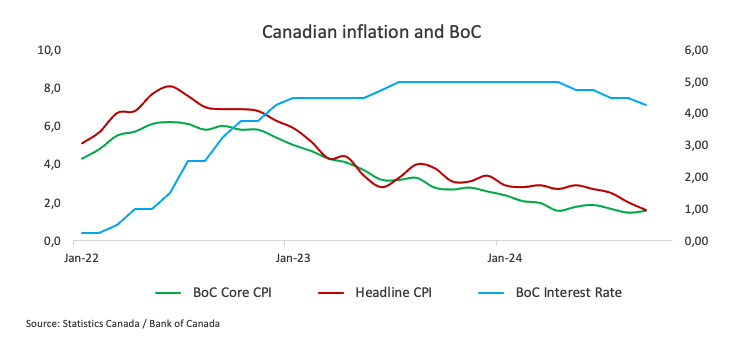
It is worth noting that the BoC aims to maintain consumer prices around the midpoint of the 1%-3% range.
A dovish cut appears well on the horizon
Despite the anticipated rate cut, the central bank's overall stance is expected to lean towards the bearish side, particularly against the backdrop of declining inflation, further cooling of the labour market, and GDP running below the bank’s latest forecasts.
So far, swaps markets in Canada see around a 70% chance of a half-point rate reduction on Wednesday.
According to a BoC survey released on October 11, Canadian firms reported continued weak demand and slow sales growth, though they noted a marginal improvement in conditions during the third quarter. The survey also suggested that rate cuts could potentially provide a further boost to these conditions.
Following the rate cut on September 4, the Minutes published on September 18 revealed that the bank’s Governing Council was divided on the inflation outlook ahead of its decision to cut rates for the third consecutive time. The BoC stated that it was balancing the effects of two conflicting forces on inflation: the ongoing high costs of shelter and services and a slowing economy coupled with rising unemployment.
According to the Minutes, council members expressed the view that if the economy and labour market did not improve as expected in response to lower borrowing costs, it could be necessary to reduce the policy rate more rapidly.
At his latest remarks on September 24, BoC Governor Tiff Macklem indicated that, given the bank’s ongoing progress in bringing inflation back towards the 2% target, further rate cuts are a reasonable expectation. Macklem emphasized the bank’s goal of keeping inflation near the middle of its 1%-3% control range. "We need to stick the landing," he said, adding that the bank is aiming for stronger economic growth to help absorb the remaining slack in the economy.
Previewing the BoC’s interest rate decision, analysts at Standard Chartered noted: “We now expect the Bank of Canada (BoC) to lower the policy rate by 50bps (instead of 25 bps) at both the October and December meetings, taking the year-end rate to 3.25% (3.75% prior). The September headline inflation undershoot and diminishing inflationary pressure from shelter prices are likely to open the door for faster easing. Falling inflation expectations and continued slack in the economy further bolster the case for 50bps moves.”
When will the BoC release its monetary policy decision, and how could it affect USD/CAD?
The Bank of Canada will announce its policy decision at 13:45 GMT on Wednesday, followed by a press conference from Governor Macklem at 14:30 GMT.
With no major surprises anticipated, the impact on the Canadian Dollar (CAD) is expected to stem more from the central bank’s messaging than the actual interest rate decision.
Pablo Piovano, Senior Analyst at FXStreet, notes that USD/CAD has been in a strong upward trend since late September, with the pair hitting October tops near 1.3850 so far this week. The strong rebound came almost exclusively on the back of the robust recovery of the US Dollar (USD).
Pablo adds: "The immediate target emerges at the 2024 peak at 1.3946 recorded on August 5."
He concludes: "Occasional bearish attempts could prompt USD/CAD to retest the provisional 100-day SMA at 1.3664, ahead of the more significant 200-day SMA at 1.3622, all prior to the September bottom of 1.3418 seen on September 25.”
Economic Indicator
BoC Monetary Policy Statement
At each of the Bank of Canada (BoC) eight meetings, the Governing Council releases a post-meeting statement explaining its policy decision. The statement may influence the volatility of the Canadian Dollar (CAD) and determine a short-term positive or negative trend. A hawkish view is considered bullish for CAD, whereas a dovish view is considered bearish.
Read more.Last release: Wed Sep 04, 2024 13:45
Frequency: Irregular
Actual: -
Consensus: -
Previous: -
Source: Bank of Canada
Interest rates FAQs
Interest rates are charged by financial institutions on loans to borrowers and are paid as interest to savers and depositors. They are influenced by base lending rates, which are set by central banks in response to changes in the economy. Central banks normally have a mandate to ensure price stability, which in most cases means targeting a core inflation rate of around 2%. If inflation falls below target the central bank may cut base lending rates, with a view to stimulating lending and boosting the economy. If inflation rises substantially above 2% it normally results in the central bank raising base lending rates in an attempt to lower inflation.
Higher interest rates generally help strengthen a country’s currency as they make it a more attractive place for global investors to park their money.
Higher interest rates overall weigh on the price of Gold because they increase the opportunity cost of holding Gold instead of investing in an interest-bearing asset or placing cash in the bank. If interest rates are high that usually pushes up the price of the US Dollar (USD), and since Gold is priced in Dollars, this has the effect of lowering the price of Gold.
The Fed funds rate is the overnight rate at which US banks lend to each other. It is the oft-quoted headline rate set by the Federal Reserve at its FOMC meetings. It is set as a range, for example 4.75%-5.00%, though the upper limit (in that case 5.00%) is the quoted figure. Market expectations for future Fed funds rate are tracked by the CME FedWatch tool, which shapes how many financial markets behave in anticipation of future Federal Reserve monetary policy decisions.
Author

FXStreet Team
FXStreet
Composed of a group of economic journalists and FX experts, the FXStreet content team produces and oversees all content published on FXStreet. It provides a purely journalistic approach to the Forex market.

















