Banxico minutes signal more easing ahead as economy slows
- Banxico board sees increased economic slack and downside inflation risks, reinforcing expectations for more rate cuts.
- Majority noted orderly MXN trading and improving liquidity conditions despite external volatility.
- USD/MXN could test 20.00 if support at 20.30 breaks; upside risk only resumes above 20.50.
On Thursday, April 10, Banco de Mexico (Banxico) released its latest meeting minutes, in which all board members stated that the Mexican economy is slowing down amid an evolving disinflation process, which paves the way for further easing.
Banxico's meeting key quotes:
Board estimates that looking ahead it could continue calibrating the monetary policy stance and consider adjusting in similar magnitudes.
Majority of board members said the economy is expected to show increased slack.
Most board members said MXN trading conditions remained orderly and even showed improvements during the period.
Majority stated balance of risks to economic activity is biased to the downside.
Most indicated that risks to downside for inflation have gained relevance.
Majority of board said the expected weakness of economic activity and greater slack conditions will contribute to continuation of disinflation process.
One board member said flash estimate for February suggests the contraction will extend to that month.
A scenario of high and permanent tariffs on all US imports from Mexico is unlikely to materialize.
USD/MXN Price Forecast: Technical outlook
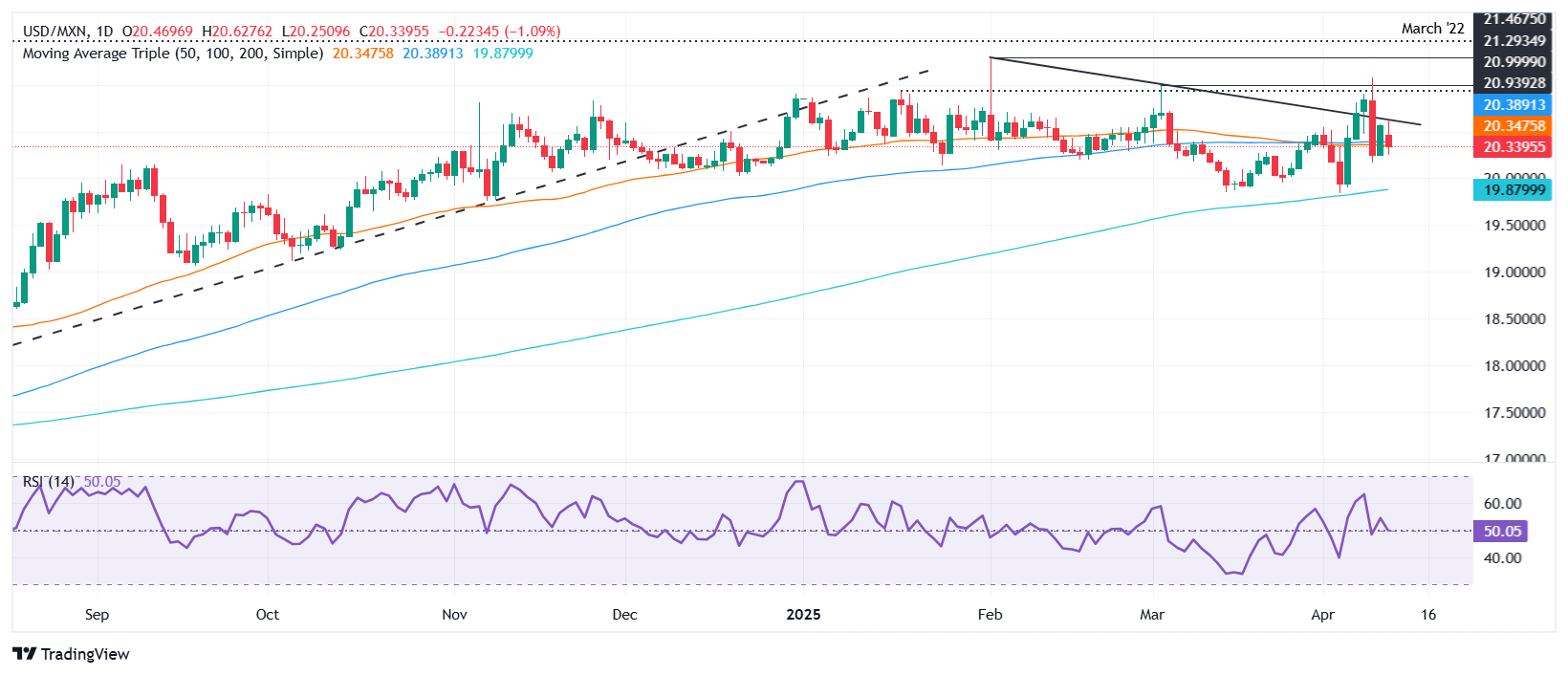
Even though the USD/MXN remains upwardly biased, a drop below the 20.30 area could pave the way for further losses. The next key support level lies at 20.00, followed by the 200-day Simple Moving Average (SMA) at 19.83. If surpassed, the next stop would be 19.50. Conversely, a bullish continuation looms if buyers push the pair past the 20.50 area, with the 21.00 figure next.
Banxico FAQs
The Bank of Mexico, also known as Banxico, is the country’s central bank. Its mission is to preserve the value of Mexico’s currency, the Mexican Peso (MXN), and to set the monetary policy. To this end, its main objective is to maintain low and stable inflation within target levels – at or close to its target of 3%, the midpoint in a tolerance band of between 2% and 4%.
The main tool of the Banxico to guide monetary policy is by setting interest rates. When inflation is above target, the bank will attempt to tame it by raising rates, making it more expensive for households and businesses to borrow money and thus cooling the economy. Higher interest rates are generally positive for the Mexican Peso (MXN) as they lead to higher yields, making the country a more attractive place for investors. On the contrary, lower interest rates tend to weaken MXN. The rate differential with the USD, or how the Banxico is expected to set interest rates compared with the US Federal Reserve (Fed), is a key factor.
Banxico meets eight times a year, and its monetary policy is greatly influenced by decisions of the US Federal Reserve (Fed). Therefore, the central bank’s decision-making committee usually gathers a week after the Fed. In doing so, Banxico reacts and sometimes anticipates monetary policy measures set by the Federal Reserve. For example, after the Covid-19 pandemic, before the Fed raised rates, Banxico did it first in an attempt to diminish the chances of a substantial depreciation of the Mexican Peso (MXN) and to prevent capital outflows that could destabilize the country.
Author

Christian Borjon Valencia
FXStreet
Markets analyst, news editor, and trading instructor with over 14 years of experience across FX, commodities, US equity indices, and global macro markets.

















