Bank of England says to brace for interest rate rises

The Bank of England cautioned over the weekend over inflation and business delivery headaches. Additionally, BoE policymaker Michael Saunders told households to get ready for "significantly earlier" interest rate rises as inflation pressure mounts in the British economy, the Telegraph newspaper said on Saturday.
"I'm not in favour of using code words or stating our intentions in advance of the meeting too precisely. The decisions get taken at the proper time," Saunders said.
"I think it is appropriate that the markets have moved to price a significantly earlier path of tightening than they did previously," Saunders added.
The markets had been factoring in prospects of a rate rise in prior months on the back of hawkish rhetoric at the Old Lady. For instance, the BoE Governor Andrew Bailey said inflation running above the central bank's 2.0% target was concerning and had to be managed to prevent it from becoming permanently embedded.
''Obviously, I am concerned with inflation above target,” he said, adding, ''if you look at our last forecast, it is going to go higher I am afraid.''
''As the Bank of England governor, I would prefer it not be there. But we are in very unusual times and what I would say is we have to manage our way through these times.''
Meanwhile, Saunders said markets had fully priced in a February rate hike by the British central bank and had half-priced in a December increase in borrowing costs.
Saunders said this weekend that investors were right to bet on faster increases in borrowing costs with consumer price inflation heading above 4%, adding to signs the BoE might become the first major central bank to raise rates since the pandemic struck. However, such commentary has been insufficient to steer GBP into greener pastures, bogged down by a series of negative headlines, some of which actually point to the risk of stagflation.
''The UK has a significant current account deficit and, with international investors likely unnerved by the negative news, this may be increasing the sensitivity of the pound to the worsened backdrop,'' analysts at Rabobank explained earlier in the month, noting also the strength in the Us dollar hindering the pounds ability to recover.
The nine-member Monetary Policy Committee at last month's BoE meeting voted unanimously to keep rates at 0.1%. However, Saunders and Deputy Governor Dave Ramsden voted to halt the BoE's government bond purchases ahead of schedule.
GBP/USD implications
Following a dismal US Nonfarm Payrolls report on Friday that would be expected to weigh on the US dollar, the British pound could find demand at the start of this week on central bank themes.
The Federal Reserve would be expected to taper with caution and rate rise rhetoric could well be dialled down if US data continues to disappoint this winter. However, inflation concerns will be the key driver for which the Fed has indicated to be higher and longer-lasting than originally anticipated.
Fears that inflation will spike yet higher, and thus also become more entrenched than expected, are unlikely to ease this week with forthcoming US CPI figures that are expected to indicate yet another increase in both headline (5.4%) and core rates (4.1%). On the activity side, UK GDP is expected to have rebounded in August.
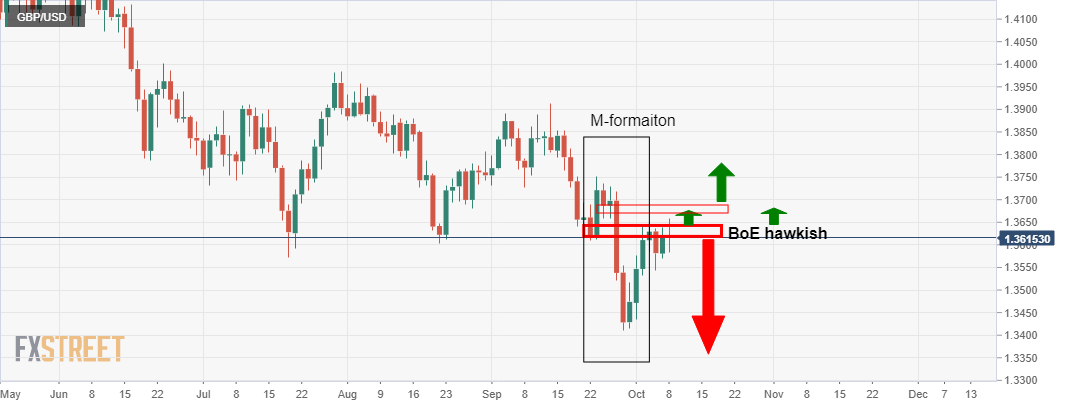
As per the chart above, GBP/USD has corrected and stalled at old support which gives rise to prospects of a downside continuation for the days ahead. However, the BoE theme could give the pound a boost to start the week into the M-formations neckline and derail the bearish outlook, at least, for the immediate term.
Author

Ross J Burland
FXStreet
Ross J Burland, born in England, UK, is a sportsman at heart. He played Rugby and Judo for his county, Kent and the South East of England Rugby team.