|

BABA Stock News: Alibaba Group drops further as new chip restrictions weigh on Chinese ADRs

  • NYSE: BABA fell by 4.9% during Tuesday’s trading session. 
  • Alibaba established a new 2.1-million-square-foot campus for its Cloud division.
  • The US export restrictions on semiconductor chips continued to weigh on Alibaba. 

Alibaba Group (BABA) slipped further on Tuesday as the stock continued to see selling pressure following the United States restricting exports of semiconductors to China. Shares of BABA fell by 4.9% and closed the trading session at a price of $75.37. It was another volatile day of trading on Wall Street as stocks jumped higher out of the gate but erased those gains by the closing bell. The S&P 500 fell for the fifth straight day, while the Nasdaq closed at its lowest price since July 2020. Overall, the Dow Jones managed to post a 0.1% gain, while the S&P 500 and the Nasdaq fell by 0.7% and 1.1%, respectively, during the session. 

Alibaba stock price

Alibaba recently established a brand new 2.1-million-square-foot complex for its Alibaba Cloud division in Hangzhou. The corporate campus spans ten different buildings and over 450,000 square meters of floor space. It is approximately the same size as Alphabet’s (GOOGL) Silicon Valley headquarters in Mountain View, California. Alibaba’s Cloud division continues to be one of its fastest-growing segments, accounting for 9% of its revenue in the most recent quarter.

Alibaba’s stock was clearly still being impacted by the recent export restrictions that were placed on China by the United States. The restrictions will see a ban on equipment being sold to China that previously allowed companies to make advanced chips. The purpose of the restrictions is to stifle Chinese technology and military advancements, so it should come as no surprise that Chinese tech stocks continued to show weakness on Tuesday. 
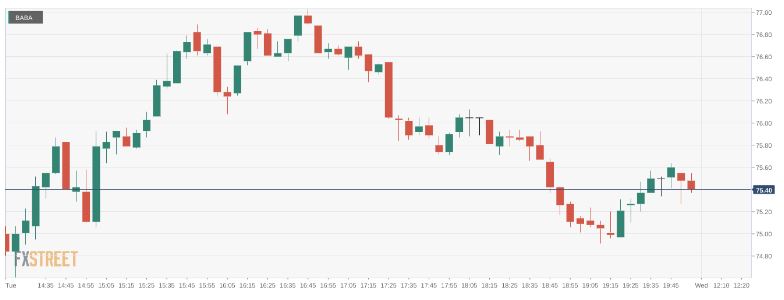
BABA 5-minute chart 10/11/22

Premium

You have reached your limit of 3 free articles for this month.

Start your subscription and get access to all our original articles.

Subscribe to PremiumSign In

Author

More from Stocks Reporter
Share:

Markets move fast. We move first.

Orange Juice Newsletter brings you expert driven insights - not headlines. Every day on your inbox.

By subscribing you agree to our Terms and conditions.

Editor's Picks

EUR/USD bounces toward 1.1750 as US Dollar loses strength

EUR/USD returned to the 1.1750 price zone in the American session on Friday, despite falling Wall Street, which indicates risk aversion. Trading conditions remain thin following the New Year holiday and ahead of the weekend, with the focus shifting to US employment and European data scheduled for next week.

GBP/USD nears 1.3500, holds within familiar levels

After testing 1.3400 on the last day of 2025, GBP/USD managed to stage a rebound. Nevertheless, the pair finds it difficult to gather momentum and trades with modest intraday gains at around 1.3490 as market participants remain in holiday mood.

Gold trims intraday gains, approaches $4,300

Gold retreated sharply from the $4,400  area and trades flat for the day in the $4,320 price zone. Choppy trading conditions exacerbated the intraday decline, although XAU/USD bearish case is out of the picture, considering growing expectations for a dovish Fed and persistent geopolitical tensions.

Cardano gains early New Year momentum, bulls target falling wedge breakout

Cardano kicks off the New Year on a positive note and is extending gains, trading above $0.36 at the time of writing on Friday. Improving on-chain and derivatives data point to growing bullish interest, while the technical outlook keeps an upside breakout in focus.

Economic outlook 2026-2027 in advanced countries: Solidity test

After a year marked by global economic resilience and ending on a note of optimism, 2026 looks promising and could be a year of solid economic performance. In our baseline scenario, we expect most of the supportive factors at work in 2025 to continue to play a role in 2026.

Crypto market outlook for 2026

Year 2025 was volatile, as crypto often is.  Among positive catalysts were favourable regulatory changes in the U.S., rise of Digital Asset Treasuries (DAT), adoption of AI and tokenization of Real-World-Assets (RWA).
















