Australia’s Unemployment Rate climbs to 4.1% in June vs. 4.0% expected

Australia’s Unemployment Rate rose to 4.1% in June, compared with the expectations and the previous figure of 4.0%, according to the official data released by the Australian Bureau of Statistics (ABS) on Thursday.
Furthermore, the Australian Employment Change arrived at 50.2K in June from 39.7K in May, compared with the consensus forecast of 20.0K.
The participation rate in Australia increased to 66.9% in June, compared to 66.8% in May. Meanwhile, Full-Time Employment increased by 43.3K in the same period from 41.7K in the previous reading. The Part-Time Employment increased by 6.8K in June versus -2.1K prior.
Bjorn Jarvis, ABS head of labour statistics, said with the key highlights noted below
With employment rising by around 50,000 people and the number of unemployed growing by 10,000 people, the unemployment rate rose slightly to 4.1 per cent, and the participation rate rose to 66.9 per cent.
Unemployment rose 10,000 people in June, following a fall of 9,000 in May. While it has increased from a low of 491,000 people in October 2022 to 608,000 in June, it is still around 100,000 people or 14.2 per cent lower than just prior to the COVID-19 pandemic.
The unemployment rate was 0.5 percentage points higher than June last year, and 1.1 percentage points lower than March 2020.
AUD/USD reaction to the Australia Employment report
The Australian Dollar posts modest gains in an immediate reaction to the Australia Employment report. The AUD/USD pair is trading at 0.6733, adding 0.06% on the day.
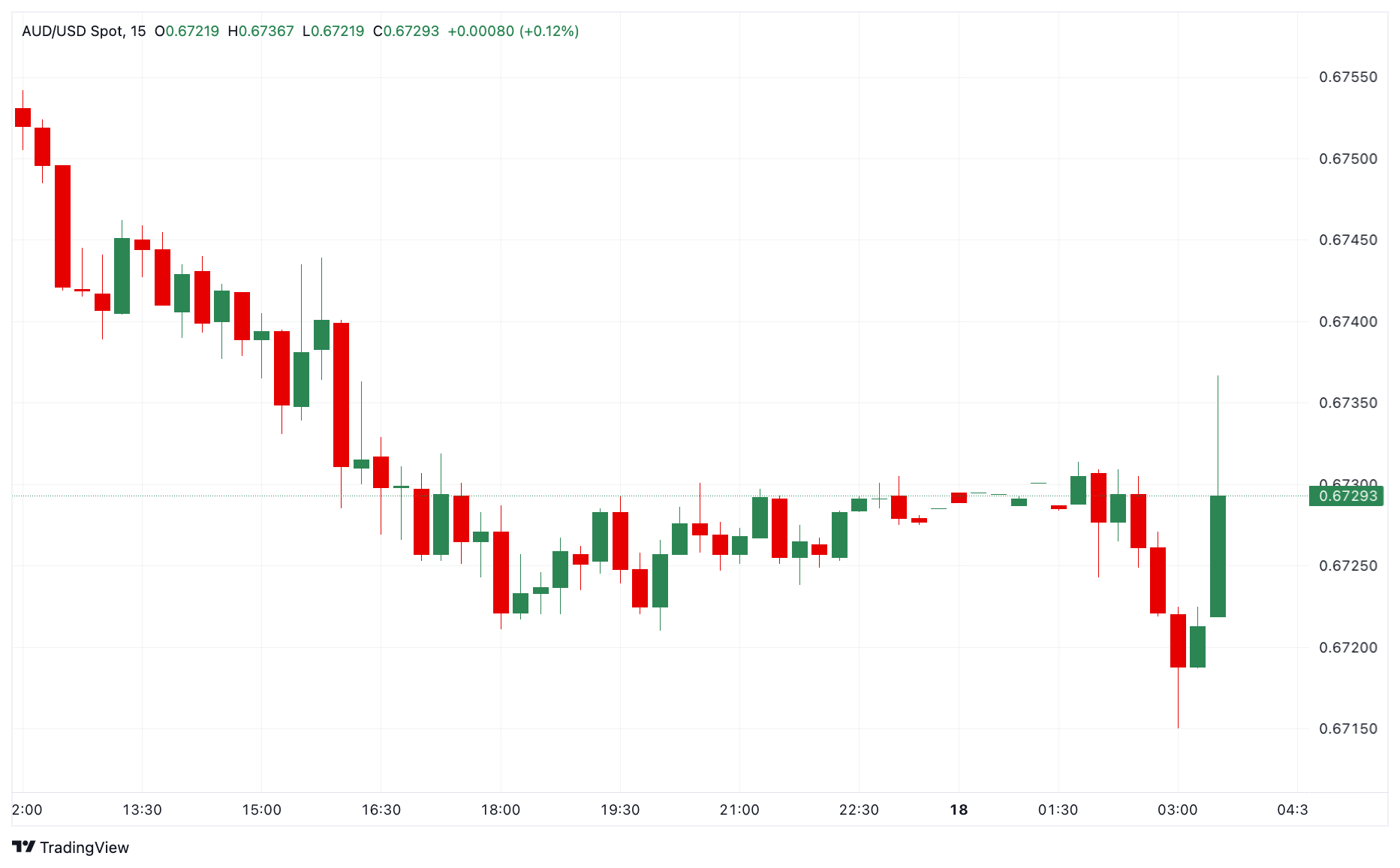
Australian Dollar price this week
The table below shows the percentage change of Australian Dollar (AUD) against listed major currencies this week. Australian Dollar was the strongest against the New Zealand Dollar.
| USD | EUR | GBP | CAD | AUD | JPY | NZD | CHF | |
| USD | -0.47% | -0.29% | 0.28% | 0.61% | -1.47% | 0.49% | -1.43% | |
| EUR | 0.46% | 0.17% | 0.74% | 1.06% | -0.99% | 0.94% | -0.98% | |
| GBP | 0.28% | -0.18% | 0.57% | 0.89% | -1.16% | 0.74% | -1.15% | |
| CAD | -0.29% | -0.75% | -0.57% | 0.33% | -1.79% | 0.18% | -1.77% | |
| AUD | -0.61% | -1.08% | -0.90% | -0.32% | -2.08% | -0.13% | -2.06% | |
| JPY | 1.47% | 1.01% | 1.18% | 1.74% | 2.02% | 1.87% | 0.01% | |
| NZD | -0.46% | -0.94% | -0.77% | -0.19% | 0.13% | -1.91% | -1.93% | |
| CHF | 1.41% | 0.96% | 1.13% | 1.70% | 2.03% | -0.01% | 1.86% |
The heat map shows percentage changes of major currencies against each other. The base currency is picked from the left column, while the quote currency is picked from the top row. For example, if you pick the Euro from the left column and move along the horizontal line to the Japanese Yen, the percentage change displayed in the box will represent EUR (base)/JPY (quote).
This section below was published at 21:30 GMT on Thursday as a preview of the Australia Employment report
- The Australian Unemployment Rate is foreseen unchanged at 4% in June.
- Employment Change expected at 20K, down from the previous 39.7K.
- AUD/USD struggles to extend gains ahead of the announcement.
With sentiment dominating financial markets, the Australian Bureau of Statistics (ABS) will release the monthly employment report on Thursday at 1:30 GMT. The country is expected to have added 20K new positions in June, while the Unemployment Rate is foreseen to remain steady at 4%. The Australian Dollar (AUD) heads into the event with a firmer tone against its United States (US) rival, with AUD/USD trimming part of its early week losses.
The ABS splits the headline Employment Change figure into full-time and part-time positions. As a rule of thumb, full-time jobs imply working 38 hours per week or more and usually include additional benefits, but they mostly represent consistent income. On the other hand, part-time employment generally means higher hourly rates but lacks consistency and benefits. That’s why full-time jobs have more weight than part-time ones when setting an AUD directional path.
Back in May, the monthly employment report showed that Australia managed to create 41.7K full-time jobs but lost part-time positions, resulting in a net Employment Change of 39.7K. The Unemployment Rate contracted from the previous 4.1% to 4%.
Australian Unemployment Rate seen stable in June
As previously noted, financial markets anticipate the Unemployment Rate will remain steady at 4% and that the economy created 20K new positions in June.
The Australian Unemployment Rate peaked at 4.1% in April, matching the January reading and a level not seen since 2022. A higher unemployment rate usually signals a loosening labor market, allowing central banks to cut interest rates.
The Reserve Bank of Australia (RBA), however, maintained the Cash Rate at 4.35% in its June meeting and seems in no rush to cut interest rates. It is worth reminding that the RBA’s “duty is to contribute to the stability of the currency, full employment, and the economic prosperity and welfare of the Australian people.”
With that in mind, an easing Unemployment Rate and solid job creation will be seen as a tightening labor market, which means a further delay in potential interest rate cuts. In fact, the stronger the labor market, the higher the odds for a rate hike. The latest scenario is quite unlikely, given the risk it poses to economic growth, but speculative interest has not yet fully disregarded a potential rate hike. On rate cuts, bets keep moving forward, with the first potential trim in Australia foreseen in 2025.
When will the Australian employment report be released, and how could it affect AUD/USD?
The ABS will publish the June employment report early on Thursday. As previously stated, Australia is expected to have added 20K new job positions in the month, while the Unemployment Rate is foreseen at 4%. Finally, the Participation Rate is foreseen to hold at 66.8%.
The AUD/USD pair fell towards 0.6713 on Tuesday, clinching two consecutive daily losses despite an upbeat market mood that sent Wall Street into unexplored territory. However, stocks lost momentum, and the USD shed some ground with the pair bouncing from such a low and holding on to modest intraday gains at around 0.6740 ahead of the announcement.
From a technical perspective, Valeria Bednarik, Chief Analyst at FXStreet, notes: “The AUD/USD pair is bullish, although the momentum is missing. The daily chart shows a bullish 20 Simple Moving Average (SMA), partially losing its upward strength but still advancing below the current level and above mildly bullish 100 and 200 SMAs. Meanwhile, technical indicators hold onto positive levels, in line with the bullish case, but lack directional strength, suggesting investors are unsure where to go next.”
Bednarik adds: “AUD/USD has a strong static resistance level at 0.6770, with gains beyond it exposing the 0.6820/40 price zone. In the case of a bearish reaction, the pair will find support initially at around 0.6700, followed by the 0.6660 mark. As usual, the market will react not directly to the figures but to how those would affect the upcoming RBA monetary policy decision.”
Employment FAQs
Labor market conditions are a key element in assessing the health of an economy and thus a key driver for currency valuation. High employment, or low unemployment, has positive implications for consumer spending and economic growth, boosting the value of the local currency. Moreover, a very tight labor market – a situation in which there is a shortage of workers to fill open positions – can also have implications on inflation levels because low labor supply and high demand leads to higher wages.
The pace at which salaries are growing in an economy is key for policymakers. High wage growth means that households have more money to spend, usually leading to price increases in consumer goods. In contrast to more volatile sources of inflation such as energy prices, wage growth is seen as a key component of underlying and persisting inflation as salary increases are unlikely to be undone. Central banks around the world pay close attention to wage growth data when deciding on monetary policy.
The weight that each central bank assigns to labor market conditions depends on its objectives. Some central banks explicitly have mandates related to the labor market beyond controlling inflation levels. The US Federal Reserve (Fed), for example, has the dual mandate of promoting maximum employment and stable prices. Meanwhile, the European Central Bank’s (ECB) sole mandate is to keep inflation under control. Still, and despite whatever mandates they have, labor market conditions are an important factor for policymakers given their significance as a gauge of the health of the economy and their direct relationship to inflation.The Trade Balance, which is the difference between what a country earns from its exports versus what it pays for its imports, is another factor that can influence the value of the Australian Dollar. If Australia produces highly sought after exports, then its currency will gain in value purely from the surplus demand created from foreign buyers seeking to purchase its exports versus what it spends to purchase imports. Therefore, a positive net Trade Balance strengthens the AUD, with the opposite effect if the Trade Balance is negative.
Economic Indicator
Unemployment Rate s.a.
The Unemployment Rate, released by the Australian Bureau of Statistics, is the number of unemployed workers divided by the total civilian labor force, expressed as a percentage. If the rate increases, it indicates a lack of expansion within the Australian labor market and a weakness within the Australian economy. A decrease in the figure is seen as bullish for the Australian Dollar (AUD), while an increase is seen as bearish.
Read more.Next release: Thu Jul 18, 2024 01:30
Frequency: Monthly
Consensus: 4%
Previous: 4%
Source: Australian Bureau of Statistics
The Australian Bureau of Statistics (ABS) publishes an overview of trends in the Australian labour market, with unemployment rate a closely watched indicator. It is released about 15 days after the month end and throws light on the overall economic conditions, as it is highly correlated to consumer spending and inflation. Despite the lagging nature of the indicator, it affects the Reserve Bank of Australia’s (RBA) interest rate decisions, in turn, moving the Australian dollar. Upbeat figure tends to be AUD positive.
Author

FXStreet Team
FXStreet
Composed of a group of economic journalists and FX experts, the FXStreet content team produces and oversees all content published on FXStreet. It provides a purely journalistic approach to the Forex market.

















