Australian Dollar hovers near three-month highs on market sentiment
- Australian Dollar could gain ground on the positive sentiment.
- Australia’s Dollar tests three-month highs toward the 0.6600 level.
- RBA Governor Bullock’s remarks support the Aussie pair.
- PBoC strengthens financial support for private enterprises in listing and financing, mergers and acquisitions, and restructuring.
- US Dollar seems to halt the losses as US bond yields improve.

The Australian Dollar (AUD) struggles to continue the winning streak for the third successive session on Monday. The AUD/USD pair hovers below the three-month high at 0.6590, and received upward support from the negative tone surrounding the US Dollar (USD). This negative sentiment has been influenced by the mixed S&P Global PMI data, contributing to the Aussie pair's strength.
Australia's Dollar experienced a boost in response to positive market sentiment, driven by news of continued stimulus in the Chinese property market. This has improved investors' mood, as reflected in the positive performance of equity markets. Furthermore, the People's Bank of China (PBoC) has issued a notice to strengthen financial support for private firms. This comprehensive support encompasses assistance for private enterprises in listing and financing, mergers and acquisitions, as well as restructuring.
AUD faces downward pressure after the release of China Industrial Profit Year-to-Date (YTD) data on China's industrial profits, narrowing down to a decline of 7.8%, an improvement from the previous drop of 9.0%. In the month of October, there was a positive shift, with industrial enterprises' profits showing a 2.7% increase, contrasting with the 11.9% decrease observed earlier.
The PBoC has committed to increasing bond issuance by privately owned firms and is actively encouraging lenders not to cut or suspend loans for private companies facing temporary difficulties but exhibiting competitive technologies.
Furthermore, the recent hawkish comments from Reserve Bank of Australia (RBA) Governor Michele Bullock are providing support for the Aussie pair. Bullock emphasized that the inflation challenge is increasingly driven by domestic demand, underscoring that monetary policy tightening is the appropriate response to demand-driven inflation.
US Dollar Index (DXY) losses ground despite improved US Treasury yields. This comes amid speculations that the US Federal Reserve (Fed) might ease monetary policy next year. However, Fed officials' comments last week hinted at the need for further tightening. They also emphasized that decisions would depend on incoming data to take appropriate measures to address inflation concerns.
It is a busy week ahead for Australia and the United States on the economic front. RBA Bullock's speech, retail sales, and inflation figures will likely be closely watched in Australia, providing insights into the potential monetary policy considerations. In the United States (US), Gross Domestic Product Annualized (Q3), Core PCE - Price Index, and the ISM Manufacturing PMI will be key indicators.
Daily Digest Market Movers: Australian Dollar seems to move on an upward trajectory on hawkish RBA
- RBA's meeting minutes revealed that the board acknowledged a "credible case" against an immediate rate hike but considered the case for tightening stronger due to increased inflation risks. The decision on further tightening would hinge on data and risk assessment.
- National Australia Bank (NAB) anticipates another RBA rate hike, expecting it to occur at the February 2024 meeting.
- The Federal Open Market Committee (FOMC) meeting minutes revealed that members would further entertain the idea of tightening monetary policy if incoming information suggests insufficient progress toward the Committee's inflation objective.
- FOMC members unanimously agree that policy should stay restrictive for some time until there is clear and sustainable evidence of inflation moving down toward the Committee's target.
- US S&P Global Composite PMI for November shows it remained unchanged at 50.7. The Services PMI increased to 50.8 in November from 50.6 in October, surpassing the market consensus of 50.4. However, the Manufacturing PMI eased to 49.4 from 50.0, falling short of the 49.8 estimated.
Technical Analysis: Australian Dollar hovers below the three-month highs aligned to 0.6600 psychological level
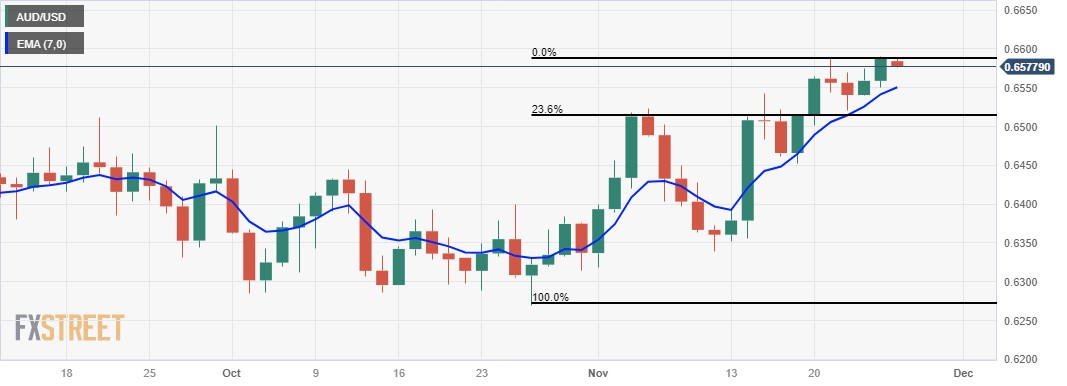
The Australian Dollar hovers around the 0.6580 level on Monday, just below the three-month high reached at 0.6590 on Friday, which aligns with the psychological resistance of the 0.6600 level. On the downside, the seven-day Exponential Moving Average (EMA) at 0.6550 could serve as crucial support, followed by the 23.6% Fibonacci retracement at 0.6513. If the pair falls below this level, it may test the major support at the 0.6500 level.
AUD/USD: Daily Chart
Australian Dollar price today
The table below shows the percentage change of Australian Dollar (AUD) against listed major currencies today. Australian Dollar was the strongest against the Canadian Dollar.
| USD | EUR | GBP | CAD | AUD | JPY | NZD | CHF | |
| USD | -0.09% | -0.15% | 0.10% | -0.02% | -0.40% | 0.06% | -0.05% | |
| EUR | 0.09% | -0.06% | 0.19% | 0.07% | -0.29% | 0.16% | 0.04% | |
| GBP | 0.15% | 0.06% | 0.25% | 0.13% | -0.24% | 0.21% | 0.10% | |
| CAD | -0.09% | -0.18% | -0.24% | -0.11% | -0.48% | -0.03% | -0.14% | |
| AUD | 0.02% | -0.06% | -0.13% | 0.12% | -0.36% | 0.09% | -0.02% | |
| JPY | 0.40% | 0.29% | 0.17% | 0.51% | 0.38% | 0.45% | 0.35% | |
| NZD | -0.06% | -0.15% | -0.21% | 0.03% | -0.09% | -0.46% | -0.11% | |
| CHF | 0.04% | -0.04% | -0.10% | 0.15% | 0.03% | -0.33% | 0.12% |
The heat map shows percentage changes of major currencies against each other. The base currency is picked from the left column, while the quote currency is picked from the top row. For example, if you pick the Euro from the left column and move along the horizontal line to the Japanese Yen, the percentage change displayed in the box will represent EUR (base)/JPY (quote).
Australian Dollar FAQs
What key factors drive the Australian Dollar?
One of the most significant factors for the Australian Dollar (AUD) is the level of interest rates set by the Reserve Bank of Australia (RBA). Because Australia is a resource-rich country another key driver is the price of its biggest export, Iron Ore. The health of the Chinese economy, its largest trading partner, is a factor, as well as inflation in Australia, its growth rate and Trade Balance. Market sentiment – whether investors are taking on more risky assets (risk-on) or seeking safe-havens (risk-off) – is also a factor, with risk-on positive for AUD.
How do the decisions of the Reserve Bank of Australia impact the Australian Dollar?
The Reserve Bank of Australia (RBA) influences the Australian Dollar (AUD) by setting the level of interest rates that Australian banks can lend to each other. This influences the level of interest rates in the economy as a whole. The main goal of the RBA is to maintain a stable inflation rate of 2-3% by adjusting interest rates up or down. Relatively high interest rates compared to other major central banks support the AUD, and the opposite for relatively low. The RBA can also use quantitative easing and tightening to influence credit conditions, with the former AUD-negative and the latter AUD-positive.
How does the health of the Chinese Economy impact the Australian Dollar?
China is Australia’s largest trading partner so the health of the Chinese economy is a major influence on the value of the Australian Dollar (AUD). When the Chinese economy is doing well it purchases more raw materials, goods and services from Australia, lifting demand for the AUD, and pushing up its value. The opposite is the case when the Chinese economy is not growing as fast as expected. Positive or negative surprises in Chinese growth data, therefore, often have a direct impact on the Australian Dollar and its pairs.
How does the price of Iron Ore impact the Australian Dollar?
Iron Ore is Australia’s largest export, accounting for $118 billion a year according to data from 2021, with China as its primary destination. The price of Iron Ore, therefore, can be a driver of the Australian Dollar. Generally, if the price of Iron Ore rises, AUD also goes up, as aggregate demand for the currency increases. The opposite is the case if the price of Iron Ore falls. Higher Iron Ore prices also tend to result in a greater likelihood of a positive Trade Balance for Australia, which is also positive of the AUD.
How does the Trade Balance impact the Australian Dollar?
The Trade Balance, which is the difference between what a country earns from its exports versus what it pays for its imports, is another factor that can influence the value of the Australian Dollar. If Australia produces highly sought after exports, then its currency will gain in value purely from the surplus demand created from foreign buyers seeking to purchase its exports versus what it spends to purchase imports. Therefore, a positive net Trade Balance strengthens the AUD, with the opposite effect if the Trade Balance is negative.
Author

Akhtar Faruqui
FXStreet
Akhtar Faruqui is a Forex Analyst based in New Delhi, India. With a keen eye for market trends and a passion for dissecting complex financial dynamics, he is dedicated to delivering accurate and insightful Forex news and analysis.