Australian Dollar advances despite Fed caution, awaits PBoC Interest Rate Decision
- The Australian Dollar appreciates following the higher-than-expected increase in new jobs created in August.
- Australian Employment Change rose by 47.5K in August, surpassing the consensus forecast of 25.0K.
- Federal Reserve’s bumper rate cut signals its commitment to safeguarding the labor market and protecting the economy from recession.

The Australian Dollar (AUD) recovered its daily losses and continues its winning streak against the US Dollar (USD), following the labor market report released on Thursday. Additionally, traders continue to assess the Federal Reserve’s (Fed) 50 basis points (bps) interest rate cut on Wednesday. The People’s Bank of China’s (PBoC) Monetary Policy Committee (MPC) is scheduled to hold its quarterly basis meeting on Friday to review its loan prime rate (LPR).
Australian Employment Change came in at 47.5K in August, down from 58.2K in July, but well above the consensus forecast of 25.0K. The Unemployment Rate remained steady at 4.2% in August, in line with both expectations and the previous month's figure, according to data released by the Australian Bureau of Statistics (ABS).
The Federal Open Market Committee (FOMC) lowered the federal funds rate to a range of 4.75% to 5.0%, marking the Fed’s first rate cut in over four years. This move signals the Fed’s commitment to safeguarding the labor market and steering the economy away from any signs of recession.
Federal Reserve Chair Jerome Powell stated during a press conference after the monetary policy meeting, “This decision signifies our increased confidence that, with the right adjustment to our policy approach, we can sustain a strong labor market while achieving moderate economic growth and bringing inflation down to a sustainable 2% level.”
Daily Digest Market Movers: Australian Dollar rises after a stronger Employment Change
- Fed policymakers updated their quarterly economic forecasts, increasing the median projection for unemployment to 4.4% by the end of 2024, up from the 4% estimate made in June. They also raised their long-term projection for the federal funds rate from 2.8% to 2.9%.
- JP Morgan CEO Jamie Dimon stated on Tuesday that whether the Federal Reserve cuts interest rates by 25 or 50 basis points, the impact will be “not earth-shattering.” Dimon emphasized, “They need to do it,” but noted that such moves are relatively minor in the grand scheme of things, as "there's a real economy" operating beneath the Fed’s rate changes, according to Bloomberg.
- US Retail Sales rose by 0.1% month-over-month in August, following a revised 1.1% increase in July, surpassing expectations of a 0.2% decline and indicating resilient consumer spending. Meanwhile, the Retail Sales Control Group increased by 0.3%, slightly below the previous month's 0.4% rise.
- ANZ-Roy Morgan Australian Consumer Confidence climbed 1.8 points, reaching an eight-week high of 84.1. While ANZ notes that the rise was broad-based, confidence remains firmly in pessimistic territory.
- Economists at Goldman Sachs and Citi have reduced their 2024 GDP growth forecasts for China to 4.7%, falling short of Beijing's target of around 5.0%. SocGen describes the situation as a "downward spiral," while Barclays calls it "from bad to worse" and a "vicious cycle." Morgan Stanley also cautions that "things could get worse before they get better," according to a Reuters report.
- The University of Michigan’s Consumer Sentiment Index rose to 69.0 in September, exceeding the market expectations of 68.0 reading and marking a four-month high. This increase reflects a gradual improvement in consumers' outlook on the US economy after months of declining economic expectations.
- China's economy weakened in August, with a continued slowdown in industrial activity and declining real estate prices, as Beijing faces growing pressure to increase spending to boost demand. According to Business Standard, this was reported by the National Bureau of Statistics on Saturday.
- The Reserve Bank of Australia (RBA) Michele Bullock stated that it is premature to consider rate cuts due to persistently high inflation. Additionally, RBA Assistant Governor Sarah Hunter noted that while the labor market remains tight, wage growth appears to have peaked and is expected to slow further.
Technical Analysis: Australian Dollar hovers around 0.6750; next support at nine-day EMA
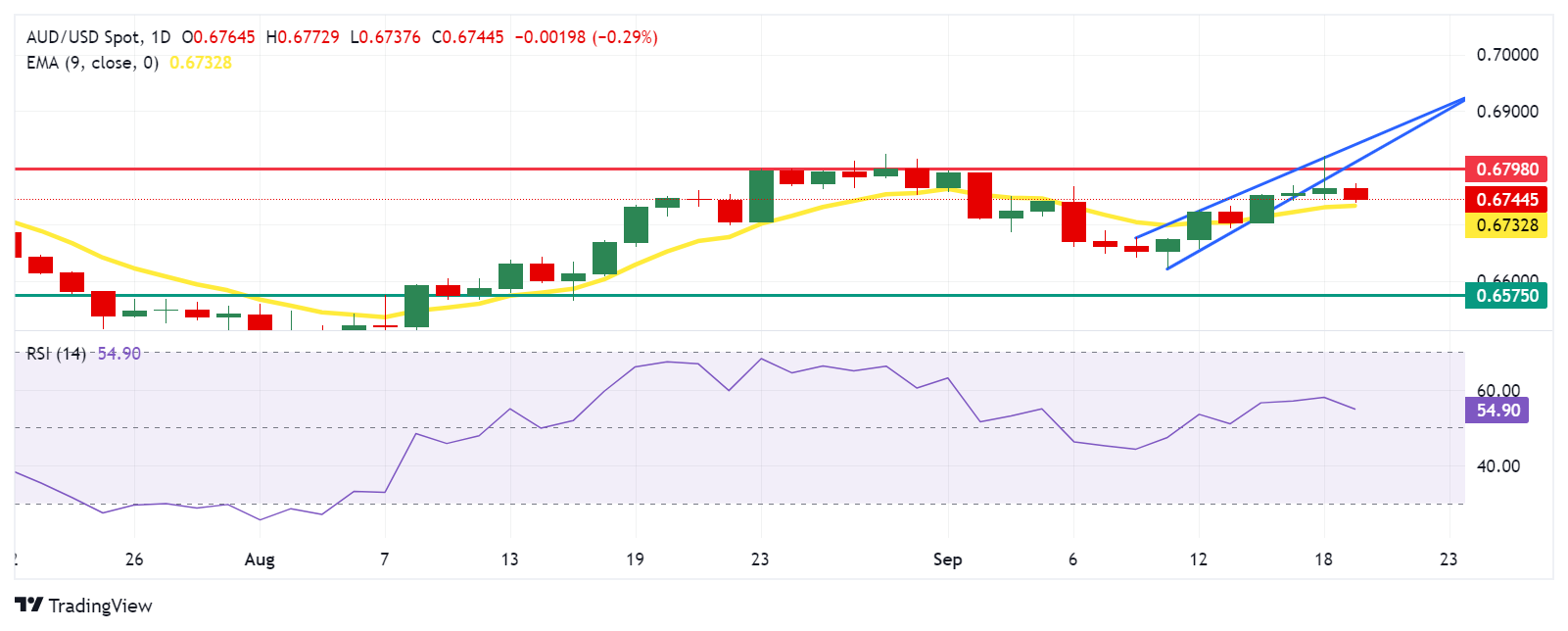
The AUD/USD pair trades near 0.6750 on Thursday. Technical analysis of the daily chart shows that the pair is positioned below the lower boundary of a rising wedge pattern, signaling a bearish reversal. However, the 14-day Relative Strength Index (RSI) remains slightly above the 50 mark, indicating that a break below the nine-day Exponential Moving Average (EMA) is needed to confirm the reversal.
Regarding the upside, the AUD/USD pair may test a seven-month high of 0.6798, followed by the lower boundary of the rising wedge at the 0.6810 level. A return to the rising wedge would reinforce the bullish bias and push the pair toward the upper boundary of the rising wedge at the 0.6840 level.
On the downside, the AUD/USD pair may test the nine-day Exponential Moving Average (EMA) at 0.6733, with the next support at the psychological level of 0.6700. A break below the latter could push the pair toward the throwback support zone around 0.6575.
AUD/USD: Daily Chart
Australian Dollar PRICE Today
The table below shows the percentage change of Australian Dollar (AUD) against listed major currencies today. Australian Dollar was the strongest against the Japanese Yen.
| USD | EUR | GBP | JPY | CAD | AUD | NZD | CHF | |
|---|---|---|---|---|---|---|---|---|
| USD | -0.08% | -0.04% | 0.31% | -0.07% | -0.49% | -0.12% | 0.13% | |
| EUR | 0.08% | 0.03% | 0.40% | 0.02% | -0.39% | -0.03% | 0.22% | |
| GBP | 0.04% | -0.03% | 0.34% | -0.03% | -0.45% | -0.10% | 0.16% | |
| JPY | -0.31% | -0.40% | -0.34% | -0.36% | -0.79% | -0.45% | -0.19% | |
| CAD | 0.07% | -0.02% | 0.03% | 0.36% | -0.42% | -0.04% | 0.19% | |
| AUD | 0.49% | 0.39% | 0.45% | 0.79% | 0.42% | 0.38% | 0.61% | |
| NZD | 0.12% | 0.03% | 0.10% | 0.45% | 0.04% | -0.38% | 0.25% | |
| CHF | -0.13% | -0.22% | -0.16% | 0.19% | -0.19% | -0.61% | -0.25% |
The heat map shows percentage changes of major currencies against each other. The base currency is picked from the left column, while the quote currency is picked from the top row. For example, if you pick the Australian Dollar from the left column and move along the horizontal line to the US Dollar, the percentage change displayed in the box will represent AUD (base)/USD (quote).
Fed FAQs
Monetary policy in the US is shaped by the Federal Reserve (Fed). The Fed has two mandates: to achieve price stability and foster full employment. Its primary tool to achieve these goals is by adjusting interest rates. When prices are rising too quickly and inflation is above the Fed’s 2% target, it raises interest rates, increasing borrowing costs throughout the economy. This results in a stronger US Dollar (USD) as it makes the US a more attractive place for international investors to park their money. When inflation falls below 2% or the Unemployment Rate is too high, the Fed may lower interest rates to encourage borrowing, which weighs on the Greenback.
The Federal Reserve (Fed) holds eight policy meetings a year, where the Federal Open Market Committee (FOMC) assesses economic conditions and makes monetary policy decisions. The FOMC is attended by twelve Fed officials – the seven members of the Board of Governors, the president of the Federal Reserve Bank of New York, and four of the remaining eleven regional Reserve Bank presidents, who serve one-year terms on a rotating basis.
In extreme situations, the Federal Reserve may resort to a policy named Quantitative Easing (QE). QE is the process by which the Fed substantially increases the flow of credit in a stuck financial system. It is a non-standard policy measure used during crises or when inflation is extremely low. It was the Fed’s weapon of choice during the Great Financial Crisis in 2008. It involves the Fed printing more Dollars and using them to buy high grade bonds from financial institutions. QE usually weakens the US Dollar.
Quantitative tightening (QT) is the reverse process of QE, whereby the Federal Reserve stops buying bonds from financial institutions and does not reinvest the principal from the bonds it holds maturing, to purchase new bonds. It is usually positive for the value of the US Dollar.
Author

Akhtar Faruqui
FXStreet
Akhtar Faruqui is a Forex Analyst based in New Delhi, India. With a keen eye for market trends and a passion for dissecting complex financial dynamics, he is dedicated to delivering accurate and insightful Forex news and analysis.