Australian Dollar attempts to extend losses post trimming intraday gains, US CPI eyed
- Australian Dollar trims intraday gains ahead of US CPI.
- Consumer Inflation Expectations increased to 4.8% from the previous figure of 4.6%.
- US Dollar remains defensive despite upbeat US economic data.

The Australian Dollar (AUD) has trimmed its intraday gains, extending losses despite the uptick in Australian Consumer Inflation Expectations. The Melbourne Institute’s Consumer Inflation Expectations for October has been reported at 4.8%, showing a slight increase from the September figure of 4.6%.
Australia’s data indicated a modest uptick in consumer expectations regarding inflation, which can be linked to higher oil prices. The surge in petrol prices, likely influences consumer expectations about what lies ahead.
Additionally, the AUD/USD pair could gain strength as the possibility of another interest rate hike by the Reserve Bank of Australia (RBA) heightens.
The US Dollar Index (DXY) is struggling to hold ground around 105.70 at the time of writing due to the downbeat US Treasury yields. The US Dollar (USD) encounters challenges despite robust economic data from the United States (US), notably in wholesale inflation, and the disclosure of the Federal Open Market Committee (FOMC) meeting minutes.
The US currency seems caught in a struggle as various factors counterbalance the positive economic signals. Speculations are rife about the US Federal Reserve (Fed) potentially shelving the notion of a rate hike. This speculation gains momentum from dovish comments and neutral postures adopted by key officials, adding an element of uncertainty to the currency's outlook.
Daily Digest Market Movers: Australian Dollar retraces recent losses on higher Consumer Expectations
- Australia witnessed a rebound in inflation in August, largely driven by elevated oil prices. This resurgence raises the probability of another interest rate hike by the Reserve Bank of Australia (RBA).
- The unfolding Middle East conflict adds a layer of complexity to the situation, potentially prompting the RBA to implement a 25 basis points (bps) interest rate hike, reaching 4.35% by the year's end.
- The heightened geopolitical tension is fostering a surge in demand for commodities, particularly energy and gold. This surge is exerting a positive influence on the performance of the AUD/USD pair.
- Australia’s Westpac Consumer Confidence showed that current buying conditions improved in October. The index rose 2.9% from the previous 1.5% decline in September.
- US Producer Price Index (PPI) surged in September on a yearly basis, jumping from 2.0% to 2.2%, surpassing the anticipated 1.6%. Core PPI experienced a rise, climbing to 2.7% from the anticipated easing to 2.3%, surpassing the earlier figure of 2.5%.
- The yields on US Treasury bonds experienced losses on Wednesday, with the 10-year US Treasury bond yield marking the lowest level at 4.54%.
- The Federal Open Market Committee (FOMC) minutes shed light on a divergence of opinions, underlining the importance of data reliance. The consensus for additional interest rate hikes appears contingent on a significant uptick in inflation.
- Some participants argue that as the policy rate approaches its peak, the focus should shift from the extent of rate increases to determining how long to maintain the policy rate at restrictive levels.
- Speculation is rife about the Fed potentially abandoning the idea of a rate hike. This speculation gains momentum from dovish comments and neutral stances from officials, contributing to the nuanced economic landscape.
- Fed Governor Christopher Waller advocates a watchful approach to rate developments, suggesting that tightening in financial markets "would do some of the work for us." On the other hand, Fed Governor Michelle Bowman leans towards another rate hike, citing inflation persisting above the Fed's 2% target.
- Thursday's Consumer Price Index (CPI) release is generating heightened anticipation. Projections suggest a dip in the annual rate for September, sliding from 3.7% to 3.6%. The weekly Jobless Claims report follows and could contribute further insights into the economic landscape.
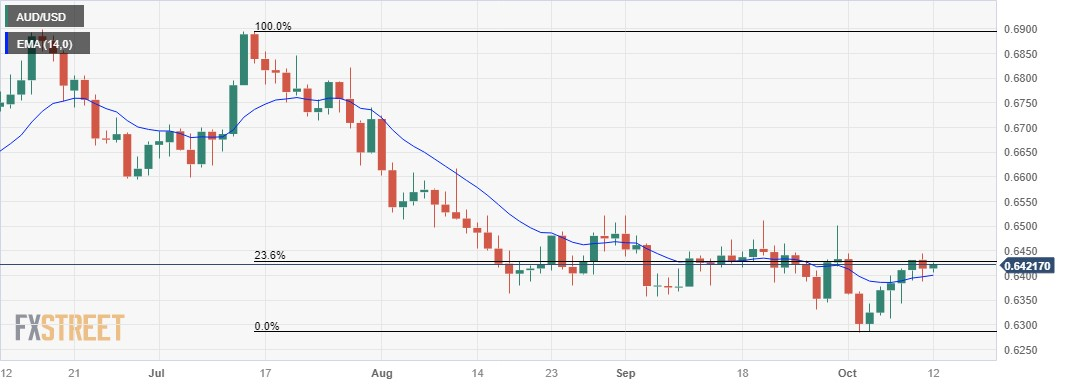
Technical Analysis: Australian Dollar hovers above 0.6400, immediate resistance at 23.6% Fibonacci retracement
The Australian Dollar hovers around 0.6410, aligning with the 23.6% Fibonacci retracement level at 0.6429. This juncture poses a significant hurdle, and a clear breakthrough could pave the way for upward momentum, aiming at the psychological milestone of 0.6500. Conversely, on the downside, a key support level is situated around the 14-day Exponential Moving Average (EMA) at 0.6400. These delineated levels serve as vital indicators for potential shifts in the trajectory of the AUD/USD pair, influencing market sentiment and trader decisions.
AUD/USD: Daily Chart
Australian Dollar price today
The table below shows the percentage change of Australian Dollar (AUD) against listed major currencies today. Australian Dollar was the weakest against the Swiss Franc.
| USD | EUR | GBP | CAD | AUD | JPY | NZD | CHF | |
| USD | 0.01% | 0.14% | -0.02% | 0.12% | 0.09% | 0.33% | -0.05% | |
| EUR | -0.01% | 0.12% | -0.04% | 0.11% | 0.08% | 0.30% | -0.06% | |
| GBP | -0.14% | -0.13% | -0.17% | -0.02% | -0.05% | 0.19% | -0.20% | |
| CAD | 0.03% | 0.03% | 0.17% | 0.15% | 0.12% | 0.36% | -0.03% | |
| AUD | -0.12% | -0.11% | 0.01% | -0.15% | -0.03% | 0.19% | -0.17% | |
| JPY | -0.09% | -0.08% | 0.04% | -0.12% | 0.05% | 0.24% | -0.13% | |
| NZD | -0.32% | -0.30% | -0.18% | -0.35% | -0.20% | -0.23% | -0.36% | |
| CHF | 0.05% | 0.07% | 0.19% | 0.02% | 0.17% | 0.14% | 0.38% |
The heat map shows percentage changes of major currencies against each other. The base currency is picked from the left column, while the quote currency is picked from the top row. For example, if you pick the Euro from the left column and move along the horizontal line to the Japanese Yen, the percentage change displayed in the box will represent EUR (base)/JPY (quote).
Economic Indicator
United States Consumer Price Index (YoY)
The Consumer Price Index released by the US Bureau of Labor Statistics is a measure of price movements by the comparison between the retail prices of a representative shopping basket of goods and services. The purchase power of USD is dragged down by inflation. The CPI is a key indicator to measure inflation and changes in purchasing trends. Generally speaking, a high reading is seen as positive (or bullish) for the USD, while a low reading is seen as negative (or Bearish).
Read more.Why it matters to traders
The US Federal Reserve has a dual mandate of maintaining price stability and maximum employment. According to such mandate, inflation should be at around 2% YoY and has become the weakest pillar of the central bank’s directive ever since the world suffered a pandemic, which extends to these days. Price pressures keep rising amid supply-chain issues and bottlenecks, with the Consumer Price Index (CPI) hanging at multi-decade highs. The Fed has already taken measures to tame inflation and is expected to maintain an aggressive stance in the foreseeable future.
Author

Akhtar Faruqui
FXStreet
Akhtar Faruqui is a Forex Analyst based in New Delhi, India. With a keen eye for market trends and a passion for dissecting complex financial dynamics, he is dedicated to delivering accurate and insightful Forex news and analysis.