Australian Dollar recovers losses as US Dollar trims gains ahead of Q1 GDP Annualized
- The Australian Dollar gains ground as the US Dollar pares gains during the European hours.
- Australia’s Private Capital Expenditure declined by 0.1% in Q1, against the expected increase of 0.5%.
- A US federal court has blocked President Trump’s proposed "Liberation Day" tariffs from taking effect.

The Australian Dollar (AUD) edges higher after recovering daily losses during the European hours on Thursday. The AUD/USD pair holds gains as the US Dollar (USD) trims its gains. However, the pair faced challenges after a US federal court blocked US President Donald Trump's "Liberation Day" tariffs from taking effect. A Reuters report showed that a federal trade court ruled Trump didn't have the authority to impose sweeping tariffs on imports from countries that sell more to the US.
The Trump administration has halted some sales of jet engines, semiconductors, and certain chemicals to China. The New York Times cited two familiar sources saying that this action is a response to China’s recent export restrictions on exports of critical minerals to the US. Any change in Chinese markets could impact the Australian Dollar as Australia and China are close trade partners.
The AUD could face challenges as the Reserve Bank of Australia (RBA) is expected to deliver more rate cuts in the upcoming policy meetings. The central bank acknowledged progress in curbing inflation and warned that US-China trade barriers pose downside risks to economic growth. Governor Michele Bullock stated that the RBA is prepared to take additional action if the economic outlook deteriorates sharply, raising the prospect of future rate cuts.
Australian Dollar advances ahead of key economic data from US
- The US Dollar Index (DXY), which measures the value of the Greenback against six major currencies, is trading more than 0.50% higher at 100.40 at the time of writing. Traders likely await the preliminary US Q1 Gross Domestic Product (GDP) data, Personal Consumption Expenditures Prices QoQ, and Initial Jobless Claims, scheduled to be released on Thursday.
- Federal Open Market Committee's (FOMC) Minutes for the latest policy meeting, released on Wednesday, indicated that Federal Reserve (Fed) officials broadly agreed that heightened economic uncertainty justified their patient approach to interest-rate adjustments. Fed officials emphasized the need to keep interest rates unchanged for some time, as recent policy shifts cloud the US economic outlook.
- The US fiscal deficit could increase further when Trump's “One Big Beautiful Bill” goes through the Senate floor, increasing the risk of bond yields staying higher for longer. Higher bond yields can keep borrowing costs higher for consumers, businesses, and governments. Trump’s bill is expected to increase the deficit by $3.8 billion, as it would deliver tax breaks on tip income and US-manufactured car loans, according to the Congressional Budget Office (CBO).
- US Senator Ron Johnson told CNN on Sunday that "I think we have enough votes to stop the process until the president gets serious about spending reduction and reducing the deficit.” Johnson added, “My primary focus now is spending. This is completely unacceptable. Current projections are a $2.2 trillion per year deficit.”
- Moody’s downgraded the US credit rating from Aaa to Aa1, following similar downgrades by Fitch Ratings in 2023 and Standard & Poor’s in 2011. Moody’s now projects US federal debt to climb to around 134% of GDP by 2035, up from 98% in 2023, with the budget deficit expected to widen to nearly 9% of GDP. This deterioration is attributed to rising debt-servicing costs, expanding entitlement programs, and falling tax revenues.
- The US Dollar faced challenges due to improved risk-on sentiment following the alleviation of trade tensions between the United States and the European Union (EU). President Trump extended the tariff deadline on imports from the EU from June 1 to July 9.
- China Industrial Profits rose 3% year-over-year in April, following a previous growth of 2.6%. Additionally, the profits increased 1.4% YoY in the first four months of 2025, advancing from 0.8% growth in the January–March period. The Global Times, a Chinese state media outlet, reported that positive developments contributed to a rise in industrial profits in April.
- Australia's Private Capital Expenditure surprisingly fell by 0.1% the first quarter, against the expected increase of 0.5%.
- The Australian Bureau of Statistics reported that monthly inflation for a fixed basket of goods and services acquired by household consumers, steadied at 2.4% year-over-year in April, surpassing the expected 2.3% increase.
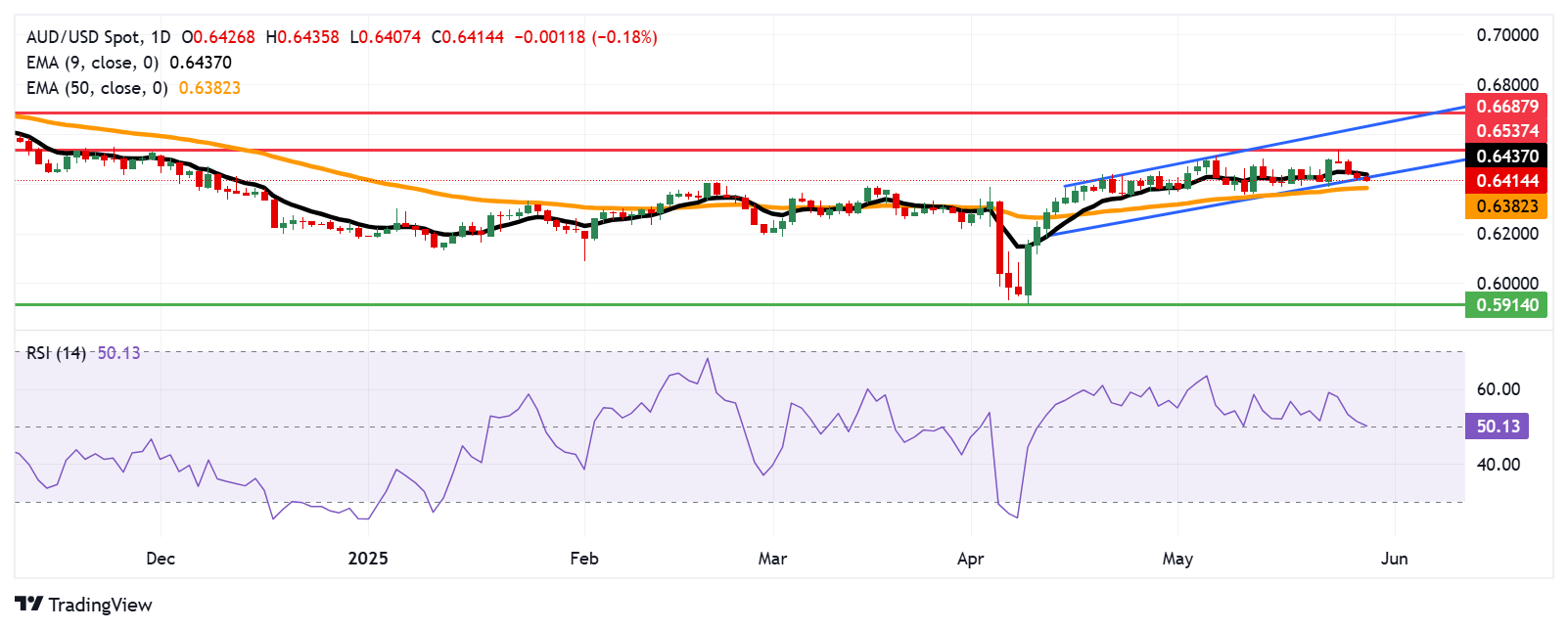
Australian Dollar remains below ascending channel near 0.6400, 50-day EMA
The AUD/USD pair is trading around 0.6410 on Thursday, with a weakening bullish bias. The technical analysis of the daily chart indicates that the pair has broken below the ascending channel’s lower boundary. The short-term price momentum also weakens as the pair remains below the nine-day Exponential Moving Average (EMA). The 14-day Relative Strength Index (RSI) holds at the 50 mark, suggesting neutral bias is in play.
The AUD/USD pair could attempt to regain ground to stay within the ascending channel and test the immediate barrier at the nine-day EMA of 0.6437, followed by a six-month high at 0.6537, which was recorded on May 26. A breach above this level could reinforce the bullish bias and support the pair to approach the upper boundary of the ascending channel around 0.6640.
On the downside, the 50-day EMA at 0.6382 appears as the initial support. A break below this level could weaken the medium-term price momentum and put downward pressure on the pair to navigate the region around 0.5914, the lowest since March 2020.
AUD/USD: Daily Chart
Australian Dollar PRICE Today
The table below shows the percentage change of Australian Dollar (AUD) against listed major currencies today. Australian Dollar was the strongest against the Japanese Yen.
| USD | EUR | GBP | JPY | CAD | AUD | NZD | CHF | |
|---|---|---|---|---|---|---|---|---|
| USD | 0.19% | 0.12% | 0.51% | 0.00% | -0.12% | 0.23% | 0.49% | |
| EUR | -0.19% | -0.06% | 0.31% | -0.18% | -0.24% | 0.04% | 0.29% | |
| GBP | -0.12% | 0.06% | 0.37% | -0.11% | -0.16% | 0.09% | 0.28% | |
| JPY | -0.51% | -0.31% | -0.37% | -0.50% | -0.64% | -0.32% | -0.11% | |
| CAD | -0.01% | 0.18% | 0.11% | 0.50% | -0.17% | 0.23% | 0.37% | |
| AUD | 0.12% | 0.24% | 0.16% | 0.64% | 0.17% | 0.29% | 0.44% | |
| NZD | -0.23% | -0.04% | -0.09% | 0.32% | -0.23% | -0.29% | 0.15% | |
| CHF | -0.49% | -0.29% | -0.28% | 0.11% | -0.37% | -0.44% | -0.15% |
The heat map shows percentage changes of major currencies against each other. The base currency is picked from the left column, while the quote currency is picked from the top row. For example, if you pick the Australian Dollar from the left column and move along the horizontal line to the US Dollar, the percentage change displayed in the box will represent AUD (base)/USD (quote).
Economic Indicator
Gross Domestic Product Annualized
The real Gross Domestic Product (GDP) Annualized, released quarterly by the US Bureau of Economic Analysis, measures the value of the final goods and services produced in the United States in a given period of time. Changes in GDP are the most popular indicator of the nation’s overall economic health. The data is expressed at an annualized rate, which means that the rate has been adjusted to reflect the amount GDP would have changed over a year’s time, had it continued to grow at that specific rate. Generally speaking, a high reading is seen as bullish for the US Dollar (USD), while a low reading is seen as bearish.
Read more.Next release: Thu May 29, 2025 12:30 (Prel)
Frequency: Quarterly
Consensus: -0.3%
Previous: -0.3%
Source: US Bureau of Economic Analysis
The US Bureau of Economic Analysis (BEA) releases the Gross Domestic Product (GDP) growth on an annualized basis for each quarter. After publishing the first estimate, the BEA revises the data two more times, with the third release representing the final reading. Usually, the first estimate is the main market mover and a positive surprise is seen as a USD-positive development while a disappointing print is likely to weigh on the greenback. Market participants usually dismiss the second and third releases as they are generally not significant enough to meaningfully alter the growth picture.
Author

Akhtar Faruqui
FXStreet
Akhtar Faruqui is a Forex Analyst based in New Delhi, India. With a keen eye for market trends and a passion for dissecting complex financial dynamics, he is dedicated to delivering accurate and insightful Forex news and analysis.

















