Australian Dollar holds gains despite a stable US Dollar ahead of PCE Price Index
- The Australian Dollar holds its position after Retail Sales reported no growth in July.
- Australia’s Retail Sales stagnated month-on-month in July, against the expected 0.3% increase.
- The US Dollar received support following stronger-than-expected US GDP data for Q2.

The Australian Dollar (AUD) remains steady against the stable US Dollar (USD) following the Retail Sales report on Friday, which showed no growth month-on-month in July, falling short of the anticipated 0.3% and the previous 0.5% increase. However, stronger-than-expected US Gross Domestic Product (GDP) data for the second quarter released on Thursday has put pressure on the AUD/USD pair.
The AUD/USD pair could see further gains as July’s higher-than-expected Monthly Consumer Price Index (CPI) has bolstered expectations that the Reserve Bank of Australia (RBA) may adopt a more hawkish policy stance. Recent RBA Minutes also showed that board members agreed that a rate cut would be unlikely soon.
The US Dollar found support from better-than-expected economic data, but dovish comments from Federal Reserve officials could limit its gains. On Thursday, Atlanta Fed President Raphael Bostic suggested it might be "time to move" on rate cuts as inflation continues to cool and the unemployment rate rises more than anticipated, per Reuters.
According to the CME FedWatch Tool, markets are fully anticipating at least a 25 basis point (bps) rate cut by the Fed at its September meeting. Investors will be paying close attention to Friday’s release of the US Personal Consumption Expenditure (PCE) Price Index for July, seeking clues about the future direction of US interest rates.
Daily Digest Market Movers: Australian Dollar inches higher following Retail Sales data
- The US Gross Domestic Product (GDP) grew at an annualized rate of 3.0% in the second quarter, exceeding both the expected and previous growth rate of 2.8%. Additionally, Initial Jobless Claims showed that the number of people filing for unemployment benefits fell to 231,000 for the week ending August 23, down from the previous 233,000 and slightly below the expected 232,000.
- US Core Personal Consumption Expenditures (QoQ), the Federal Reserve's preferred measure of underlying inflation, increased by 2.8% in the second quarter, slightly below the market forecast of 2.9%. This marks a significant deceleration from the 3.7% growth observed in the first quarter.
- Australia's Private Capital Expenditure unexpectedly declined by 2.2% in the second quarter, reversing from an upwardly revised 1.9% expansion in the previous period and falling short of market expectations for a 1.0% increase. This marks the first contraction in new capital expenditure since the third quarter of 2023.
- Australia's Monthly Consumer Price Index (CPI) increased by 3.5% year-on-year in July, down from June's 3.8% but slightly above the market consensus of 3.4%. Despite the slight decrease, this marks the lowest CPI figure since March.
- San Francisco Federal Reserve President Mary Daly stated on Monday in an interview with Bloomberg TV that "the time is upon us" to begin cutting interest rates, likely starting with a quarter-percentage point reduction. Daly suggested that if inflation continues to slow gradually and the labor market maintains a "steady, sustainable" pace of job growth, it would be reasonable to "adjust policy at the regular, normal cadence."
- FOMC Minutes for July’s policy meeting indicated that most Fed officials agreed last month that they would likely cut their benchmark interest rate at the upcoming meeting in September as long as inflation continued to cool.
- On Tuesday, the RBA Minutes suggested that the board members had considered a rate hike earlier this month before ultimately deciding that maintaining current rates would better balance the risks. Additionally, RBA members agreed that a rate cut is unlikely soon.
Technical Analysis: Australian Dollar holds position near 0.6800
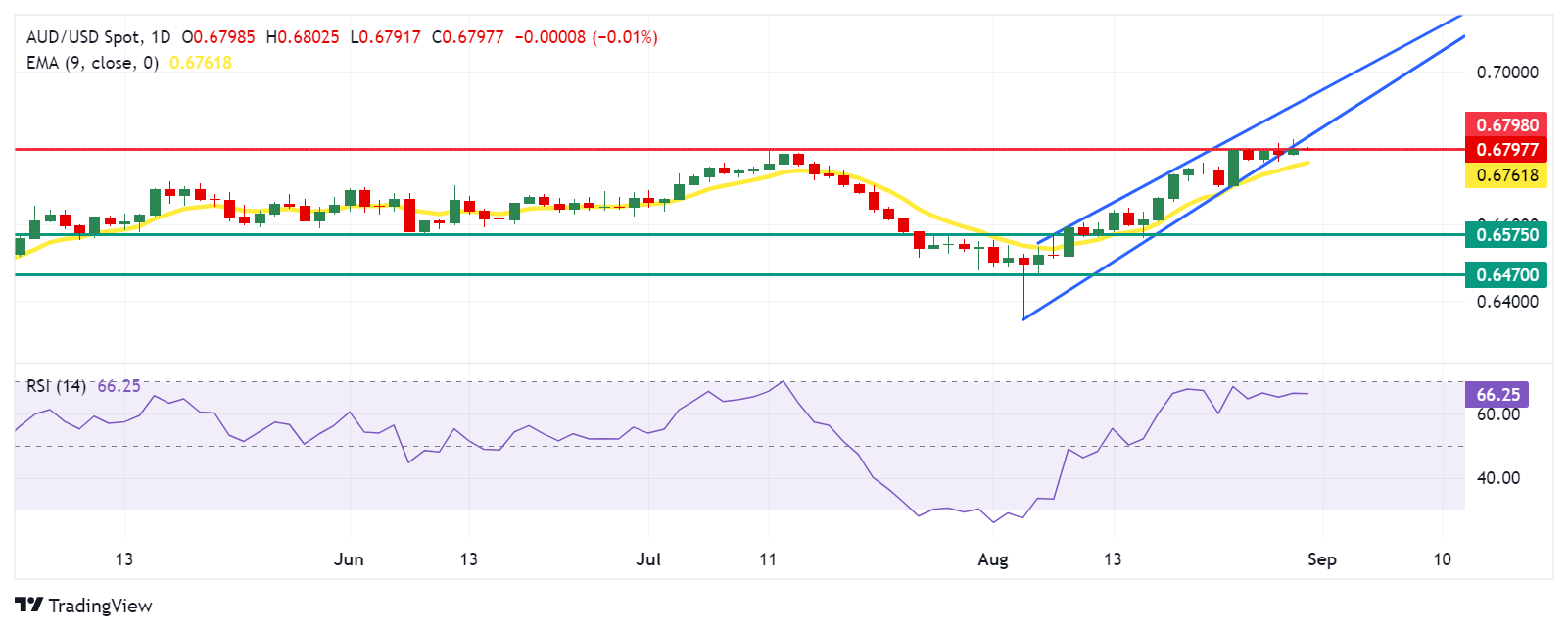
The Australian Dollar trades around 0.6790 on Friday. Analyzing the daily chart, the AUD/USD pair appears to be testing the lower boundary of its ascending channel, indicating a potential reinforcement of the bullish bias. However, the 14-day Relative Strength Index (RSI) remains just below the 70 mark, which continues to support the ongoing bullish trend.
Regarding resistance, the AUD/USD pair is testing the immediate barrier at the lower boundary of the ascending channel, near the seven-month high of 0.6798. A break above this level could open the path for the pair to target the region around the upper boundary of the ascending channel, near the 0.6920 level.
On the downside, the AUD/USD pair may find support near the nine-day Exponential Moving Average (EMA) at the 0.6761 level. A drop below this EMA could weaken the bullish bias and exert downward pressure, potentially leading the pair to test the throwback level at 0.6575, followed by a lower variant at 0.6470.
AUD/USD: Daily Chart
Australian Dollar PRICE Today
The table below shows the percentage change of Australian Dollar (AUD) against listed major currencies today. Australian Dollar was the strongest against the Canadian Dollar.
| USD | EUR | GBP | JPY | CAD | AUD | NZD | CHF | |
|---|---|---|---|---|---|---|---|---|
| USD | 0.01% | 0.02% | -0.12% | 0.02% | -0.06% | -0.06% | 0.07% | |
| EUR | -0.01% | -0.00% | -0.13% | 0.01% | -0.07% | -0.06% | 0.06% | |
| GBP | -0.02% | 0.00% | -0.13% | 0.01% | -0.07% | -0.05% | 0.03% | |
| JPY | 0.12% | 0.13% | 0.13% | 0.17% | 0.08% | 0.08% | 0.17% | |
| CAD | -0.02% | -0.01% | -0.01% | -0.17% | -0.10% | -0.06% | 0.01% | |
| AUD | 0.06% | 0.07% | 0.07% | -0.08% | 0.10% | 0.00% | 0.09% | |
| NZD | 0.06% | 0.06% | 0.05% | -0.08% | 0.06% | -0.01% | 0.09% | |
| CHF | -0.07% | -0.06% | -0.03% | -0.17% | -0.01% | -0.09% | -0.09% |
The heat map shows percentage changes of major currencies against each other. The base currency is picked from the left column, while the quote currency is picked from the top row. For example, if you pick the Australian Dollar from the left column and move along the horizontal line to the US Dollar, the percentage change displayed in the box will represent AUD (base)/USD (quote).
Interest rates FAQs
Interest rates are charged by financial institutions on loans to borrowers and are paid as interest to savers and depositors. They are influenced by base lending rates, which are set by central banks in response to changes in the economy. Central banks normally have a mandate to ensure price stability, which in most cases means targeting a core inflation rate of around 2%. If inflation falls below target the central bank may cut base lending rates, with a view to stimulating lending and boosting the economy. If inflation rises substantially above 2% it normally results in the central bank raising base lending rates in an attempt to lower inflation.
Higher interest rates generally help strengthen a country’s currency as they make it a more attractive place for global investors to park their money.
Higher interest rates overall weigh on the price of Gold because they increase the opportunity cost of holding Gold instead of investing in an interest-bearing asset or placing cash in the bank. If interest rates are high that usually pushes up the price of the US Dollar (USD), and since Gold is priced in Dollars, this has the effect of lowering the price of Gold.
The Fed funds rate is the overnight rate at which US banks lend to each other. It is the oft-quoted headline rate set by the Federal Reserve at its FOMC meetings. It is set as a range, for example 4.75%-5.00%, though the upper limit (in that case 5.00%) is the quoted figure. Market expectations for future Fed funds rate are tracked by the CME FedWatch tool, which shapes how many financial markets behave in anticipation of future Federal Reserve monetary policy decisions.
Author

Akhtar Faruqui
FXStreet
Akhtar Faruqui is a Forex Analyst based in New Delhi, India. With a keen eye for market trends and a passion for dissecting complex financial dynamics, he is dedicated to delivering accurate and insightful Forex news and analysis.