Australian Dollar pares recent gains following RBA Bullock's comments
- The Australian Dollar advances due to the delay in the implementation of Trump's tariffs.
- The Reserve Bank of Australia decided to keep cash rate unchanged at 3.85% on Tuesday.
- President Trump has signed an executive order delaying the implementation of new tariffs from July to August 1.

The Australian Dollar (AUD) gains ground against the US Dollar (USD) on Tuesday, halting its three-day losing streak. The AUD/USD pair appreciates as the Reserve Bank of Australia (RBA) decided to leave Official Cash Rate (OCR) unchanged at 3.85%, against the highly anticipated 25 basis point rate cut in July.
RBA Governor Michele Bullock said, at a post-meeting press conference, that while rates have already been cut by 50 basis points, the full effects are yet to be realized. Bullock highlighted that more data and developments will be available by the next meeting. She emphasized that a cautious and gradual approach to policy easing remains appropriate.
Australian Treasurer Jim Chalmers said that the Reserve Bank of Australia’s decision to hold rates was neither the outcome millions of Australians had hoped for nor what markets had anticipated. Chalmers added that the central bank has signaled a clear direction on inflation and interest rates moving forward.
The AUD/USD pair faced challenges amid renewed tariff concerns. However, the White House announced late Monday that US President Donald Trump has signed an executive order delaying the implementation of new tariffs from July to August 1, per Bloomberg.
China’s central bank announced measures to further open its capital markets by supporting more onshore investors to invest in offshore bonds. The People’s Bank of China (PBoC) prepares to expand the Bond Connect program to include a wider range of domestic institutions, such as brokers, mutual funds, wealth managers, and insurers. This follows earlier reports that authorities are considering doubling the quota of the Southbound Bond Connect program to the equivalent of USD 139 billion. Any change in the Chinese economy could impact the AUD as China and Australia are close trading partners.
Australian Dollar advances as implementation of new US tariffs delays
- The US Dollar Index (DXY), which measures the value of the US Dollar against six major currencies, is maintaining its position around 97.50 at the time of writing.
- US President Donald Trump posted on social media on Monday that “Any Country aligning themselves with the Anti-American policies of BRICS, will be charged an ADDITIONAL 10% Tariff. There will be no exceptions to this policy.”
- US Nonfarm Payrolls indicated that the US labor force grew by 147,000 jobs, surpassing the anticipated 110,000 in June. Additionally, the Unemployment Rate declined to 4.1% from 4.2%. Meanwhile, weekly Jobless Claims fell to 233,000, down from 237,000, reflecting a resilient US labor market.
- US ADP Employment Change fell for the first time in more than two years in June. The private-sector payrolls decreased by 33,000 in June after a downwardly revised 29,000 gain in May. This figure came in below the market consensus of 95,000.
- The Financial Times reported that China is increasingly rerouting its exports through Southeast Asia in an effort to circumvent US tariffs imposed by the Trump administration. In May, direct shipments from China to the US fell by 43% in May, while China's overall exports climbed by 4.8%. This shift was marked by a 15% surge in exports to Southeast Asia and a 12% increase to the European Union (EU). However, the US trade agreement with Vietnam now includes a 40% tariff on trans-shipped goods to curb such practices.
- The Chinese Commerce Ministry said in a statement on Friday that “China and the US are stepping up efforts to implement the outcomes of the London framework.” The US has notified China of canceling restrictive measures against Chinese exports. China is reviewing applications for export licenses of controlled items under laws and regulations.
- ANZ Job Advertisements increased by 1.8% in June after a decline of 1.2% in May. The data presents the number of job advertisements in the major metropolitan newspapers and on the internet sites in Australia.
Australian Dollar moves above 0.6500, rebounds to ascending channel
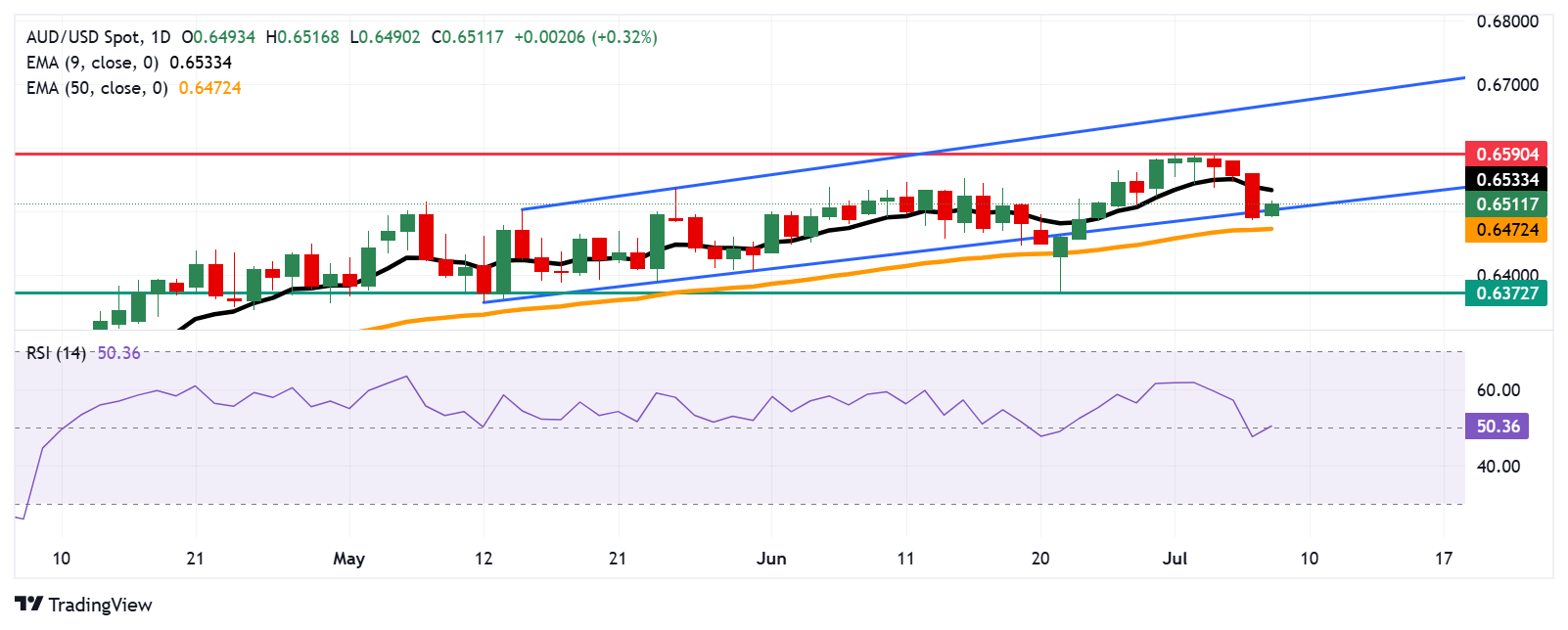
The AUD/USD pair is trading around 0.6510 on Tuesday. The daily chart’s technical analysis indicated a renewing bullish sentiment as the pair has rebounded to the existing ascending channel pattern. The 14-day Relative Strength Index (RSI) is positioned on the 50 mark, suggesting a neutral bias. Further movements will offer a clear directional trend. The pair remains below the nine-day Exponential Moving Average (EMA), suggesting that short-term price momentum is weakening.
The AUD/USD pair may test the primary barrier at the nine-day EMA of 0.6533. A break above this level could improve the price momentum and support the pair to approach the eight-month high of 0.6590, recorded on July 1. Further advances would support the pair to explore the region around the upper boundary of the ascending channel around 0.6670.
On the downside, the AUD/USD pair may test the ascending channel’s lower boundary around 0.6500, followed by the 50-day EMA at 0.6472. A break below this crucial support zone would weaken the medium-term price momentum and open the doors for the pair to test the two-month low at 0.6372.
AUD/USD: Daily Chart
Australian Dollar PRICE Today
The table below shows the percentage change of Australian Dollar (AUD) against listed major currencies today. Australian Dollar was the strongest against the US Dollar.
| USD | EUR | GBP | JPY | CAD | AUD | NZD | CHF | |
|---|---|---|---|---|---|---|---|---|
| USD | -0.27% | -0.22% | -0.09% | -0.26% | -0.75% | -0.45% | -0.27% | |
| EUR | 0.27% | 0.06% | 0.24% | 0.02% | -0.49% | -0.17% | 0.00% | |
| GBP | 0.22% | -0.06% | 0.22% | -0.03% | -0.55% | -0.22% | -0.05% | |
| JPY | 0.09% | -0.24% | -0.22% | -0.20% | -0.70% | -0.34% | -0.11% | |
| CAD | 0.26% | -0.02% | 0.03% | 0.20% | -0.51% | -0.19% | -0.05% | |
| AUD | 0.75% | 0.49% | 0.55% | 0.70% | 0.51% | 0.32% | 0.51% | |
| NZD | 0.45% | 0.17% | 0.22% | 0.34% | 0.19% | -0.32% | 0.18% | |
| CHF | 0.27% | -0.01% | 0.05% | 0.11% | 0.05% | -0.51% | -0.18% |
The heat map shows percentage changes of major currencies against each other. The base currency is picked from the left column, while the quote currency is picked from the top row. For example, if you pick the Australian Dollar from the left column and move along the horizontal line to the US Dollar, the percentage change displayed in the box will represent AUD (base)/USD (quote).
Economic Indicator
RBA Interest Rate Decision
The Reserve Bank of Australia (RBA) announces its interest rate decision at the end of its eight scheduled meetings per year. If the RBA is hawkish about the inflationary outlook of the economy and raises interest rates it is usually bullish for the Australian Dollar (AUD). Likewise, if the RBA has a dovish view on the Australian economy and keeps interest rates unchanged, or cuts them, it is seen as bearish for AUD.
Read more.Last release: Tue Jul 08, 2025 04:30
Frequency: Irregular
Actual: 3.85%
Consensus: 3.6%
Previous: 3.85%
Source: Reserve Bank of Australia
Author

Akhtar Faruqui
FXStreet
Akhtar Faruqui is a Forex Analyst based in New Delhi, India. With a keen eye for market trends and a passion for dissecting complex financial dynamics, he is dedicated to delivering accurate and insightful Forex news and analysis.

















