Australian Dollar holds positive ground due to correction in US Dollar, employment data eyed
- Australian Dollar struggles to recover from the recent losses.
- RBA’s decision to keep policy rates unchanged might exert pressure on the Aussie Dollar.
- Higher US Treasury yields bolster the Greenback, coupled with upbeat US employment data.

The Australian Dollar (AUD) treads waters to halt a two-day losing streak on Wednesday. However, the AUD/USD pair is under pressure due to risk-off sentiment and stronger US Dollar (USD). Additionally, the pair weakened after the interest rate decision by the Reserve Bank of Australia (RBA) on Tuesday.
Australia's central bank opted to maintain the status quo, leaving the current interest rate unchanged at 4.10% in the recent policy meeting. This decision might exert pressure on the Aussie pair. Nevertheless, there is a possibility of a rate hike, with expectations pointing toward a peak of 4.35% by the end of the year. This projection aligns with the persistent elevation of inflation above the target.
The US Dollar Index (DXY) climbed to an 11-month high on the back of the upbeat US employment data and higher US Treasury yields. US JOLTS Job Openings exceeded expectations, leading to an increase in US yields. The 10-year US Treasury yield reached its highest since 2007.
Additionally, market caution regarding the US Federal Reserve's (Fed) interest rate trajectory is contributing to the positive sentiment surrounding the Greenback.
Daily Digest Market Movers: Australian Dollar weakens due to stronger US Dollar, market caution
- RBA chose to maintain the Official Cash Rate (OCR) at 4.10%, aligning with widespread expectations, which might exert pressure on the Aussie Dollar.
- Michele Bullock, the newly appointed governor of the RBA, emphasized in her inaugural monetary policy statement that there might be a need for additional tightening of monetary policy.
- Bullock mentioned that recent data align with the return of inflation to the target range. While inflation in Australia has peaked, it remains elevated and is expected to persist for a while.
- The 10-year US Treasury yield reached 4.85% on Wednesday, the highest level since 2007.
- US JOLTS Job Openings improved to 9.61M in August from the previous reading of 8.92M. The market was expecting a decline to 8.80M figures.
- Cleveland Federal Reserve President Loretta Mester stated on Tuesday that she is likely to favor an interest rate hike at the next meeting if the current economic situation holds.
- Atlanta Fed President Raphael Bostic shared his perspective on the Federal Reserve's policy outlook, stating, "I am not in a hurry to raise, not in a hurry to reduce either." He emphasized a patient approach, indicating that there is no urgency for further actions at the moment.
- Traders await the US employment data, with the release of the ADP and ISM reports on Wednesday and the Nonfarm Payrolls on Friday. Australia’s Trade Balance will also be eyed on Thursday.
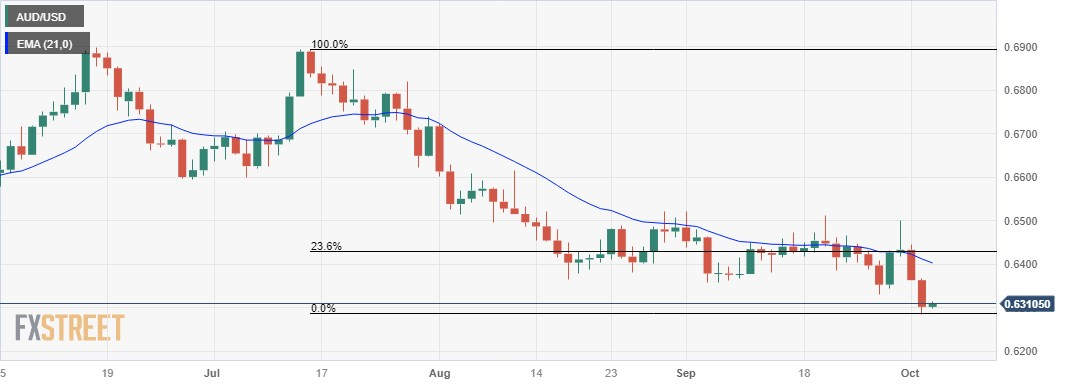
Technical Analysis: Australian Dollar hovers around 0.6300, November's low emerges as support
Australian Dollar trades around 0.6320 on Wednesday. The major level at 0.6300 emerges as the immediate support, followed by November's low at 0.6272. On the upside, the 21-day Exponential Moving Average (EMA) at 0.6402 appears to be a key barrier, following the 23.6% Fibonacci retracement at 0.6464 level.
AUD/USD: Daily Chart
Economic Indicator
Australia Trade Balance (MoM)
The trade balance released by the Australian Bureau of Statistics is the difference in the value of its imports and exports of Australian goods. Export data can give an important reflection of Australian growth, while imports provide an indication of domestic demand. Trade Balance gives an early indication of the net export performance. If a steady demand in exchange for Australian exports is seen, that would turn into a positive growth in the trade balance, and that should be positive for the AUD.
Read more.Author

Akhtar Faruqui
FXStreet
Akhtar Faruqui is a Forex Analyst based in New Delhi, India. With a keen eye for market trends and a passion for dissecting complex financial dynamics, he is dedicated to delivering accurate and insightful Forex news and analysis.
















