Australian Dollar gains ground due to risk-on mood, awaits Fed Powell testimony
- The Australian Dollar advances as a ceasefire has been agreed upon between Iran and Israel.
- The upbeat S&P Global Australia PMI data dampened expectations of the RBA cutting interest rates anytime soon.
- Fed's Michelle Bowman stated that the time to cut interest rates is approaching.

The Australian Dollar (AUD) appreciates against the US Dollar (USD) on Tuesday, extending its gains for the second successive session. The AUD/USD pair gains ground after US President Donald Trump said a ceasefire has been agreed upon between Iran and Israel. Trump said that a "complete and total" ceasefire between Israel and Iran will go into effect to end the conflict between the two nations.
Iran fired missiles at the Al Udeid Air Base in Qatar on Monday. Qatar officials said that the missile barrage was intercepted and that the base had been evacuated in advance. Trump announced late Saturday that he had "obliterated" Iran's three nuclear facilities, including Fordow, Natanz, and Isfahan, in strikes overnight. Iranian parliament approved a measure to close the Strait of Hormuz.
The latest upbeat S&P Global Purchasing Managers Index (PMI) data revealed that Australia’s private sector grew at its second-fastest pace in ten months, weakening short-term rate cut expectations by the Reserve Bank of Australia (RBA).
Traders will likely observe Fed Chair Jerome Powell, who is scheduled to testify before the US Congress on Tuesday and Wednesday, in search of clues about the future direction of interest rates.
Australian Dollar appreciates as the US Dollar holds losses amid improved market sentiment
- The US Dollar Index (DXY), which measures the value of the US Dollar against six major currencies, is trading at around 98.20 at the time of writing. The Greenback faced challenges following the dovish remarks from the Federal Reserve (Fed) officials.
- Fed’s Vice Chair for Supervision Michelle Bowman noted on Monday that the time to cut interest rates is getting nearer as risks to the job market may be on the rise. Bowman also highlighted that inflation appears to be on a sustained path back to 2%, and she is less concerned that tariffs will cause an inflation problem.
- Federal Reserve (Fed) Governor Christopher Waller noted on Friday that the US central bank could start easing monetary policy as soon as next month, signaling flexibility amid global economic uncertainty and rising geopolitical risks.
- The US Fed decided to keep the interest rate steady at 4.5% in June as widely expected. The Federal Open Market Committee (FOMC) still sees around 50 basis points of interest rate cuts through the end of 2025.
- Fed Chair Jerome Powell warned that ongoing policy uncertainty will keep the Fed in a rate-hold stance, and any rate cuts will be contingent on further improvement in labor and inflation data.
- The People’s Bank of China (PBOC) decided to leave its Loan Prime Rates (LPRs) unchanged on Friday. The one-year and five-year LPRs were at 3.00% and 3.50%, respectively.
- S&P Global Australia Manufacturing Purchasing Managers Index remained consistent at a 51.0 reading in June. Meanwhile, the Services PMI edged higher to 51.3 from the previous reading of 50.6, while the Composite PMI improved to 51.2 in June from 50.5 prior.
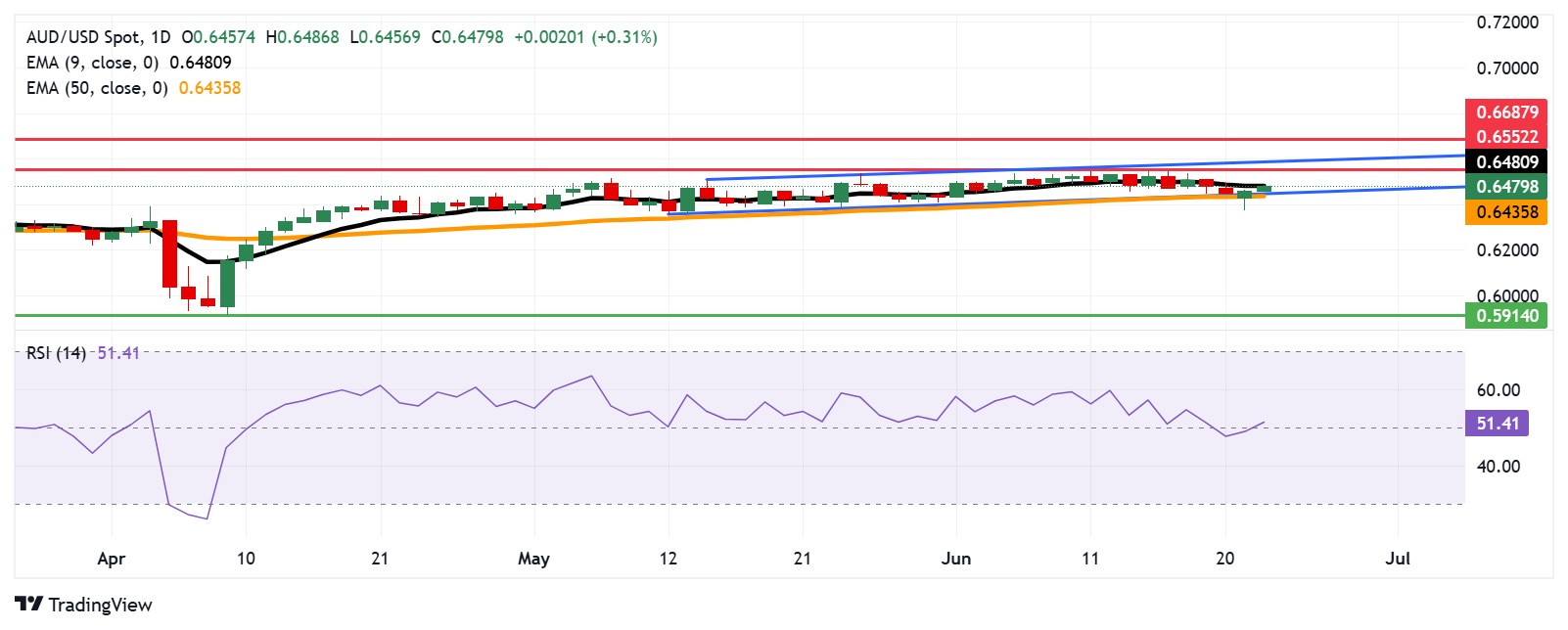
Australian Dollar tests nine-day EMA near 0.6500
AUD/USD is trading around 0.6480 on Tuesday. The technical analysis of the daily chart shows a revival of the bullish bias, as the pair has rebounded to the ascending channel pattern. Additionally, the 14-day Relative Strength Index (RSI) has moved slightly above the 50 mark, strengthening the bearish bias. However, the pair is still below the nine-day Exponential Moving Average (EMA), indicating that short-term price momentum is weaker.
The AUD/USD pair is primarily testing the nine-day EMA at 0.6480. A successful breach above this level would reinforce the bullish sentiment and lead the pair to approach the seven-month high of 0.6552, which was recorded on June 16, followed by the ascending channel’s upper boundary around 0.6600.
On the downside, the immediate support appears at the lower boundary of the ascending channel around 0.6440, aligned with the 50-day EMA at 0.6435. A break below this crucial support zone would help the bearish bias to grow and put downward pressure on the AUD/USD pair to test the “throwback support” around the psychological level of 0.6400. A break below this level may prompt the pair to navigate the region around 0.5914, the lowest level since March 2020.
AUD/USD: Daily Chart
Australian Dollar PRICE Today
The table below shows the percentage change of Australian Dollar (AUD) against listed major currencies today. Australian Dollar was the strongest against the US Dollar.
| USD | EUR | GBP | JPY | CAD | AUD | NZD | CHF | |
|---|---|---|---|---|---|---|---|---|
| USD | -0.24% | -0.43% | -0.67% | -0.15% | -0.80% | -0.89% | 0.03% | |
| EUR | 0.24% | -0.23% | -0.45% | 0.08% | -0.57% | -1.08% | 0.27% | |
| GBP | 0.43% | 0.23% | -0.22% | 0.32% | -0.33% | -0.85% | 0.36% | |
| JPY | 0.67% | 0.45% | 0.22% | 0.54% | -0.17% | -0.26% | 0.58% | |
| CAD | 0.15% | -0.08% | -0.32% | -0.54% | -0.66% | -1.17% | 0.04% | |
| AUD | 0.80% | 0.57% | 0.33% | 0.17% | 0.66% | -0.52% | 0.69% | |
| NZD | 0.89% | 1.08% | 0.85% | 0.26% | 1.17% | 0.52% | 1.22% | |
| CHF | -0.03% | -0.27% | -0.36% | -0.58% | -0.04% | -0.69% | -1.22% |
The heat map shows percentage changes of major currencies against each other. The base currency is picked from the left column, while the quote currency is picked from the top row. For example, if you pick the Australian Dollar from the left column and move along the horizontal line to the US Dollar, the percentage change displayed in the box will represent AUD (base)/USD (quote).
Economic Indicator
Fed's Chair Powell testifies
Federal Reserve Chair Jerome Powell testifies before Congress, providing a broad overview of the economy and monetary policy. Powell's prepared remarks are published ahead of the appearance on Capitol Hill.
Read more.Next release: Tue Jun 24, 2025 14:00
Frequency: Irregular
Consensus: -
Previous: -
Source: Federal Reserve
Author

Akhtar Faruqui
FXStreet
Akhtar Faruqui is a Forex Analyst based in New Delhi, India. With a keen eye for market trends and a passion for dissecting complex financial dynamics, he is dedicated to delivering accurate and insightful Forex news and analysis.

















