Australian Dollar moves little due to increased risk aversion following Trump's tariffs
- The Australian Dollar remains steady as Trump imposes a 25% tariff on all steel and aluminum imports.
- Australia’s Westpac Consumer Confidence rose 0.1% in February, reaching 92.2 from 92.1 prior.
- The US Dollar appreciates amid the rising cautious mood surrounding the Fed’s policy outlook.

The Australian Dollar (AUD) remains subdued against the US Dollar (USD) on Tuesday. The AUD/USD pair could decline due to US President Donald Trump’s decision to expand steel and aluminum tariffs by 25% to include all imports, nullifying trade agreements with key US allies, including Australia. The White House confirmed that all import tax exclusions had been removed and indicated that further action on microchips and vehicles would be considered in the coming weeks.
Trump later stated he would give "great consideration" to Australia's request for an exemption from the steel tariffs, citing the country's trade deficit with the U.S. In response, Australian Trade Minister Don Farrell emphasized on Monday that Australia was seeking a tariff exemption similar to the one it secured during Trump’s presidency in 2018.
Australia’s Westpac Consumer Confidence increased by 0.1% in February, reaching 92.2 from 92.1 in January. Despite the slight uptick, consumer confidence remained subdued due to ongoing concerns over household finances and the rising cost of living.
Market sentiment suggests growing expectations that the Reserve Bank of Australia (RBA) will lower its 4.35% cash rate at its next meeting in February. Traders now see a 95% probability of a cut to 4.10%, as recent data indicates that underlying inflation has eased more rapidly than the RBA anticipated. This has prompted several major Australian banks to shift their forecast for the first rate cut from May to February.
Australian Dollar declines amid rising cautious tone surrounding Fed’s policy outlook
- The US Dollar Index (DXY), which measures the US Dollar’s value against six major currencies, extends its gains for the fourth successive session and rises to near 108.50 at the time of writing.
- A Reuters poll of economists now suggests the Federal Reserve will delay cutting interest rates until next quarter amid rising inflation concerns. Many who had previously expected a March rate cut have revised their forecasts. The majority of economists surveyed between February 4-10 anticipate at least one rate cut by June, though opinions on the exact timing remain divided.
- The US Dollar receives support as the US Federal Reserve (Fed) is now expected to keep interest rates steady this year, following January’s jobs report released on Friday, which indicated slowing job growth but a lower Unemployment Rate.
- US Nonfarm Payrolls (NFP) increased by 143,000 in January, significantly below December’s revised figure of 307,000 and the market expectation of 170,000. However, the Unemployment Rate declined slightly to 4% in January from 4.1% in December.
- US Initial Jobless Claims rose to 219K for the week ending January 31, as reported by the US Department of Labor (DOL) on Thursday. This print surpasses initial estimates of 213K and was higher than the previous week's revised tally of 208K (from 207K).
- Federal Reserve (Fed) Bank of Chicago President Austan Goolsbee mentioned on Friday that inconsistent policy approaches from the US government cause a high level of economic uncertainty that makes it difficult for the Fed to draw a bead on where the economy, and inflation specifically, are likely heading.
- Meanwhile, Fed Board of Governors member Adriana Kugler noted that US growth and economic activity remain healthy overall, but noted that progress toward the Fed's inflation goals has been somewhat lopsided, per Reuters.
- In an interview with CNBC, Minneapolis Fed President Neel Kashkari said that he would move towards supporting further rate cuts if they see good inflation data and the labor market stays strong
- China’s Consumer Price Index (CPI) grew at an annual rate of 0.5% in January, up from 0.1% in December and exceeding the market forecast of 0.4%. On a monthly basis, CPI inflation rose 0.7% in January, compared to December’s flat reading of 0%, though it fell short of the expected 0.8% increase.
Technical Analysis: Australian Dollar tests nine-day EMA, followed by 0.6250
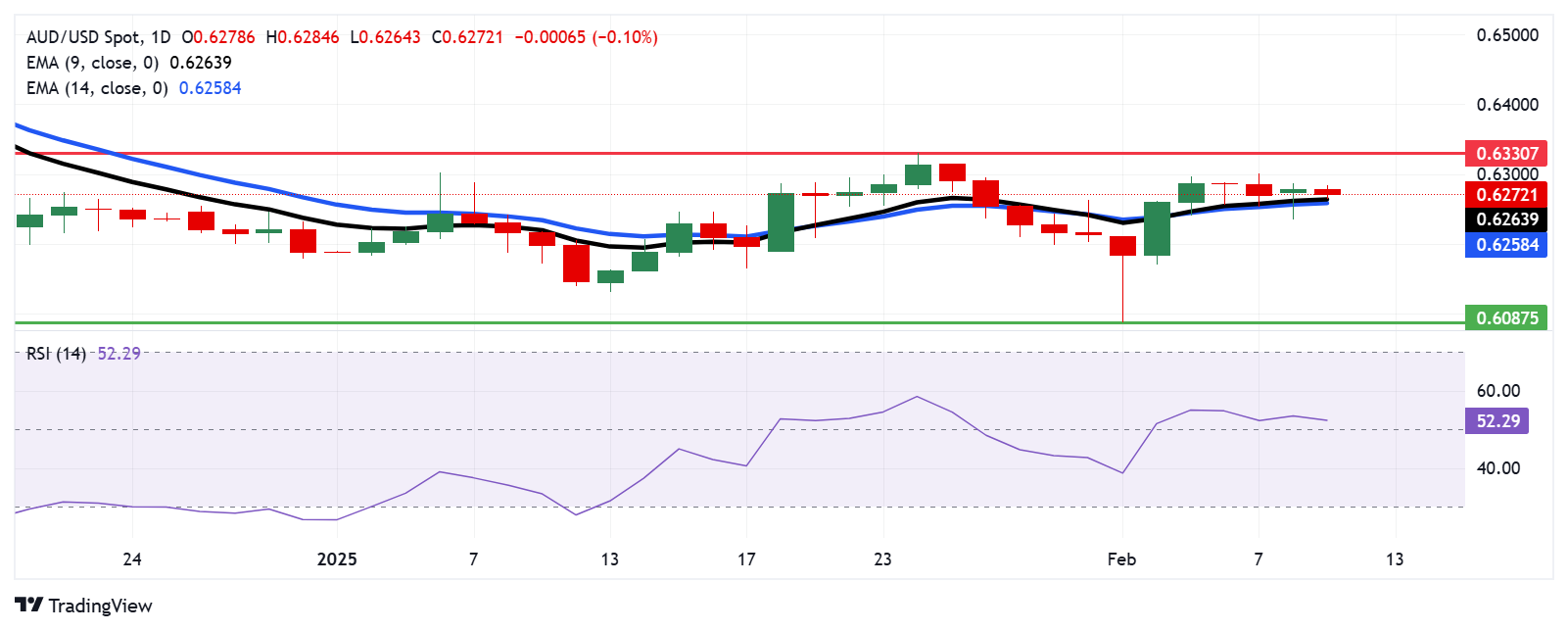
The AUD/USD pair hovers near 0.6270 on Tuesday, testing the nine- and 14-day Exponential Moving Averages (EMAs) on the daily chart. A break below these levels could weaken short-term price momentum. The 14-day Relative Strength Index (RSI) maintains its position above the 50 mark, suggesting a bullish bias is active.
On the upside, the AUD/USD pair may explore the region around the eight-week high of 0.6330, last reached on January 24.
The AUD/USD pair tests immediate support at the nine-day EMA of 0.6264 level, followed by the 14-day EMA of 0.6258. A decisive break below these levels could weaken the short-term price momentum, potentially pushing the pair toward 0.6087—the lowest level since April 2020, recorded on February 3.
AUD/USD: Daily Chart
Australian Dollar PRICE Today
The table below shows the percentage change of Australian Dollar (AUD) against listed major currencies today. Australian Dollar was the weakest against the New Zealand Dollar.
| USD | EUR | GBP | JPY | CAD | AUD | NZD | CHF | |
|---|---|---|---|---|---|---|---|---|
| USD | 0.04% | 0.15% | 0.00% | 0.19% | 0.04% | -0.06% | 0.02% | |
| EUR | -0.04% | 0.10% | -0.06% | 0.16% | 0.00% | -0.10% | -0.01% | |
| GBP | -0.15% | -0.10% | -0.15% | 0.05% | -0.11% | -0.21% | -0.12% | |
| JPY | 0.00% | 0.06% | 0.15% | 0.20% | 0.04% | -0.06% | 0.04% | |
| CAD | -0.19% | -0.16% | -0.05% | -0.20% | -0.16% | -0.26% | -0.17% | |
| AUD | -0.04% | 0.00% | 0.11% | -0.04% | 0.16% | -0.10% | -0.01% | |
| NZD | 0.06% | 0.10% | 0.21% | 0.06% | 0.26% | 0.10% | 0.09% | |
| CHF | -0.02% | 0.01% | 0.12% | -0.04% | 0.17% | 0.01% | -0.09% |
The heat map shows percentage changes of major currencies against each other. The base currency is picked from the left column, while the quote currency is picked from the top row. For example, if you pick the Australian Dollar from the left column and move along the horizontal line to the US Dollar, the percentage change displayed in the box will represent AUD (base)/USD (quote).
Australian Dollar FAQs
One of the most significant factors for the Australian Dollar (AUD) is the level of interest rates set by the Reserve Bank of Australia (RBA). Because Australia is a resource-rich country another key driver is the price of its biggest export, Iron Ore. The health of the Chinese economy, its largest trading partner, is a factor, as well as inflation in Australia, its growth rate and Trade Balance. Market sentiment – whether investors are taking on more risky assets (risk-on) or seeking safe-havens (risk-off) – is also a factor, with risk-on positive for AUD.
The Reserve Bank of Australia (RBA) influences the Australian Dollar (AUD) by setting the level of interest rates that Australian banks can lend to each other. This influences the level of interest rates in the economy as a whole. The main goal of the RBA is to maintain a stable inflation rate of 2-3% by adjusting interest rates up or down. Relatively high interest rates compared to other major central banks support the AUD, and the opposite for relatively low. The RBA can also use quantitative easing and tightening to influence credit conditions, with the former AUD-negative and the latter AUD-positive.
China is Australia’s largest trading partner so the health of the Chinese economy is a major influence on the value of the Australian Dollar (AUD). When the Chinese economy is doing well it purchases more raw materials, goods and services from Australia, lifting demand for the AUD, and pushing up its value. The opposite is the case when the Chinese economy is not growing as fast as expected. Positive or negative surprises in Chinese growth data, therefore, often have a direct impact on the Australian Dollar and its pairs.
Iron Ore is Australia’s largest export, accounting for $118 billion a year according to data from 2021, with China as its primary destination. The price of Iron Ore, therefore, can be a driver of the Australian Dollar. Generally, if the price of Iron Ore rises, AUD also goes up, as aggregate demand for the currency increases. The opposite is the case if the price of Iron Ore falls. Higher Iron Ore prices also tend to result in a greater likelihood of a positive Trade Balance for Australia, which is also positive of the AUD.
The Trade Balance, which is the difference between what a country earns from its exports versus what it pays for its imports, is another factor that can influence the value of the Australian Dollar. If Australia produces highly sought after exports, then its currency will gain in value purely from the surplus demand created from foreign buyers seeking to purchase its exports versus what it spends to purchase imports. Therefore, a positive net Trade Balance strengthens the AUD, with the opposite effect if the Trade Balance is negative.
Author

Akhtar Faruqui
FXStreet
Akhtar Faruqui is a Forex Analyst based in New Delhi, India. With a keen eye for market trends and a passion for dissecting complex financial dynamics, he is dedicated to delivering accurate and insightful Forex news and analysis.