Australian Dollar appreciates due to improved risk sentiment, hawkish RBA
- The Australian Dollar advances further due to improved risk sentiment.
- The RBA concentrates on the potential upside risks to inflation and does not anticipate any rate cuts soon.
- The US Dollar loses ground due to dovish comments from Fed officials.

The Australian Dollar (AUD) continues its winning streak for the third consecutive day against the US Dollar (USD) on Monday. The upside of the AUD/USD pair could be attributed to improved risk sentiment, along with the hawkish mood surrounding the Reserve Bank of Australia (RBA) regarding its policy outlook. Investors will be closely watching the RBA Meeting Minutes and the People’s Bank of China’s (PBoC) Interest Rate Decision on Tuesday.
RBA Governor Michele Bullock stated on Friday that the Australian central bank is focused on the potential upside risks to inflation and anticipates no rate cuts in the near term. Bullock emphasized that the RBA board believes it has struck the right balance between controlling inflation and maintaining stability in the current economic climate, according to ABC News.
The US Dollar (USD) receives downward pressure as the likelihood of an interest rate cut by the Federal Reserve (Fed) starting in September increases. Last week's US economic data showed Retail Sales exceeding expectations, while both the Producer Price Index (PPI) and Consumer Price Index (CPI) indicated that inflation is easing. Additionally, Housing Starts in July fell to their lowest level since 2020. This week, all eyes will be on Federal Reserve Chair Jerome Powell's upcoming speech.
Daily Digest Market Movers: Australian Dollar advances as RBA may adopt a hawkish stance
- Federal Reserve Bank of San Francisco President Mary Daly emphasized Sunday that the US central bank should take a gradual approach to reducing borrowing costs, according to the Financial Times. Daly pushed back against economists' concerns that the US economy is on the verge of a sharp slowdown that would justify rapid interest rate cuts.
- Federal Reserve Bank of Chicago President Austan Goolsbee warned that central bank officials should be cautious about keeping a restrictive policy in place longer than necessary. While it's uncertain whether the Fed will cut interest rates next month, failing to do so could harm the labor market, per CNBC.
- On Friday, US Housing Starts dropped by 6.8% in July to 1.238 million units, following a 1.1% increase in June. Meanwhile, the University of Michigan’s Consumer Sentiment Index rose to 67.8 in August, showing its first increase in five months, surpassing expectations and up from 66.4 in July.
- On Thursday, US Retail Sales rose by 1.0% month-over-month in July, a significant rebound from June's 0.2% decline, according to the US Census Bureau. This figure exceeded the forecasted increase of 0.3%. Additionally, Initial Jobless Claims for the week ending August 9 came in at 227,000, better than the anticipated 235,000 and a decrease from the previous week's 234,000.
- The People's Bank of China (PBoC) announced on Thursday that it will renew the medium-term lending facility funds maturing on August 15th later this month. The central bank also lent CNY 577.7 billion (USD 80.9 billion) through seven-day reverse bond repurchase agreements at 1.7% in an open market operation, maintaining the previous rate, according to Reuters. Any change in the Chinese economy could impact the Australian market as both countries are close trade partners.
- US headline Consumer Price Index (CPI) rose 2.9% year-over-year in July, slightly down from the 3% increase in June and below market expectations. The Core CPI, which excludes food and energy, climbed 3.2% year-over-year, a slight decrease from the 3.3% rise in June but aligned with market forecasts.
Technical Analysis: Australian Dollar rises toward 0.6700
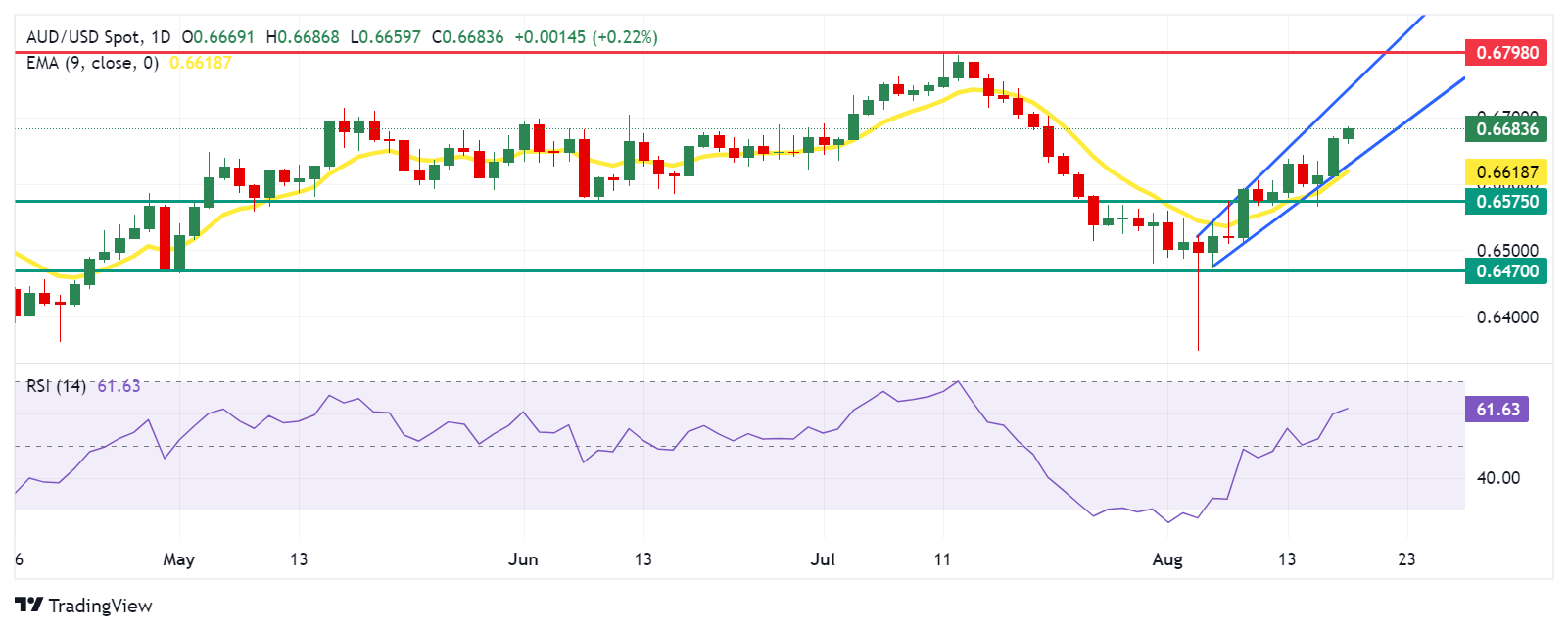
The Australian Dollar trades around 0.6680 on Monday. According to daily chart analysis, the AUD/USD pair is moving upwards within the ascending channel, which suggests a bullish bias. Additionally, the 14-day Relative Strength Index (RSI) is climbing toward the 70 mark, reinforcing the current bullish momentum.
On the upside, the AUD/USD pair could aim for the area near the upper boundary of the ascending channel at the 0.6740 level. A breakout above the ascending channel could push the pair toward its seven-month high of 0.6798, which was reached on July 11.
For support, the lower boundary of the ascending channel, around 0.6630, serves as the immediate support level for the AUD/USD pair, followed by the nine-day Exponential Moving Average (EMA) at 0.6618. A drop below the EMA could see the pair test the throwback level at 0.6575. If the pair falls below this support zone, it could indicate a bearish bias, potentially leading it toward the throwback level at 0.6470.
AUD/USD: Daily Chart
Australian Dollar PRICE Today
The table below shows the percentage change of Australian Dollar (AUD) against listed major currencies today. Australian Dollar was the strongest against the US Dollar.
| USD | EUR | GBP | JPY | CAD | AUD | NZD | CHF | |
|---|---|---|---|---|---|---|---|---|
| USD | -0.15% | -0.08% | -1.21% | -0.11% | -0.18% | -0.55% | -0.26% | |
| EUR | 0.15% | -0.00% | -1.00% | 0.04% | -0.13% | -0.57% | -0.14% | |
| GBP | 0.08% | 0.00% | -1.17% | 0.01% | -0.13% | -0.50% | -0.13% | |
| JPY | 1.21% | 1.00% | 1.17% | 1.04% | 1.00% | 0.78% | 0.82% | |
| CAD | 0.11% | -0.04% | -0.01% | -1.04% | -0.10% | -0.36% | -0.18% | |
| AUD | 0.18% | 0.13% | 0.13% | -1.00% | 0.10% | -0.29% | -0.01% | |
| NZD | 0.55% | 0.57% | 0.50% | -0.78% | 0.36% | 0.29% | 0.31% | |
| CHF | 0.26% | 0.14% | 0.13% | -0.82% | 0.18% | 0.00% | -0.31% |
The heat map shows percentage changes of major currencies against each other. The base currency is picked from the left column, while the quote currency is picked from the top row. For example, if you pick the Australian Dollar from the left column and move along the horizontal line to the US Dollar, the percentage change displayed in the box will represent AUD (base)/USD (quote).
RBA FAQs
The Reserve Bank of Australia (RBA) sets interest rates and manages monetary policy for Australia. Decisions are made by a board of governors at 11 meetings a year and ad hoc emergency meetings as required. The RBA’s primary mandate is to maintain price stability, which means an inflation rate of 2-3%, but also “..to contribute to the stability of the currency, full employment, and the economic prosperity and welfare of the Australian people.” Its main tool for achieving this is by raising or lowering interest rates. Relatively high interest rates will strengthen the Australian Dollar (AUD) and vice versa. Other RBA tools include quantitative easing and tightening.
While inflation had always traditionally been thought of as a negative factor for currencies since it lowers the value of money in general, the opposite has actually been the case in modern times with the relaxation of cross-border capital controls. Moderately higher inflation now tends to lead central banks to put up their interest rates, which in turn has the effect of attracting more capital inflows from global investors seeking a lucrative place to keep their money. This increases demand for the local currency, which in the case of Australia is the Aussie Dollar.
Macroeconomic data gauges the health of an economy and can have an impact on the value of its currency. Investors prefer to invest their capital in economies that are safe and growing rather than precarious and shrinking. Greater capital inflows increase the aggregate demand and value of the domestic currency. Classic indicators, such as GDP, Manufacturing and Services PMIs, employment, and consumer sentiment surveys can influence AUD. A strong economy may encourage the Reserve Bank of Australia to put up interest rates, also supporting AUD.
Quantitative Easing (QE) is a tool used in extreme situations when lowering interest rates is not enough to restore the flow of credit in the economy. QE is the process by which the Reserve Bank of Australia (RBA) prints Australian Dollars (AUD) for the purpose of buying assets – usually government or corporate bonds – from financial institutions, thereby providing them with much-needed liquidity. QE usually results in a weaker AUD.
Quantitative tightening (QT) is the reverse of QE. It is undertaken after QE when an economic recovery is underway and inflation starts rising. Whilst in QE the Reserve Bank of Australia (RBA) purchases government and corporate bonds from financial institutions to provide them with liquidity, in QT the RBA stops buying more assets, and stops reinvesting the principal maturing on the bonds it already holds. It would be positive (or bullish) for the Australian Dollar.
Author

Akhtar Faruqui
FXStreet
Akhtar Faruqui is a Forex Analyst based in New Delhi, India. With a keen eye for market trends and a passion for dissecting complex financial dynamics, he is dedicated to delivering accurate and insightful Forex news and analysis.

















