Australian Dollar loses ground as US Dollar remains solid ahead of PCE Inflation
- The Australian Dollar may regain ground due to improved market sentiment amid China’s stimulus measures.
- Australian Treasurer Jim Chalmers views China's new stimulus measures as a "really welcome development."
- Higher US Treasury yields contribute to the support of the US Dollar.

The Australian Dollar (AUD) edges lower against the US Dollar (USD) on Friday. The AUD/USD pair receives downward pressure from a stable Greenback amid improved US Treasury yields. However, the downside of the risk-sensitive AUD could be restrained as news of further stimulus from China, its largest trading partner, lifted market sentiment globally.
Australian Treasurer Jim Chalmers is currently in China to strengthen economic ties between the two nations. During his visit, Chalmers held candid and productive discussions with the National Development and Reform Commission (NDRC). He highlighted China's economic slowdown as a key factor in weaker global growth while welcoming the country's new stimulus measures as a "really welcome development."
The US Dollar could face pressure following dovish remarks from Federal Reserve officials. Fed Governor Lisa Cook stated on Thursday that she supported last week's 50 basis points (bps) interest rate cut, citing increased "downside risks" to employment, according to Reuters.
Traders are now expected to closely monitor the US Personal Consumption Expenditures (PCE) Price Index data for August, which is scheduled for release later in the North American session.
Daily Digest Market Movers: Australian Dollar edges lower despite a positive market sentiment
- US Gross Domestic Product Annualized increased at a rate of 3.0% in the second quarter, as previously estimated, according to the US Bureau of Economic Analysis (BEA) on Thursday. Meanwhile, the GDP Price Index rose 2.5% in the second quarter.
- US Initial Jobless Claims for the week ending September 20 were reported at 218K, according to the US Department of Labor (DoL). This figure came in below the initial consensus of 225K and was lower than the previous week's revised number of 222K (previously reported as 219K).
- China plans to inject over CNY 1 trillion in capital into its largest state banks, facing challenges such as shrinking margins, declining profits, and increasing bad loans. This substantial capital infusion would mark the first of its kind since the 2008 global financial crisis.
- According to the Reserve Bank of Australia's Financial Stability Review from September 2024, the Australian financial system remains resilient, with risks largely contained. However, notable concerns include stress in China's financial sector and the limited response from Beijing to address these issues. Domestically, a small but growing portion of Australian home borrowers are falling behind on their payments, though only about 2% of owner-occupier borrowers are at serious risk of default.
- The Commonwealth Bank of Australia (CBA) anticipates that the RBA must revise its consumption forecasts downward in November. The RBA has already acknowledged downside risks to its current outlook. This potential revision, combined with expectations of a further rise in unemployment and trimmed mean inflation aligning with CBA's forecasts, could position the RBA to implement rate cuts before the end of the year.
- Federal Reserve Governor Adriana Kugler said on Wednesday that she “strongly supported” the Fed’s decision to cut the interest rates by a half point last week. Kugler further stated that it will be appropriate to make additional rate cuts if inflation continues to ease as expected, per Bloomberg.
- In a recent note, JP Morgan advised investors to monitor commodities and bond yields in light of the positive market outlook following China's stimulus proposals on Tuesday. The bank emphasized that global growth has received a new boost from China, a factor that has been lacking in recent years. This development notably reduces the risk of a recession and is seen as favorable for the markets. However, JP Morgan also cautioned about the potential risk of reinflation.
- Australia’s Monthly Consumer Price Index rose 2.7% year-over-year in August, down from the previous 3.5% rise and expected 2.8% increase.
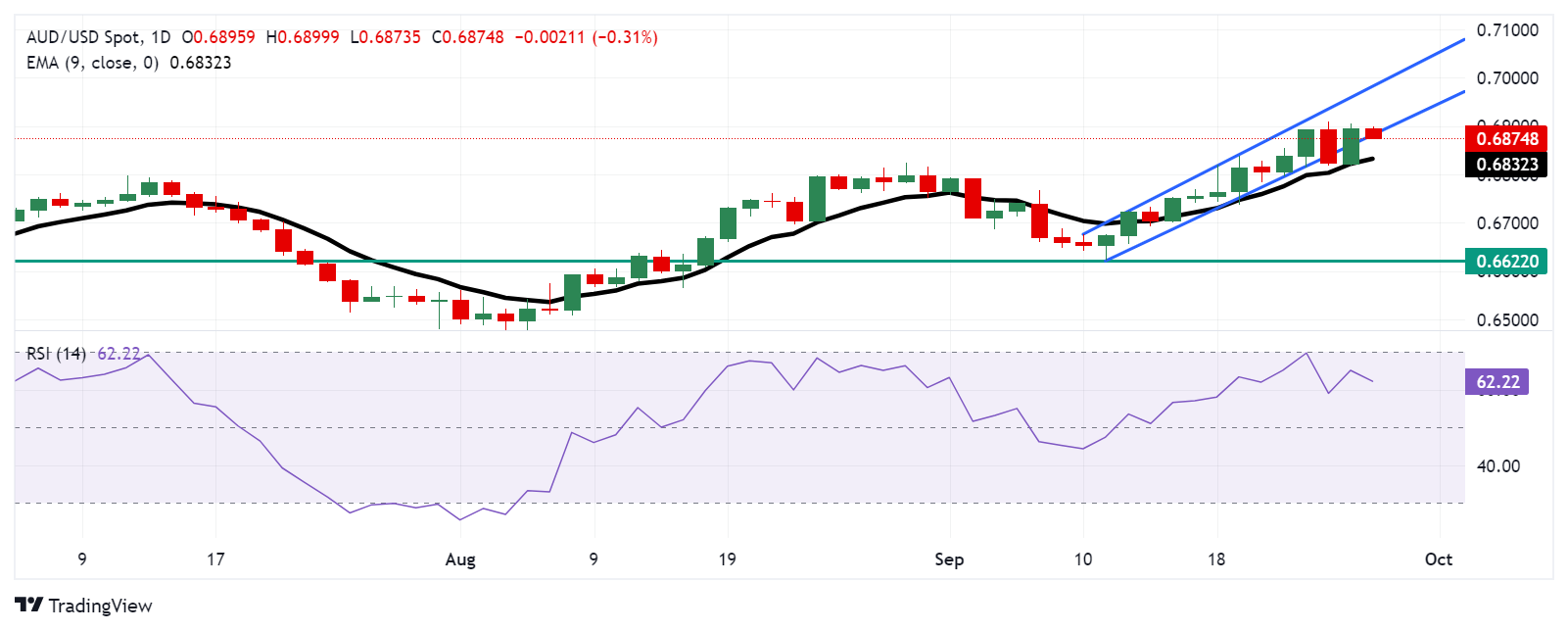
Technical Analysis: Australian Dollar hovers around the lower ascending channel boundary near 0.6900
The AUD/USD pair trades near 0.6880 on Friday. Technical analysis of the daily chart shows that the pair is positioned near the lower boundary of an ascending channel pattern, with further movement likely to provide a clearer indication of market bias. Additionally, the 14-day Relative Strength Index (RSI) remains above the 50 level, indicating that bullish sentiment is still holding.
In terms of resistance, the AUD/USD pair could explore the region around the upper boundary of the ascending channel, around the 0.6990 level.
On the downside, a break below the lower boundary of the ascending channel could weaken the bullish bias and lead the AUD/USD pair to test the nine-day Exponential Moving Average (EMA) at the 0.6832 level. The next significant support is at the psychological level of 0.6700, followed by the six-week low of 0.6622.
AUD/USD: Daily Chart
(This story was corrected on September 27 at 05:50 GMT to say, in the third paragraph of the technical analysis, that a break below the lower boundary of the ascending channel could weaken the bullish bias, not bearish.)
Australian Dollar PRICE Today
The table below shows the percentage change of Australian Dollar (AUD) against listed major currencies today. Australian Dollar was the weakest against the US Dollar.
| USD | EUR | GBP | JPY | CAD | AUD | NZD | CHF | |
|---|---|---|---|---|---|---|---|---|
| USD | 0.13% | 0.24% | 0.99% | 0.19% | 0.27% | 0.40% | 0.28% | |
| EUR | -0.13% | 0.10% | 0.85% | 0.03% | 0.14% | 0.27% | 0.15% | |
| GBP | -0.24% | -0.10% | 0.74% | -0.06% | 0.02% | 0.17% | 0.05% | |
| JPY | -0.99% | -0.85% | -0.74% | -0.81% | -0.71% | -0.59% | -0.68% | |
| CAD | -0.19% | -0.03% | 0.06% | 0.81% | 0.06% | 0.22% | 0.09% | |
| AUD | -0.27% | -0.14% | -0.02% | 0.71% | -0.06% | 0.15% | 0.01% | |
| NZD | -0.40% | -0.27% | -0.17% | 0.59% | -0.22% | -0.15% | -0.12% | |
| CHF | -0.28% | -0.15% | -0.05% | 0.68% | -0.09% | -0.01% | 0.12% |
The heat map shows percentage changes of major currencies against each other. The base currency is picked from the left column, while the quote currency is picked from the top row. For example, if you pick the Australian Dollar from the left column and move along the horizontal line to the US Dollar, the percentage change displayed in the box will represent AUD (base)/USD (quote).
Australian Dollar FAQs
One of the most significant factors for the Australian Dollar (AUD) is the level of interest rates set by the Reserve Bank of Australia (RBA). Because Australia is a resource-rich country another key driver is the price of its biggest export, Iron Ore. The health of the Chinese economy, its largest trading partner, is a factor, as well as inflation in Australia, its growth rate and Trade Balance. Market sentiment – whether investors are taking on more risky assets (risk-on) or seeking safe-havens (risk-off) – is also a factor, with risk-on positive for AUD.
The Reserve Bank of Australia (RBA) influences the Australian Dollar (AUD) by setting the level of interest rates that Australian banks can lend to each other. This influences the level of interest rates in the economy as a whole. The main goal of the RBA is to maintain a stable inflation rate of 2-3% by adjusting interest rates up or down. Relatively high interest rates compared to other major central banks support the AUD, and the opposite for relatively low. The RBA can also use quantitative easing and tightening to influence credit conditions, with the former AUD-negative and the latter AUD-positive.
China is Australia’s largest trading partner so the health of the Chinese economy is a major influence on the value of the Australian Dollar (AUD). When the Chinese economy is doing well it purchases more raw materials, goods and services from Australia, lifting demand for the AUD, and pushing up its value. The opposite is the case when the Chinese economy is not growing as fast as expected. Positive or negative surprises in Chinese growth data, therefore, often have a direct impact on the Australian Dollar and its pairs.
Iron Ore is Australia’s largest export, accounting for $118 billion a year according to data from 2021, with China as its primary destination. The price of Iron Ore, therefore, can be a driver of the Australian Dollar. Generally, if the price of Iron Ore rises, AUD also goes up, as aggregate demand for the currency increases. The opposite is the case if the price of Iron Ore falls. Higher Iron Ore prices also tend to result in a greater likelihood of a positive Trade Balance for Australia, which is also positive of the AUD.
The Trade Balance, which is the difference between what a country earns from its exports versus what it pays for its imports, is another factor that can influence the value of the Australian Dollar. If Australia produces highly sought after exports, then its currency will gain in value purely from the surplus demand created from foreign buyers seeking to purchase its exports versus what it spends to purchase imports. Therefore, a positive net Trade Balance strengthens the AUD, with the opposite effect if the Trade Balance is negative.
Author

Akhtar Faruqui
FXStreet
Akhtar Faruqui is a Forex Analyst based in New Delhi, India. With a keen eye for market trends and a passion for dissecting complex financial dynamics, he is dedicated to delivering accurate and insightful Forex news and analysis.















