Australian Dollar depreciates due to market caution
- The Australian Dollar loses ground despite the hawkish RBA’s policy outlook.
- The AUD inches lower as the US Dollar appreciates amid less-dovish sentiment surrounding the Fed.
- Michigan Consumer Sentiment Index is expected to come in at 69.0 in October, against its previous 68.9 reading.

The Australian Dollar (AUD) edged lower against the US Dollar (USD) on Thursday. However, the AUD/USD pair saw some gains as the US Dollar (USD) softened slightly due to a modest decline in US Treasury yields. The Aussie Dollar could benefit from the hawkish tone surrounding the Reserve Bank of Australia (RBA).
RBA Deputy Governor Andrew Hauser highlighted, earlier this week, the country's strong labor participation rate and stressed that, although the RBA relies on data, it is not overly fixated on it.
The US Dollar has strengthened as traders closely watch the Federal Reserve's (Fed) interest rate trajectory, amid increasing expectations that the central bank will be less aggressive in lowering rates than previously thought. Additionally, the Greenback is buoyed by rising speculation regarding a potential second term for former President Donald Trump in the upcoming US presidential election in November. Traders will likely observe US Durable Goods Orders and Michigan Consumer Sentiment Index data on Friday.
Republican nominee Donald Trump returned to his familiar reality show catchphrase during an event in Las Vegas, Nevada on Thursday. Trump stated, "Under the Trump administration, we're going to build an economy that lifts up all Americans, including African Americans, Hispanic Americans, and also members of our great Asian American and Pacific Islander community, many of whom are here today," as reported by Reuters.
Daily Digest Market Movers: Australian Dollar depreciates ahead of US presidential election
- According to the CME FedWatch Tool, there is a 97% probability of a 25-basis-point rate cut by the Fed in November, with no expectation of a larger 50-basis-point cut.
- Vice President Kamala Harris enjoyed the backing of rock legend Bruce Springsteen, entertainer Tyler Perry, and former President Barack Obama at a rally in Georgia, which attracted thousands of supporters in this key battleground state.
- S&P Global has released its preliminary October US Purchasing Managers Index (PMI) readings, showing positive momentum across sectors. The Composite PMI rose to 54.3, up from the previous 54.0. The Services PMI exceeded expectations at 55.3, compared to the forecasted 55.0, and saw a slight increase from the previous 55.2. Meanwhile, the Manufacturing PMI also came in stronger at 47.8, above the expected 47.5, and improving from the prior reading of 47.3.
- Australia's Judo Bank Composite PMI slightly rose to 49.8 in October, up from 49.6 in September, signaling a second straight month of contraction in private sector output. The Services PMI inched up to 50.6 from 50.5, marking its ninth consecutive month of expansion, while the Manufacturing PMI dipped to 46.6 from 46.7, continuing its decline.
- On Wednesday, the Fed Beige Book indicated that economic activity was "little changed in nearly all Districts," in contrast to August's report, in which three Districts reported growth and nine showed flat activity.
- In a post on the social media platform X, Federal Reserve Bank of San Francisco President Mary Daly stated that the economy is clearly in a better position, with inflation having fallen significantly and the labor market returning to a more sustainable path.
- On Monday, Federal Reserve Bank of Minneapolis President Neel Kashkari highlighted that the Fed is closely monitoring the US labor market for signs of rapid destabilization. Kashkari cautioned investors to anticipate a gradual pace of rate cuts over the coming quarters, suggesting that any monetary easing will likely be moderate rather than aggressive.
- The People's Bank of China (PBoC) reduced the 1-year Loan Prime Rate (LPR) to 3.10% from 3.35% and the 5-year LPR to 3.60% from 3.85%, which is in line with expectations. Lower borrowing costs are anticipated to stimulate China's domestic economic activity, potentially increasing demand for Australian exports.
- National Australia Bank revised its projection for the Reserve Bank of Australia (RBA) in a note last week. "We have brought forward our expectations for the timing of rate cuts, now anticipating the first cut in February 2025, instead of May," the bank stated. They continue to foresee gradual cuts, with rates expected to decrease to 3.10% by early 2026.
Technical Analysis: Australian Dollar stays below 0.6650, close to two-month lows
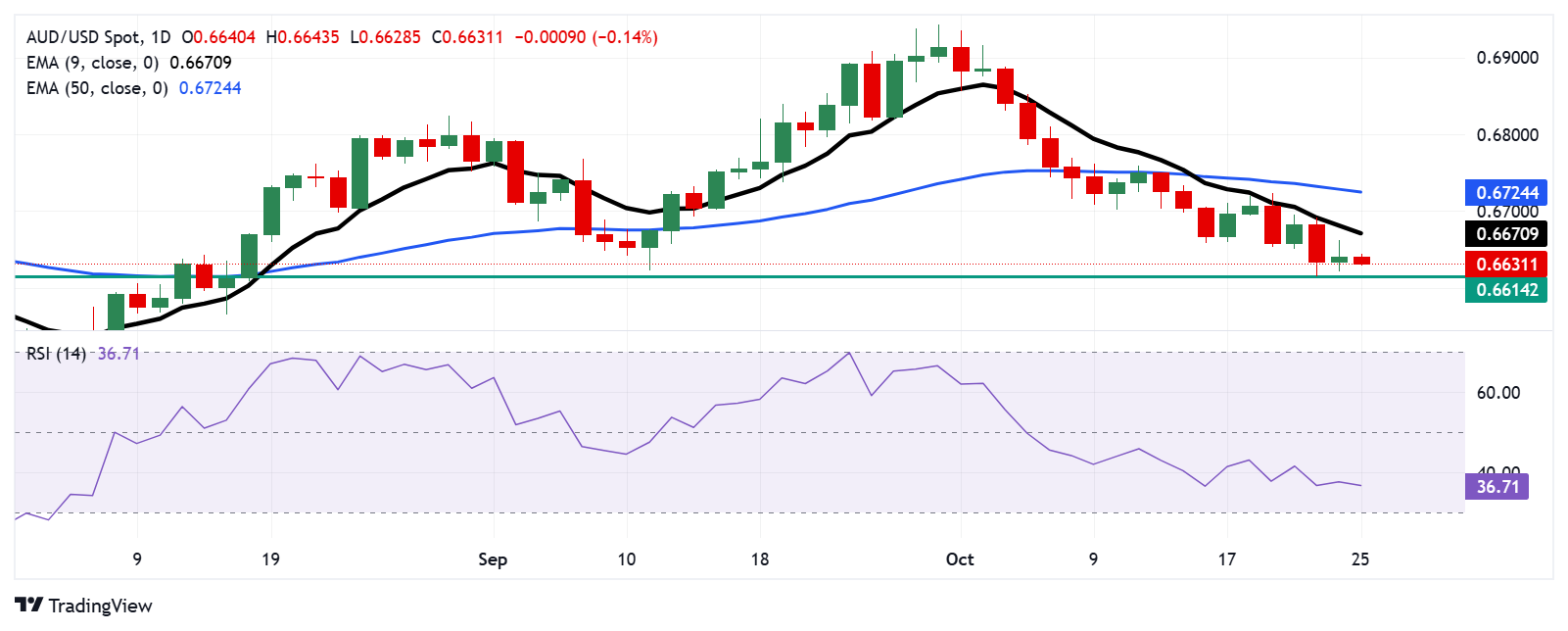
The AUD/USD pair trades around 0.6640 on Thursday, with technical analysis of the daily chart indicating a short-term bearish trend. The pair remains below the nine-day Exponential Moving Average (EMA), and the 14-day Relative Strength Index (RSI) is below 50, further confirming bearish bias.
On the support side, the AUD/USD pair is testing its two-month low of 0.6614, reached on Wednesday. The next major support level lies at the psychological threshold of 0.6600.
Regarding the upside, resistance is anticipated at the nine-day EMA at 0.6672, followed by the 50-day EMA at 0.6724. A break above these resistance levels could pave the way for a potential move toward the psychological barrier of 0.6800.
AUD/USD: Daily Chart
Australian Dollar PRICE Today
The table below shows the percentage change of Australian Dollar (AUD) against listed major currencies today. Australian Dollar was the weakest against the Japanese Yen.
| USD | EUR | GBP | JPY | CAD | AUD | NZD | CHF | |
|---|---|---|---|---|---|---|---|---|
| USD | 0.06% | 0.06% | -0.09% | -0.03% | 0.22% | 0.28% | 0.01% | |
| EUR | -0.06% | 0.01% | -0.13% | -0.09% | 0.16% | 0.23% | -0.05% | |
| GBP | -0.06% | -0.01% | -0.14% | -0.11% | 0.14% | 0.22% | -0.10% | |
| JPY | 0.09% | 0.13% | 0.14% | 0.04% | 0.30% | 0.36% | 0.07% | |
| CAD | 0.03% | 0.09% | 0.11% | -0.04% | 0.25% | 0.31% | -0.00% | |
| AUD | -0.22% | -0.16% | -0.14% | -0.30% | -0.25% | 0.07% | -0.25% | |
| NZD | -0.28% | -0.23% | -0.22% | -0.36% | -0.31% | -0.07% | -0.32% | |
| CHF | -0.01% | 0.05% | 0.10% | -0.07% | 0.00% | 0.25% | 0.32% |
The heat map shows percentage changes of major currencies against each other. The base currency is picked from the left column, while the quote currency is picked from the top row. For example, if you pick the Australian Dollar from the left column and move along the horizontal line to the US Dollar, the percentage change displayed in the box will represent AUD (base)/USD (quote).
Economic Indicator
Michigan Consumer Sentiment Index
The Michigan Consumer Sentiment Index, released on a monthly basis by the University of Michigan, is a survey gauging sentiment among consumers in the United States. The questions cover three broad areas: personal finances, business conditions and buying conditions. The data shows a picture of whether or not consumers are willing to spend money, a key factor as consumer spending is a major driver of the US economy. The University of Michigan survey has proven to be an accurate indicator of the future course of the US economy. The survey publishes a preliminary, mid-month reading and a final print at the end of the month. Generally, a high reading is bullish for the US Dollar (USD), while a low reading is bearish.
Read more.Next release: Fri Oct 25, 2024 14:00
Frequency: Monthly
Consensus: 69
Previous: 68.9
Source: University of Michigan
Consumer exuberance can translate into greater spending and faster economic growth, implying a stronger labor market and a potential pick-up in inflation, helping turn the Fed hawkish. This survey’s popularity among analysts (mentioned more frequently than CB Consumer Confidence) is justified because the data here includes interviews conducted up to a day or two before the official release, making it a timely measure of consumer mood, but foremost because it gauges consumer attitudes on financial and income situations. Actual figures beating consensus tend to be USD bullish.
Author

Akhtar Faruqui
FXStreet
Akhtar Faruqui is a Forex Analyst based in New Delhi, India. With a keen eye for market trends and a passion for dissecting complex financial dynamics, he is dedicated to delivering accurate and insightful Forex news and analysis.

















