Australian Dollar depreciates due to ongoing uncertainty ahead of US presidential election
- The Australian Dollar falls as the US Dollar remains solid ahead of the US presidential election.
- The Aussie Dollar may limit its downside as an RBA rate cut is unlikely in the near term.
- The US Dollar appreciates as recent positive US data supports the sentiment of nominal rate cuts by the Fed.

The Australian Dollar (AUD) extends its decline against the US Dollar (USD) for the third consecutive session on Tuesday. Traders are now focused on Australia’s third-quarter Consumer Price Index (CPI) data, due for release on Wednesday, as they seek further insights into the Reserve Bank of Australia’s (RBA) potential monetary policy direction.
The AUD's downside may be limited by the Reserve Bank of Australia's hawkish stance on its policy outlook. The RBA has indicated that the current cash rate of 4.35% is restrictive enough to steer inflation back within the target range of 2%-3% while still supporting employment. Consequently, a rate cut is unlikely in the near term, especially as early as next month.
The US Dollar (USD) gains strength as positive US economic data from last week indicates continued resilience in the economy. This supports the sentiment of nominal interest rate cuts by the Federal Reserve (Fed) in November.
Traders await the release of the preliminary US Q3 Gross Domestic Product (GDP) figures and October’s Nonfarm Payrolls (NFP) report, which could provide key insights into the timing and pace of the Federal Reserve’s (Fed) anticipated rate cuts.
Daily Digest Market Movers: Australian Dollar depreciates as US Dollar gains ground
- According to the CME FedWatch Tool, there is a 95.8% probability of a 25-basis-point rate cut by the Fed in November, with no expectation of a more substantial 50-basis-point cut.
- ANZ-Roy Morgan Australia Consumer Confidence dropped to 86.4 this week, down from 87.5 the previous week.
- Australia's 10-year government bond yield hovers near 4.5%, mirroring a rise in US bond yields. This increase is driven by market sentiment increasingly favoring Former President Donald Trump in the upcoming US presidential election and expectations that the Fed may adopt a more cautious stance on future rate cuts.
- According to polling site FiveThirtyEight, Trump's possibility of winning the US election has increased to 52% compared to 48% for Vice President Kamala Harris.
- Over the past three weeks, allies of former President Donald Trump have faced at least 10 court defeats in key battleground states that could impact the outcome of the November 5 election between Republican candidate Trump and his Democratic opponent, Vice President Kamala Harris.
- Recent comments from Iran’s Foreign Ministry spokesperson, Esmaeil Baghaei, about potentially using "all available tools" to respond to Israel’s recent attacks on military targets in Iran, signal a risk of further escalation. Such statements increase global uncertainty, fueling investor demand for safe-haven assets like the USD as they brace for potential conflict.
- Last week, Federal Reserve Bank of San Francisco President Mary Daly stated in a post on the social media platform X that the economy is clearly in a better position, with inflation having fallen significantly and the labor market returning to a more sustainable path.
- RBA Deputy Governor Andrew Hauser highlighted the country's strong labor participation rate last week and stressed that although the RBA relies on data, it is not overly fixated on it.
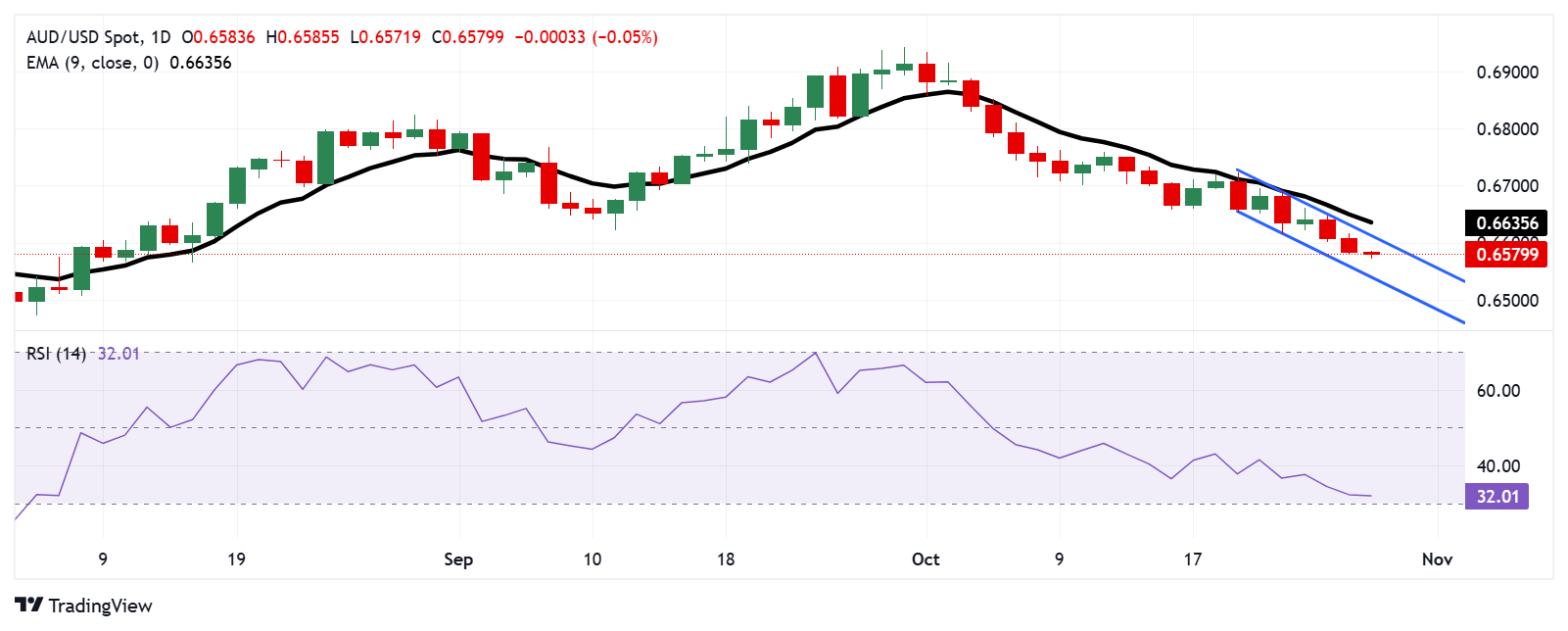
Technical Analysis: Australian Dollar falls toward 0.6550, lower boundary of the descending channel
AUD/USD trades near 0.6570 on Tuesday. The daily chart analysis points to a short-term bearish bias as the pair continues to move lower within a descending channel. The 14-day Relative Strength Index (RSI) is nearing 30, reinforcing the bearish bias.
On the support side, the pair could test the lower boundary of the descending channel around the 0.6540 level.
For resistance, the first hurdle lies at the psychological level of 0.6600, followed by the descending channel's upper boundary at 0.6610. A breakout above this point could open the door for a move toward the nine-day Exponential Moving Average (EMA) at 0.6634.
AUD/USD: Daily Chart
Australian Dollar PRICE Today
The table below shows the percentage change of Australian Dollar (AUD) against listed major currencies today. Australian Dollar was the weakest against the Japanese Yen.
| USD | EUR | GBP | JPY | CAD | AUD | NZD | CHF | |
|---|---|---|---|---|---|---|---|---|
| USD | 0.03% | 0.09% | -0.21% | 0.07% | 0.30% | 0.16% | -0.05% | |
| EUR | -0.03% | 0.06% | -0.25% | 0.04% | 0.26% | 0.13% | -0.04% | |
| GBP | -0.09% | -0.06% | -0.30% | -0.02% | 0.21% | 0.06% | -0.10% | |
| JPY | 0.21% | 0.25% | 0.30% | 0.28% | 0.52% | 0.36% | 0.20% | |
| CAD | -0.07% | -0.04% | 0.02% | -0.28% | 0.23% | 0.09% | -0.10% | |
| AUD | -0.30% | -0.26% | -0.21% | -0.52% | -0.23% | -0.14% | -0.33% | |
| NZD | -0.16% | -0.13% | -0.06% | -0.36% | -0.09% | 0.14% | -0.19% | |
| CHF | 0.05% | 0.04% | 0.10% | -0.20% | 0.10% | 0.33% | 0.19% |
The heat map shows percentage changes of major currencies against each other. The base currency is picked from the left column, while the quote currency is picked from the top row. For example, if you pick the Australian Dollar from the left column and move along the horizontal line to the US Dollar, the percentage change displayed in the box will represent AUD (base)/USD (quote).
Interest rates FAQs
Interest rates are charged by financial institutions on loans to borrowers and are paid as interest to savers and depositors. They are influenced by base lending rates, which are set by central banks in response to changes in the economy. Central banks normally have a mandate to ensure price stability, which in most cases means targeting a core inflation rate of around 2%. If inflation falls below target the central bank may cut base lending rates, with a view to stimulating lending and boosting the economy. If inflation rises substantially above 2% it normally results in the central bank raising base lending rates in an attempt to lower inflation.
Higher interest rates generally help strengthen a country’s currency as they make it a more attractive place for global investors to park their money.
Higher interest rates overall weigh on the price of Gold because they increase the opportunity cost of holding Gold instead of investing in an interest-bearing asset or placing cash in the bank. If interest rates are high that usually pushes up the price of the US Dollar (USD), and since Gold is priced in Dollars, this has the effect of lowering the price of Gold.
The Fed funds rate is the overnight rate at which US banks lend to each other. It is the oft-quoted headline rate set by the Federal Reserve at its FOMC meetings. It is set as a range, for example 4.75%-5.00%, though the upper limit (in that case 5.00%) is the quoted figure. Market expectations for future Fed funds rate are tracked by the CME FedWatch tool, which shapes how many financial markets behave in anticipation of future Federal Reserve monetary policy decisions.
Author

Akhtar Faruqui
FXStreet
Akhtar Faruqui is a Forex Analyst based in New Delhi, India. With a keen eye for market trends and a passion for dissecting complex financial dynamics, he is dedicated to delivering accurate and insightful Forex news and analysis.