Australian Dollar remains steady as US Dollar edges lower, weekly Jobless Claims awaited
- The Australian Dollar rises as the RBA intends to maintain a restrictive monetary policy.
- The RBA Meeting Minutes indicated that the board remains vigilant about the potential for further inflation.
- A Reuters poll indicated that nearly 90% of economists anticipate a 25bps cut in December.

The Australian Dollar (AUD) retraces its recent losses on Thursday, buoyed by a hawkish outlook from the Reserve Bank of Australia (RBA) concerning interest rates. Despite this, the AUD/USD pair could still face downward pressure as the US Dollar (USD) might strengthen due to safe-haven flows amid the escalating Russia-Ukraine conflict.
The Reserve Bank of Australia's November Meeting Minutes indicated that the central bank’s board remains vigilant about the potential for further inflation, stressing the importance of maintaining a restrictive monetary policy. Although board members noted no "immediate need" to alter the cash rate, they kept options open for future adjustments, emphasizing that all possibilities remain on the table.
The downside risk for the US Dollar may be constrained due to the cautious remarks from Federal Reserve (Fed) officials. Additionally, market expectations suggest that the incoming Donald Trump administration will spur inflation, thereby slowing the rate cut trajectory from the Fed, lending support to the Greenback.
Traders will be closely monitoring the US weekly Initial Jobless Claims, the Philadelphia Fed Manufacturing Index, and Existing Home Sales, all of which are scheduled for release later on Thursday.
Daily Digest Market Movers: Australian Dollar recovers recent losses amid hawkish RBA
- A Reuters poll indicated that nearly 90% of economists (94 out of 106) anticipate a 25bps cut in December, lowering the fed funds rate to 4.25%-4.50%. Economists predict shallower rate cuts in 2025 due to the risk of higher inflation from President-elect Trump's policies. The fed funds rate is forecasted to be 3.50%-3.75% by the end of 2025, which is 50bps higher than last month’s projection.
- Federal Reserve Bank of Boston President Susan Collins stated on Wednesday that while more interest rate cuts are necessary, policymakers should proceed cautiously to avoid moving too quickly or too slowly, according to Bloomberg.
- On Wednesday, Fed Governor Michelle Bowman highlighted that inflation remains elevated over the past few months and stressed the need for the Fed to proceed cautiously with rate cuts.
- Australian Treasurer Jim Chalmers stated that "tumbling iron ore prices and a softening labor market have impacted government revenue," following his Ministerial Statement on the economy on Wednesday. Chalmers outlined Australia's tough fiscal outlook, citing the weakening of China, a key trading partner, and the slowdown in the job market as contributing factors.
- Kansas City Fed President Jeffrey Schmid stated on Tuesday that he expects both inflation and employment to move closer to the Fed's targets. Schmid explained that rate cuts signal the Fed's confidence in inflation trending toward its 2% goal. He also noted that while large fiscal deficits won't necessarily drive inflation, the Fed may need to counteract potential pressures with higher interest rates.
- According to a Reuters report late Tuesday, Ukraine deployed US-supplied ATACMS missiles to strike Russian territory for the first time, signaling a significant escalation on the 1,000th day of the conflict. However, market concerns eased slightly after Russian Foreign Minister Sergei Lavrov stated that the government would "do everything possible" to prevent the outbreak of nuclear war.
- On Tuesday, an official from China’s National Development and Reform Commission (NDRC) stated that the country has "ample policy room and tools to support economic recovery." The official expressed confidence in China's economic trajectory, anticipating the recovery momentum will persist through November and December. Any change in the Chinese economy could impact the Australian markets as both nations are closely linked trade partners.
- Fed Chair Jerome Powell downplayed the likelihood of imminent rate cuts, highlighting the economy's resilience, robust labor market, and persistent inflationary pressures. Powell remarked, "The economy is not sending any signals that we need to hurry to lower rates."
- Chicago Fed President Austan Goolsbee stated on Friday that markets often overreact to changes in interest rates. Goolsbee emphasized the importance of the Fed adopting a cautious, gradual approach in moving toward the neutral rate.
- Boston Fed President Susan Collins tempered expectations for continued rate cuts in the near term while maintaining market confidence in a potential rate reduction in December. Collins stated, "I don't see a big urgency to lower rates, but I want to preserve a healthy economy."
Technical Analysis: Australian Dollar remains above 0.6500 near nine-day EMA
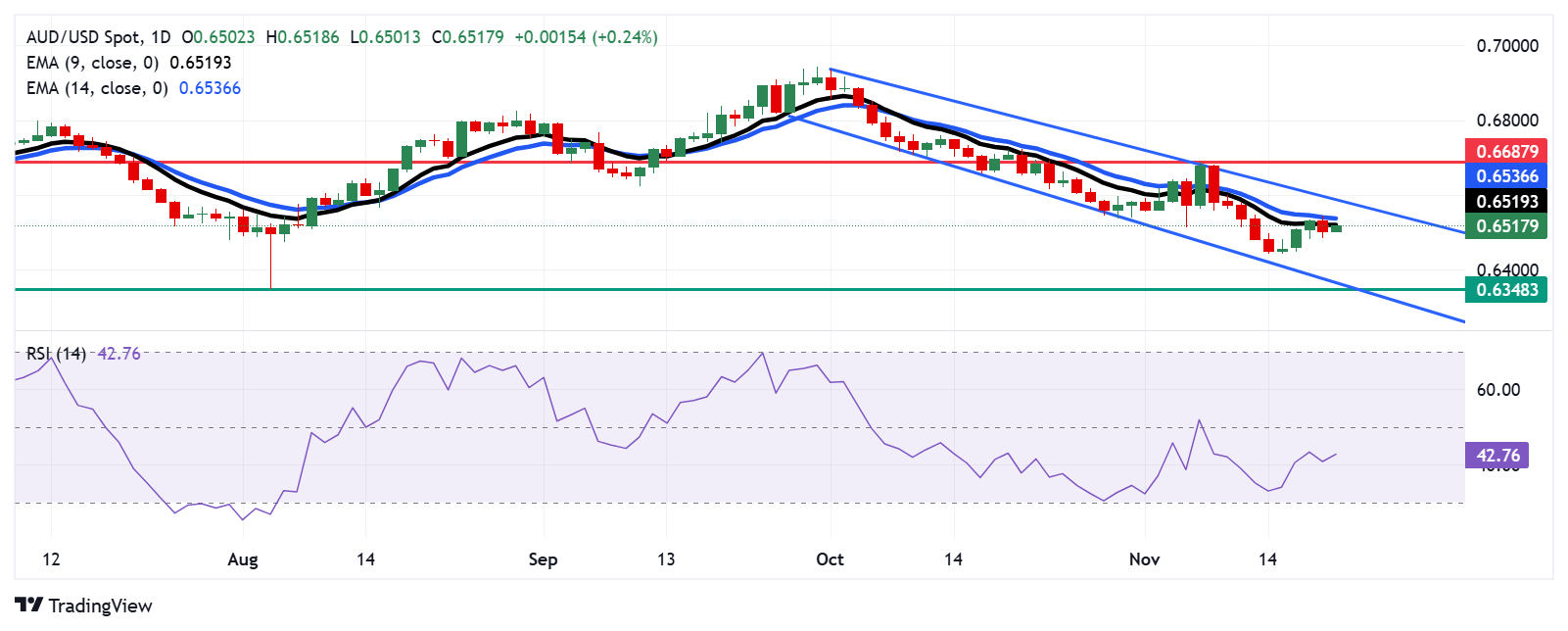
The AUD/USD pair trades near 0.6510 on Thursday. Technical analysis of the daily chart indicates a continued decline within a descending channel pattern, signaling a bearish outlook. The 14-day Relative Strength Index (RSI) is below 50, further supporting the prevailing bearish sentiment.
For support, the AUD/USD pair may approach the lower boundary of the descending channel at 0.6370, followed by its yearly low of 0.6348, recorded on August 5.
On the upside, the AUD/USD pair tests the nine-day EMA at 0.6519, followed by the 14-day EMA at 0.6536. Surpassing these levels could weaken the bearish bias and set the stage for a rally toward the four-week high of 0.6687.
AUD/USD: Daily Chart
Australian Dollar PRICE Today
The table below shows the percentage change of Australian Dollar (AUD) against listed major currencies today. Australian Dollar was the strongest against the US Dollar.
| USD | EUR | GBP | JPY | CAD | AUD | NZD | CHF | |
|---|---|---|---|---|---|---|---|---|
| USD | -0.12% | -0.06% | -0.29% | -0.10% | -0.21% | -0.08% | -0.21% | |
| EUR | 0.12% | 0.05% | -0.16% | 0.00% | -0.09% | 0.04% | -0.10% | |
| GBP | 0.06% | -0.05% | -0.18% | -0.05% | -0.16% | -0.02% | -0.15% | |
| JPY | 0.29% | 0.16% | 0.18% | 0.16% | 0.07% | 0.17% | 0.07% | |
| CAD | 0.10% | -0.01% | 0.05% | -0.16% | -0.10% | 0.03% | -0.10% | |
| AUD | 0.21% | 0.09% | 0.16% | -0.07% | 0.10% | 0.13% | 0.00% | |
| NZD | 0.08% | -0.04% | 0.02% | -0.17% | -0.03% | -0.13% | -0.13% | |
| CHF | 0.21% | 0.10% | 0.15% | -0.07% | 0.10% | -0.00% | 0.13% |
The heat map shows percentage changes of major currencies against each other. The base currency is picked from the left column, while the quote currency is picked from the top row. For example, if you pick the Australian Dollar from the left column and move along the horizontal line to the US Dollar, the percentage change displayed in the box will represent AUD (base)/USD (quote).
Economic Indicator
Initial Jobless Claims
The Initial Jobless Claims released by the US Department of Labor is a measure of the number of people filing first-time claims for state unemployment insurance. A larger-than-expected number indicates weakness in the US labor market, reflects negatively on the US economy, and is negative for the US Dollar (USD). On the other hand, a decreasing number should be taken as bullish for the USD.
Read more.Next release: Thu Nov 21, 2024 13:30
Frequency: Weekly
Consensus: 220K
Previous: 217K
Source: US Department of Labor
Every Thursday, the US Department of Labor publishes the number of previous week’s initial claims for unemployment benefits in the US. Since this reading could be highly volatile, investors may pay closer attention to the four-week average. A downtrend is seen as a sign of an improving labour market and could have a positive impact on the USD’s performance against its rivals and vice versa.
Author

Akhtar Faruqui
FXStreet
Akhtar Faruqui is a Forex Analyst based in New Delhi, India. With a keen eye for market trends and a passion for dissecting complex financial dynamics, he is dedicated to delivering accurate and insightful Forex news and analysis.















