Australia’s Unemployment Rate steadies at 4.2% in August vs. 4.2% expected

Australia’s Unemployment Rate steadied at 4.2% in August, according to the official data released by the Australian Bureau of Statistics (ABS) on Thursday. The figure came in line with the market consensus of 4.2%.
Furthermore, the Australian Employment Change arrived at -5.4K in August from 26.5K in July (revised from 24.5K), compared with the consensus forecast of 22K.
The participation rate in Australia decreased to 66.8% in August, compared to 67% in July. Meanwhile, Full-Time Employment declined by 40.9K in the same period from an increase of 63.6K in the previous reading (revised from 60.5K). The Part-Time Employment increased by 35.5K in August versus a decrease of 37.1K prior (revised from 35.9K).
Sean Crick, ABS head of labour statistics, said with the key highlights noted below
The employment-to-population ratio fell by 0.1 percentage points to 64.0 per cent.
Females who were employed full-time went down 30,000 people, and males in full-time employment was down by 11,000.
There was a rise in part-time employment for both females and males, up 18,000 and 17,000 respectively.
Market reaction to the Australia’s employment data
The Australian Dollar (AUD) attracts some sellers following the employment data. At the time of writing, the AUD/USD pair is trading 0.23% lower on the day to trade at 0.6636.
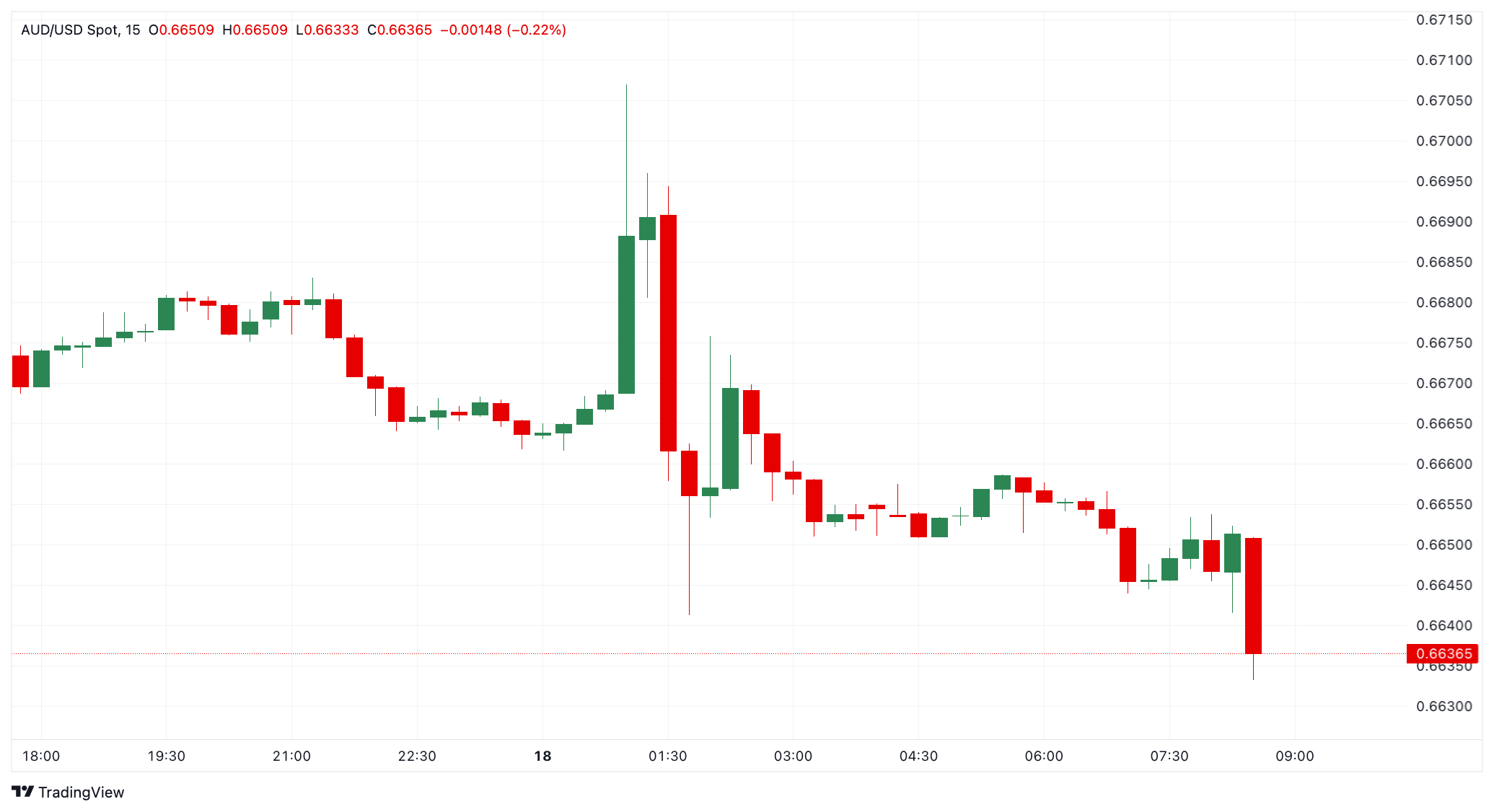
AUD/USD 15-min chart
Australian Dollar Price This week
The table below shows the percentage change of Australian Dollar (AUD) against listed major currencies this week. Australian Dollar was the weakest against the Swiss Franc.
| USD | EUR | GBP | JPY | CAD | AUD | NZD | CHF | |
|---|---|---|---|---|---|---|---|---|
| USD | -0.66% | -0.43% | -0.38% | -0.38% | 0.10% | 0.60% | -0.89% | |
| EUR | 0.66% | 0.25% | 0.21% | 0.27% | 0.80% | 1.23% | -0.24% | |
| GBP | 0.43% | -0.25% | 0.04% | 0.02% | 0.55% | 0.97% | -0.60% | |
| JPY | 0.38% | -0.21% | -0.04% | -0.05% | 0.53% | 0.98% | -0.50% | |
| CAD | 0.38% | -0.27% | -0.02% | 0.05% | 0.61% | 0.95% | -0.62% | |
| AUD | -0.10% | -0.80% | -0.55% | -0.53% | -0.61% | 0.42% | -1.07% | |
| NZD | -0.60% | -1.23% | -0.97% | -0.98% | -0.95% | -0.42% | -1.56% | |
| CHF | 0.89% | 0.24% | 0.60% | 0.50% | 0.62% | 1.07% | 1.56% |
The heat map shows percentage changes of major currencies against each other. The base currency is picked from the left column, while the quote currency is picked from the top row. For example, if you pick the Australian Dollar from the left column and move along the horizontal line to the US Dollar, the percentage change displayed in the box will represent AUD (base)/USD (quote).
This section below was published at 21:30 GMT on Thursday as a preview of the Australia Employment report
- The Australian Unemployment Rate is forecast to remain unchanged at 4.2% in August.
- Australia is expected to have added 22,000 new positions in the month, following the 24,500 added in July.
- AUD/USD aims to extend gains beyond the 0.6700 mark ahead of the announcement.
Australia will release its August monthly employment report on Thursday at 1:30 GMT, and market participants anticipate yet another month of moderate growth in the labor market.
The Australian Bureau of Statistics (ABS) is expected to announce that the country added 22,000 new job positions in the month, while the Unemployment Rate is forecast to remain stable at 4.2%. The Participation Rate is also expected to remain unchanged at 67%.
Australian ABS reports both full-time and part-time positions through the monthly Employment Change. Generally speaking, full-time jobs imply working 38 hours per week or more, usually include additional benefits and they mostly represent consistent income. On the other hand, part-time employment generally means higher hourly rates but lacks consistency and benefits. That’s why the economy prefers full-time jobs.
Australian unemployment rate expected to remain unchanged in August
Employment figures are crucial in terms of monetary policy, as most central banks base their decisions on labor conditions and inflation levels. The Reserve Bank of Australia (RBA) is no exception. Policymakers met early in August, and the Board decided to lower the Official Cash Rate (OCR) by 25 basis points (bps) to 3.6% from 3.85%, explaining that, on the one hand, inflation has continued to moderate, while on the other hand, “labor market conditions have eased further in recent months.”
Indeed, recent employment-related data has been on the disappointing end, as data from the last few months have been quite soft. The economy lost 1,100 positions in May, added 1,000 in June, and gained an additional 24,500 in July, far below the 87,600 reported in April.
A loosening labour market is generally understood as negative for the economy, but it also means the central bank has no reason to keep interest rates at high levels. Most central banks have claimed that the strength of the sector has somehow limited their ability to further lower interest rates, and Australia is no exception.
Following the RBA’s announcement, the central bank released the Minutes of such a meeting, which showed the Board judged some “further reduction in the cash rate likely needed over the coming year,” while adding that incoming data would determine the pace of rate cuts. Policymakers also noted that the labor market remained a little tight, inflation was still above the midpoint, and domestic demand was recovering.
Other than that, it is worth remembering that Australia's wage inflation is reported separately from the monthly employment data every quarter. According to the latest data available, the wage price index grew 3.4% on a yearly basis in the second quarter of 2025, the same rate of increase as seen in the three months to March, and slightly above the 3.3% anticipated. However, on a quarterly basis, the wage price index rose 0.8% in Q2, easing from the previous 0.9% and matching expectations.
With that in mind, the upcoming employment report will be read on how it could impact the upcoming RBA’s decisions. Stronger-than-anticipated job creation could boost demand for the Australian Dollar (AUD) as it would not only be positive for the economy, but also delay future interest rate cuts.
A weak employment report, on the other hand, should weigh the Aussie lower and leave the door open for additional cuts in the foreseeable future.
When will the Australian employment report be released and how could it affect AUD/USD?
The ABS August report will be released early on Thursday. As previously noted, the Australian economy is expected to have added 22,000 new job positions in the month, while the Unemployment Rate is foreseen at 4.2% and the Participation Rate at 67%.
In addition, the Federal Reserve (Fed) announced its decision on monetary policy following a two-day meeting. The central bank cut the benchmark interest rate by 25 basis points (bps), as expected. At the same time, the Summary of Economic Projections (SEP) anticipates two additional interest rate cuts this year, in line with the market’s expectations, while confirming investors’ speculation of three rate cuts before the year's end. As a result, the US Dollar came under renewed selling pressure, helping AUD/USD extend its yearly advance.
Valeria Bednarik, Chief Analyst at FXStreet, notes: “The AUD/USD pair hit a fresh 2025 high of 0.6707 ahead of the release of employment data, but changed course afterwards. The near-term picture is bearish, with the 4-hour chart showing the pair piercing a bullish 20 Simple Moving Average (SMA) currently in the 0.6660 price zone. A firm recovery above the level should see the pair retesting the aforementioned yearly high ahead of the 0.6730 price zone."
Bednarik adds: “The AUD/USD pair could ease further once below the initial support in the 0.6630 area, with 0.6590 coming up next.”
Australian Dollar FAQs
One of the most significant factors for the Australian Dollar (AUD) is the level of interest rates set by the Reserve Bank of Australia (RBA). Because Australia is a resource-rich country another key driver is the price of its biggest export, Iron Ore. The health of the Chinese economy, its largest trading partner, is a factor, as well as inflation in Australia, its growth rate and Trade Balance. Market sentiment – whether investors are taking on more risky assets (risk-on) or seeking safe-havens (risk-off) – is also a factor, with risk-on positive for AUD.
The Reserve Bank of Australia (RBA) influences the Australian Dollar (AUD) by setting the level of interest rates that Australian banks can lend to each other. This influences the level of interest rates in the economy as a whole. The main goal of the RBA is to maintain a stable inflation rate of 2-3% by adjusting interest rates up or down. Relatively high interest rates compared to other major central banks support the AUD, and the opposite for relatively low. The RBA can also use quantitative easing and tightening to influence credit conditions, with the former AUD-negative and the latter AUD-positive.
China is Australia’s largest trading partner so the health of the Chinese economy is a major influence on the value of the Australian Dollar (AUD). When the Chinese economy is doing well it purchases more raw materials, goods and services from Australia, lifting demand for the AUD, and pushing up its value. The opposite is the case when the Chinese economy is not growing as fast as expected. Positive or negative surprises in Chinese growth data, therefore, often have a direct impact on the Australian Dollar and its pairs.
Iron Ore is Australia’s largest export, accounting for $118 billion a year according to data from 2021, with China as its primary destination. The price of Iron Ore, therefore, can be a driver of the Australian Dollar. Generally, if the price of Iron Ore rises, AUD also goes up, as aggregate demand for the currency increases. The opposite is the case if the price of Iron Ore falls. Higher Iron Ore prices also tend to result in a greater likelihood of a positive Trade Balance for Australia, which is also positive of the AUD.
The Trade Balance, which is the difference between what a country earns from its exports versus what it pays for its imports, is another factor that can influence the value of the Australian Dollar. If Australia produces highly sought after exports, then its currency will gain in value purely from the surplus demand created from foreign buyers seeking to purchase its exports versus what it spends to purchase imports. Therefore, a positive net Trade Balance strengthens the AUD, with the opposite effect if the Trade Balance is negative.
Economic Indicator
Unemployment Rate s.a.
The Unemployment Rate, released by the Australian Bureau of Statistics, is the number of unemployed workers divided by the total civilian labor force, expressed as a percentage. If the rate increases, it indicates a lack of expansion within the Australian labor market and a weakness within the Australian economy. A decrease in the figure is seen as bullish for the Australian Dollar (AUD), while an increase is seen as bearish.
Read more.Next release: Thu Sep 18, 2025 01:30
Frequency: Monthly
Consensus: 4.2%
Previous: 4.2%
Source: Australian Bureau of Statistics
The Australian Bureau of Statistics (ABS) publishes an overview of trends in the Australian labour market, with unemployment rate a closely watched indicator. It is released about 15 days after the month end and throws light on the overall economic conditions, as it is highly correlated to consumer spending and inflation. Despite the lagging nature of the indicator, it affects the Reserve Bank of Australia’s (RBA) interest rate decisions, in turn, moving the Australian dollar. Upbeat figure tends to be AUD positive.
Author

FXStreet Team
FXStreet
Composed of a group of economic journalists and FX experts, the FXStreet content team produces and oversees all content published on FXStreet. It provides a purely journalistic approach to the Forex market.

















