AUDUSD: The Aussie Dollar hovers around 0.6400 ahead of the RBA and the Fed decisions
- The AUD is at the mercy of central bank decisions by the Reserve Bank of Australia (RBA) and the Federal Reserve (Fed).
- The AUDUSD tumbled on Monday as China’s PMI entered the recessionary territory, spurring a risk-off impulse.
- The USD was bolstered by Fed rate hike expectations and high US bond yields.

The AUDUSD is almost flat as the Asian session begins, following Monday’s trading session, with AUD losing ground against the USD due to a risk-off impulse. Hence, the safe-haven status of the US Dollar keeps the greenback underpinned. Factors like weaker-than-expected China data and Hong Kong Iron Ore prices tumbling below $80.00 were headwinds for the Aussie Dollar. At the time of writing, the AUDUSD is trading at 0.6396.
Broad US Dollar strength underpinned by Fed’s rate hike expectations weighed on the Aussie Dollar
Wall Street finished the session with hefty losses. A light US economic calendar keeps investors focused on the Federal Reserve’s November meeting as investors brace for a 75 bps rate hike based on the last week’s US data. Given that the Federal Reserve preferred gauge for inflation’s core Personal Consumption Expenditures (PCE) jumped by 5.1% YoY, below expectations but above August’s 4.9%, while the Employment Cost Index (ECI) for Q3 was 1.2% QoQ, lower than Q2 1.4%, is almost sure that Jerome Powell and Co., will continue to tighten monetary conditions. That said, US Treasury bond yields are higher, with most yields along the curve breaching the 4% threshold. Hence, the AUDUSD is on the brink of extending its losses if not by the Reserve Bank of Australia’s (RBA) monetary policy decision one day before the Fed.
US data wise, PMI figures released by the Regional Federal Reserve banks, like Chicago and Dallas, revealed Manufacturing Indices were ignored by AUDUSD traders. The Chicago Manufacturing Index missed expectations at 45.2, less than the previous reading. Later, the Dallas Manufacturing Index plunged to -19.2, lower than estimates, showing business conditions deteriorating for the sixth consecutive month.
AUDUSD buyers ignored Australia Retail Sales
Aside from the US, Australia revealed its Retail Sales for November, which rose by 0.6% MoM in September, aligned with estimates, and above the previous month’s reading. Even though the data was positive for the AUD, investors focused on the Fed and the RBA. Later, the Reserve Bank of Australia (RBA) is expected to hike a quarter percent (0.25%) of the Cash Rate, aligned with October’s monetary decision. The RBA’s decision to raise rates by 25 bps slowed the rate hikes and triggered a sell-off in the AUDUSD, which dived from around 0.6550, toward the YTD low at 0.6169, in just five days.
Factory activity in China weakens, weighing on the AUD
Elsewhere, China’s October official PMIs, stood at 48.7 from 50.6 reported in September, falling to contractionary territory, and weighing in commodity prices, particularly Iron Ore, which tumbled below $80 for the first time since 2019. Given the backdrop, investors’ moods shifted as they sold risk-perceived assets. In the Foreign Exchange (FX) market means selling the Aussie Dollar and buying US Dollars.
Ahead in the calendar, the Australian economic docket will feature the Reserve Bank of Australia (RBA) monetary policy decision at 02:30 GMT. Most commercial banks estimate a 25 bps rate increase, leaving the Cash Rate at 2.85%. If the RBA goes above estimates, it would be positive for the AUD; which could rally towards the 0.6500 figure; otherwise, it could be a less meaningful event, with the Federal Reserve decision looming.
On the US front, the US economic calendar will feature the S&P Global Manufacturing PMI for October, alongside the awaited ISM Manufacturing PMI and the JOLTs Job Openings.
AUD/USD Price Analysis: Technical outlook
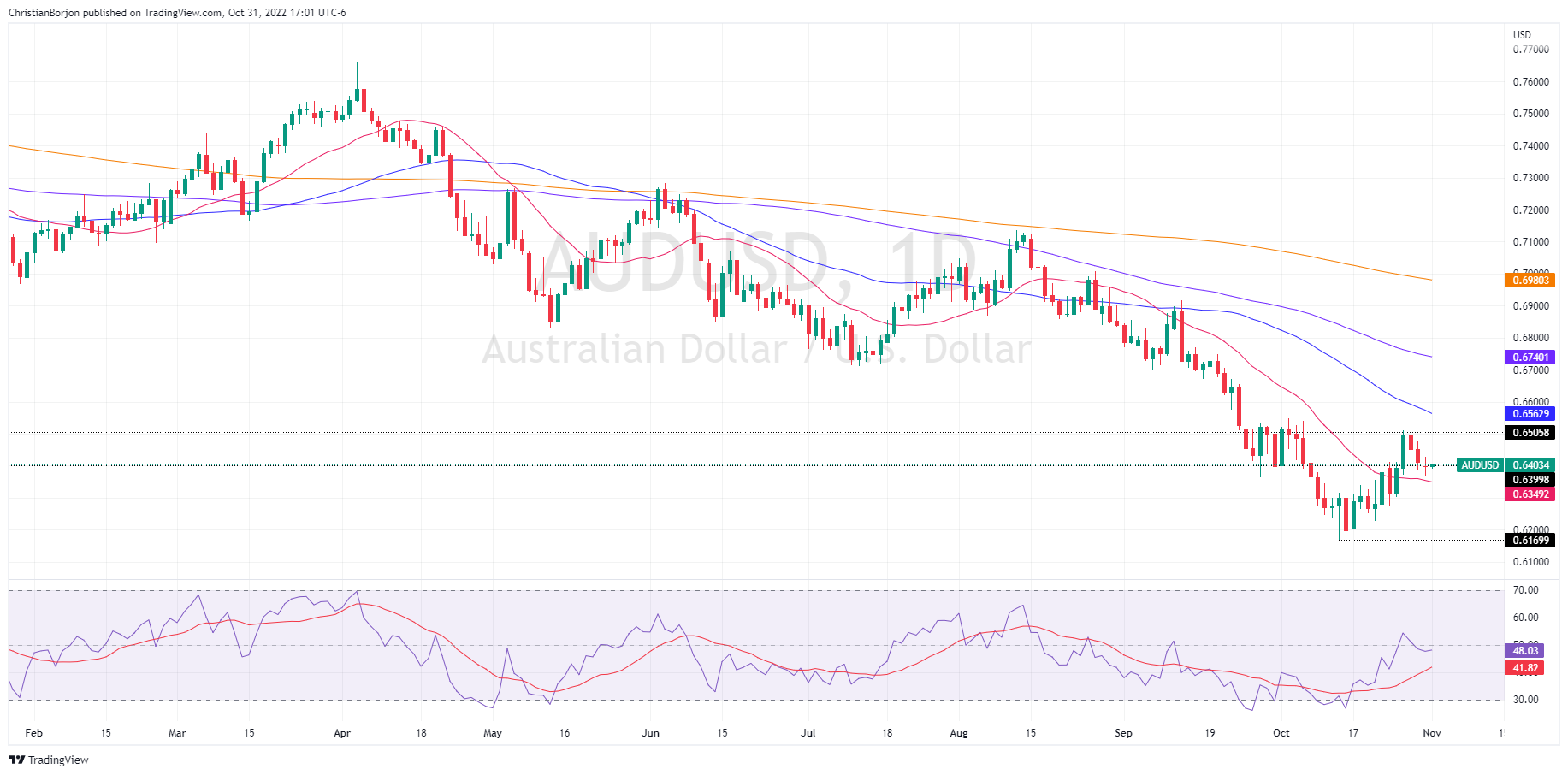
The AUDUSD downward biased is intact, with most daily Exponential Moving Averages (EMAs) remaining above the exchange rate, except for the 20-day EMA at 0.6349. The Relative Strength Index is at 48.31, at bearish territory, though almost flat, meaning that choppy trading conditions remain. If the RBA surprises the market, the Aussie Dollar, could rally towards the October 31 daily high at 0.6428, followed by the October 28 high at 0.6479. On the flip side, a fall towards the 20-day EMA at 0.6349, followed by the 0.6300 figure.
Author

Christian Borjon Valencia
FXStreet
Markets analyst, news editor, and trading instructor with over 14 years of experience across FX, commodities, US equity indices, and global macro markets.