AUD/USD slips as NFP beats and Trump cheers tax bill's final passage
- AUD/USD edges lower as markets weigh NFP and Trump’s tax victory.
- AUD/USD holds wedge support as bulls struggle to gain traction above 0.6590.
- Strong US employment data offers some support to the USD, but rising deficit and Fed uncertainty limit gains.

The Australian Dollar (AUD) is edging lower against the US Dollar (USD) on Thursday. Markets are reacting to the latest US Nonfarm Payrolls (NFP) report.
Sentiment is also being shaped by the passage of President Trump’s sweeping tax bill.
At the time of writing, AUD/USD is trading near 0.6570, reflecting cautious sentiment amid mixed macro drivers.
Trump’s bill passes the House of Representatives
News that the US House of Representatives has officially passed President Donald Trump’s “one, big, beautiful” tax bill ahead of the July 4 deadline could serve as an additional catalyst for AUD/USD.
The approval marks the first major legislative win of Trump’s second term and revives the fiscal policy thrust that defined his previous administration.
The legislation, also referred to as the “GOP Megabill,” aims to continue key components of the 2017 Tax Cuts & Jobs Act.
It also introduces deeper tax reductions aimed at fueling economic growth. Trump celebrated the passage on Truth Social, calling it a “historic victory for American workers, families, and businesses.”
While the bill delivers on Trump's promise of aggressive tax relief, early projections estimate it could add $3.3 trillion to the federal deficit over the next decade.
The size of the fiscal expansion, especially amid elevated interest rates and debt servicing costs, has reignited concerns about the long-term trajectory of US government finances.
These anxieties, coupled with renewed political uncertainty and pressure on the Federal Reserve (Fed), are weighing on overall investor confidence in the US Dollar despite otherwise supportive economic data.
NFP beats forecasts, but Trump-Powell tension and deficit fears limit USD gains
US employment data provided some support for the US Dollar, reinforcing expectations for a September rate cut.
Nonfarm Payrolls exceeded expectations in the June report, indicating that the US labor force grew by 147,000 jobs, surpassing the anticipated 110,000.
The Unemployment Rate fell to 4.1% from 4.2%. Meanwhile, weekly Jobless Claims decreased to 233,000, down from 237,000, reflecting a resilient labor market.
While strong jobs numbers might typically lift the USD, markets seem more focused on the broader trend, with political and fiscal concerns deterring investors.
President Trump’s criticism of Fed Chair Jerome Powell raised concerns about central bank independence.
AUD/USD remains conflicted at wedge resistance
From a technical standpoint, AUD/USD continues to test the upper boundary of the rising wedge pattern on the daily chart. Failed attempts to clear 0.6590, in an effort to retest the psychological resistance at 0.6600, have resulted in a mild pullback in price action.
The pair continues to trade above both the 50-day (0.6467) and 200-day (0.6433) Exponential Moving Averages (EMA), which suggests the underlying bullish trend remains intact.
AUD/USD daily chart
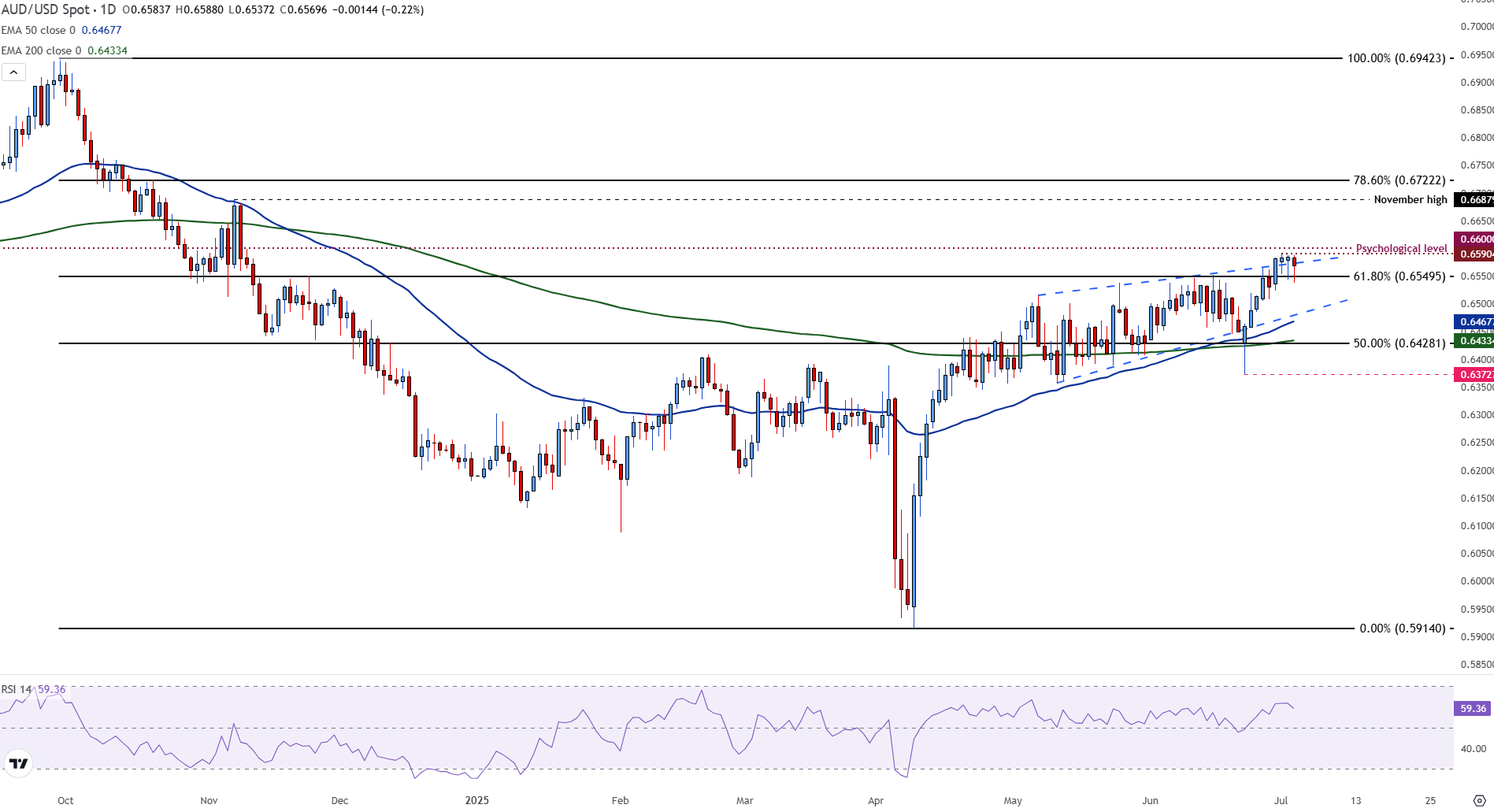
However, the Relative Strength Index (RSI) is pointing lower but remains near 60, indicating that a bullish bias remains despite weakening momentum.
A confirmed breakout above 0.6600 would likely open the door to the 78.6% Fibonacci retracement level of the September-April decline at 0.6722. On the flip side, a rejection at this level could trigger a pullback toward initial support at the 61.8% Fibo level at 0.6550, followed by deeper support near the 50% retracement at 0.6428.
US Dollar FAQs
The US Dollar (USD) is the official currency of the United States of America, and the ‘de facto’ currency of a significant number of other countries where it is found in circulation alongside local notes. It is the most heavily traded currency in the world, accounting for over 88% of all global foreign exchange turnover, or an average of $6.6 trillion in transactions per day, according to data from 2022. Following the second world war, the USD took over from the British Pound as the world’s reserve currency. For most of its history, the US Dollar was backed by Gold, until the Bretton Woods Agreement in 1971 when the Gold Standard went away.
The most important single factor impacting on the value of the US Dollar is monetary policy, which is shaped by the Federal Reserve (Fed). The Fed has two mandates: to achieve price stability (control inflation) and foster full employment. Its primary tool to achieve these two goals is by adjusting interest rates. When prices are rising too quickly and inflation is above the Fed’s 2% target, the Fed will raise rates, which helps the USD value. When inflation falls below 2% or the Unemployment Rate is too high, the Fed may lower interest rates, which weighs on the Greenback.
In extreme situations, the Federal Reserve can also print more Dollars and enact quantitative easing (QE). QE is the process by which the Fed substantially increases the flow of credit in a stuck financial system. It is a non-standard policy measure used when credit has dried up because banks will not lend to each other (out of the fear of counterparty default). It is a last resort when simply lowering interest rates is unlikely to achieve the necessary result. It was the Fed’s weapon of choice to combat the credit crunch that occurred during the Great Financial Crisis in 2008. It involves the Fed printing more Dollars and using them to buy US government bonds predominantly from financial institutions. QE usually leads to a weaker US Dollar.
Quantitative tightening (QT) is the reverse process whereby the Federal Reserve stops buying bonds from financial institutions and does not reinvest the principal from the bonds it holds maturing in new purchases. It is usually positive for the US Dollar.
Author

Tammy Da Costa, CFTe®
FXStreet
Tammy is an economist and market analyst with a deep passion for financial markets, particularly commodities and geopolitics.