AUD/USD slides as weak Australian jobs data meets robust US retail sales
- AUD/USD extends losses as bearish momentum increases.
- Disappointing employment data highlights challenges in the Australian labour market.
- AUD/USD momentum turns bearish with investors looking ahead to the US Michigan Consumer Sentiment data on Friday.


The Australian Dollar (AUD) is weakening against the US Dollar (USD) on Thursday after employment data from Australia reflected a slowdown in the labour market. Meanwhile, US Retail Sales data surprised to the upside, reflecting an increase in consumer spending in June.
At the time of writing, AUD/USD is trading below 0.6485 with intraday losses near 0.70%.
On Friday, markets will be watching the preliminary University of Michigan (UoM) Consumer Sentiment and Expectations data for July, which can offer key insights into consumer confidence. Additionally, the UoM 1-year and 5-year inflation expectations will also be in focus to see if the advanced expectations reflect an increase from the prior respective figures of 5% and 4%.
With the preliminary Sentiment Index expected to rise slightly to 61.5 from 60.7, elevated inflation expectations or strong sentiment could delay rate cut expectations, while softer readings may support a more dovish Federal Reserve (Fed) outlook.
Australian employment data signals a struggling labour market, raising expectations of RBA rate cut
Employment data released on Thursday showed that the unemployment rate in Australia rose to 4.3% in June, above the 4.1% estimate. The Employment Change for June came in at +2K, well below the +20K forecast, signaling a weaker-than-expected labor market recovery.
With a softer labour market and a slight decrease in Australian inflation expectations for July declining to 4.7%, from the previous 5% reading, the combination of factors may increase the potential for the Reserve Bank of Australia (RBA) to cut rates at its next meeting. This would take the benchmark rate from 3.85% to 3.60% if the RBA cuts by 25 basis points.
US Retail Sales jump as bets of a September rate cut soften
US Retail Sales data on Thursday reflected an increase in consumer spending for June, coming in at 0.6%, above the expected 0.1% rise.
The upside surprise in spending, despite tariff uncertainty and high interest rates, has provided a glimmer of hope for the US economy.
As the Federal Reserve continues to express concern over the potential impact of tariffs on inflation, this data, combined with a strong labour market, reflects a resilient economy.
Although the interest rate differentials are largely priced in, improved risk sentiment has also pushed out expectations of a rate cut in September.
According to the CME FedWatch Tool, the probability of a 25 basis point rate cut in September is now sitting at 52.7% , down from 65.4% this time last week. Meanwhile, the likelihood that rates will remain at current levels at the same meeting has climbed to 46.0%, increasing from 29.7%.
AUD/USD momentum turns bearish as the price tests key support
The AUD/USD pair has recently experienced a notable shift in momentum, presenting traders with a critical juncture in its medium-term trend.
After forming a Golden Cross, where the 50-day Exponential Moving Average (EMA) crossed above the 200-day EMA, the pair surged within a rising channel, only to face stiff resistance near the psychological 0.6600 level last week.
The subsequent rejection from this area, combined with a rebound in the US Dollar, has triggered a pullback. With weekly losses for AUD/USD currently at 1.40% at the time of writing, the pair has slipped below the 50-day EMA, now providing immediate resistance near 0.6490.
AUD/USD daily chart
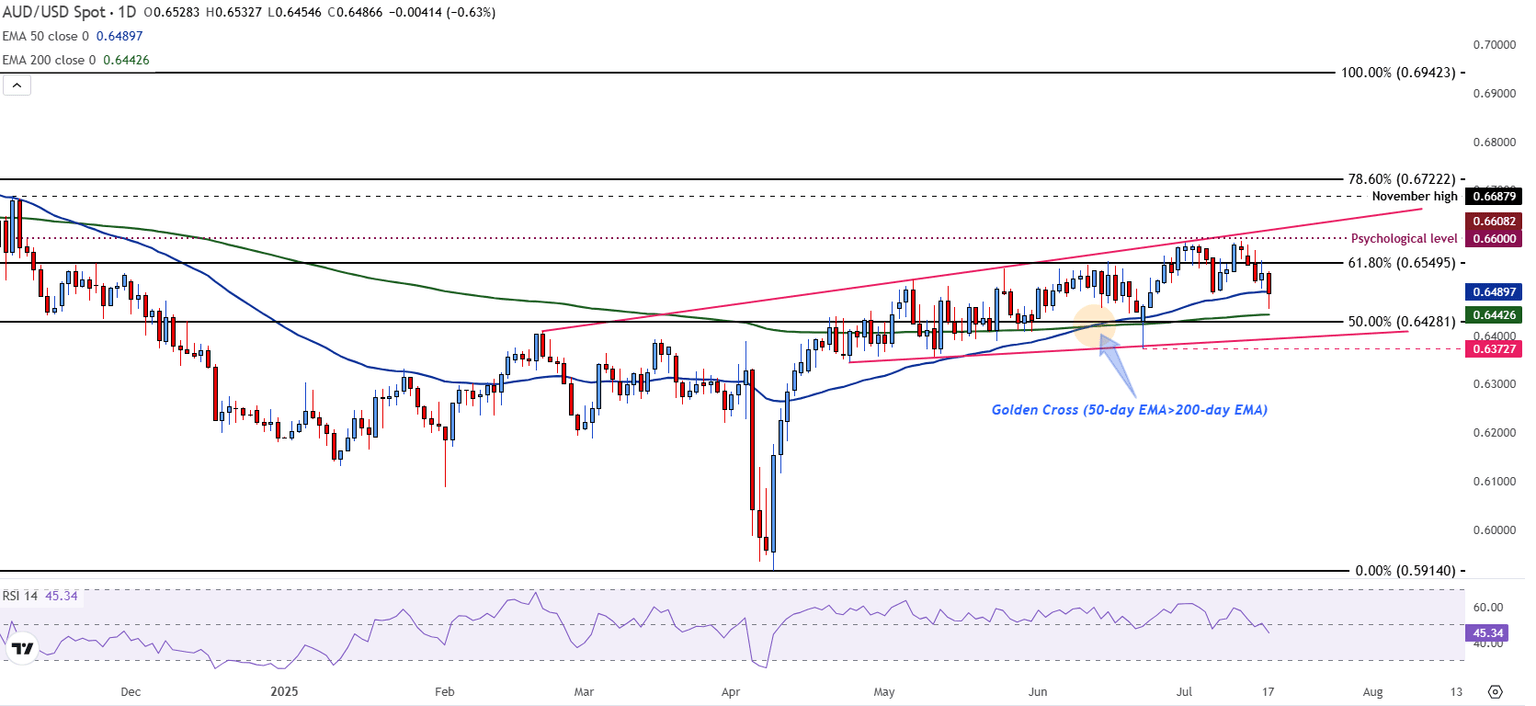
A Relative Strength Index (RSI) reading of 45 reflects an increase in bearish momentum. Meanwhile, the 200-day EMA has stepped in as support around 0.6445, just above the 50% Fibonacci retracement level of the September-April decline at 0.6421.
A decisive break below this support could open the door to further downside toward 0.6400 and possibly the lower boundary of the ascending wedge pattern at 0.6372, marking a potential bearish reversal.
However, if the price holds and rebounds above the 50-day EMA, bulls could regain control, targeting the 61.8% Fibo level at 0.6550, bringing the 0.6600 psychological level back into play.
Interest rates FAQs
Interest rates are charged by financial institutions on loans to borrowers and are paid as interest to savers and depositors. They are influenced by base lending rates, which are set by central banks in response to changes in the economy. Central banks normally have a mandate to ensure price stability, which in most cases means targeting a core inflation rate of around 2%. If inflation falls below target the central bank may cut base lending rates, with a view to stimulating lending and boosting the economy. If inflation rises substantially above 2% it normally results in the central bank raising base lending rates in an attempt to lower inflation.
Higher interest rates generally help strengthen a country’s currency as they make it a more attractive place for global investors to park their money.
Higher interest rates overall weigh on the price of Gold because they increase the opportunity cost of holding Gold instead of investing in an interest-bearing asset or placing cash in the bank. If interest rates are high that usually pushes up the price of the US Dollar (USD), and since Gold is priced in Dollars, this has the effect of lowering the price of Gold.
The Fed funds rate is the overnight rate at which US banks lend to each other. It is the oft-quoted headline rate set by the Federal Reserve at its FOMC meetings. It is set as a range, for example 4.75%-5.00%, though the upper limit (in that case 5.00%) is the quoted figure. Market expectations for future Fed funds rate are tracked by the CME FedWatch tool, which shapes how many financial markets behave in anticipation of future Federal Reserve monetary policy decisions.
Author
Tammy Da Costa, CFTe®
FXStreet
Tammy is an economist and market analyst with a deep passion for financial markets, particularly commodities and geopolitics.