AUD/USD rises above 0.6700 amidst a soft US Dollar, falling US bond yields
- AUD/USD climbs as market participants expect a US Federal Reserve pivot on its monetary policy stance.
- Boston Fed’s Susan Collins argues that the Fed will maintain steady rates after a future hike.
- Richmond Fed’s Thomas Barkin commented that turmoil at Credit Suisse removed 50 bps rate hikes off the table.

The Australian Dollar (AUD) edges higher against the US Dollar (USD), which continues to weaken across the board, as shown by a basket of six currencies, namely the US Dollar Index. In addition, US Treasury bond yields are falling, and US equities are climbing, painting a challenging outlook for the US currency. At the time of writing, the AUD/USD is trading at 0.6701.
US Dollar weakened on falling UST Bond yields after soft jobs data
Risk appetite continues to be the main driver after the banking crisis woes eased. The financial markets narrative shifted back to central banks, though not inflation but regulation. However, Federal Reserve officials like Boston Fed President Susan Collins and Richmond’s Thomas Barkin crossed news wires and spoke about monetary policy.
Boston Fed Susan Collins said that getting inflation low justifies no rate cuts. She added that the US Federal Reserve (Fed) would hold rates steady after another hike. Richmond Fed President Thomas Barkin commented that the inflation fight would take some time and that Credit Suisse’s turmoil took off the table of a 50 bps rate hike.
Even though both Fed officials looked mildly hawkish, investors had begun pricing in a no change to the Federal Funds Rate (FFR) at the upcoming meeting in May. Therefore, the AUD/USD has been underpinned by a probable shift in the US central bank monetary policy stance, though inflation data is waiting to be released on Friday.
Aside from this, jobs data from the United States (US) showed that the labor market is cooling off, with Initial Jobless Claims for the last week exceeding estimates. At the same time, the US Gross Domestic Product (GDP) for Q4 2022 was 2.6%, below forecasts of 2.7%.
On the Australian front, the latest inflation report surprised the market, as inflation was lower than expected. There are growing rumors amongst financial analysts that the Reserve Bank of Australia (RBA) could pause rate hikes in the next week.
AUD/USD Technical analysis
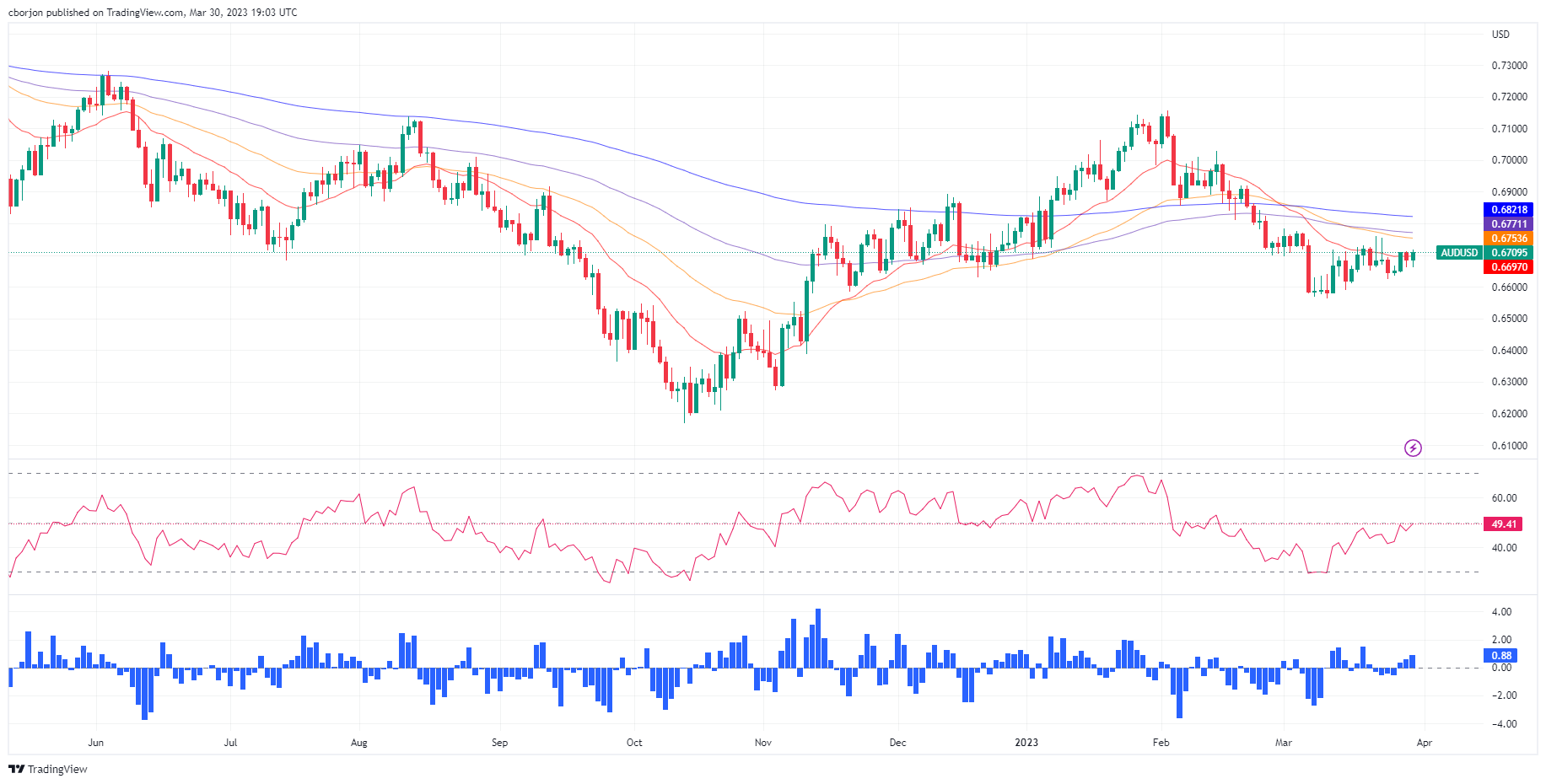
The AUD/USD is bracing for the 20-day Exponential Moving Average (EMA), at 0.6696, consolidating within a narrow 70 pip range during the last three trading days. Although oscillators remain in bearish territory, like the Relative Strength Index (RSI), the Rate of Change (RoC) is bullish. Hence, mixed signals warrant caution.
If the AUD/USD breaks upwards, it will face resistance at the 50-day EMA at 0.6753, followed by the 100 and the 200-day EMAs at 0.6771 and 0.6821, respectively. On the other hand, the AUD/USD first demand level would be the March 24 low at 0.6625, followed by the 0.6600 figure.
Author

Christian Borjon Valencia
FXStreet
Markets analyst, news editor, and trading instructor with over 14 years of experience across FX, commodities, US equity indices, and global macro markets.