AUD/USD rallies above 0.6800 on weak US ISM PMI, soft US Dollar
- US Dollar remains on the defensive, spurred by the ISM manufacturing PMI dropping to the contractionary territory.
- Inflation in the United States remained unchanged, while unemployment claims fell.
- The Australian Dollar got bolstered by a weaker US Dollar as traders eye RBA’s Governor Lowe.
- AUD/USD Price Analysis: Could test 0.7000 if the AUD/USD clears the 200-DMA.

The Australian Dollar (AUD) advances in the New York session but retraces after hitting a new two-month high around 0.6840s as sentiment shifted sour. United States (US) economic data portrays a gloomy economic outlook while increasing borrowing costs by the Federal Reserve (Fed) would keep the economy under pressure. That said, the US Dollar (USD) remains on the defensive, undermined by falling US Treasury yields. At the time of writing, the AUD/USD clings above the 0.6800 figure.
US Dollar weakened as the ISM Manufacturing PMI shrank
US equities are trading with losses. The Institute for Supply Management (ISM) for November revealed that the Manufacturing PMI dropped below the expansionary/contractionary 50 levels, down to 49.0 from 49.2 estimated by analysts. Timothy R. Fiore, Chair of the ISM, commented that US manufacturing activity dived into a contraction, with the PMI reaching its lowest level since the pandemic began. The report “reflects companies’ preparing for lower output.” Following the report, the AUD/USD dropped from the day’s high of 0.6845 to 0.6810.
Tightness in the labor market pressures the Federal Reserve
Before Wall Street opened, the Department of Labor revealed that Initial Jobless Claims for the last week increased by 225K, a decrease of 16K compared to the previous week’s and below the expected 235K by analysts. Continuing claims jumped from 1.57M to 1.603M, showing that the labor market remains tighter than Federal Reserve officials’ expectations.
US Core PCE rose by 5%, but failed to bolster the US Dollar
At the same time, the US Department of Commerce (DoC) revealed the Federal Reserve preferred measure of inflation, the US Core Personal Consumption Expenditure (PCE), which rose by 5% YoY, beneath October’s 5.2%. Even though the report flashes that inflation is beginning to ease, it remains too high. Although prices stabilized in the last couple of months, Federal Reserve Chair Jerome Powell commented that he needs “substantial evidence” that inflation is cooling.
What to watch
Aside from this, in Australia, the calendar will feature October Retail Sales, Housing data, and the Reserve Bank of Australia (RBA) Governor Philip Lowe, which will cross wires. On the US front, the US Nonfarm Payrolls report for November would update the labor market situation, while Fes speakers, ahead of the blackout period, will cross wires.
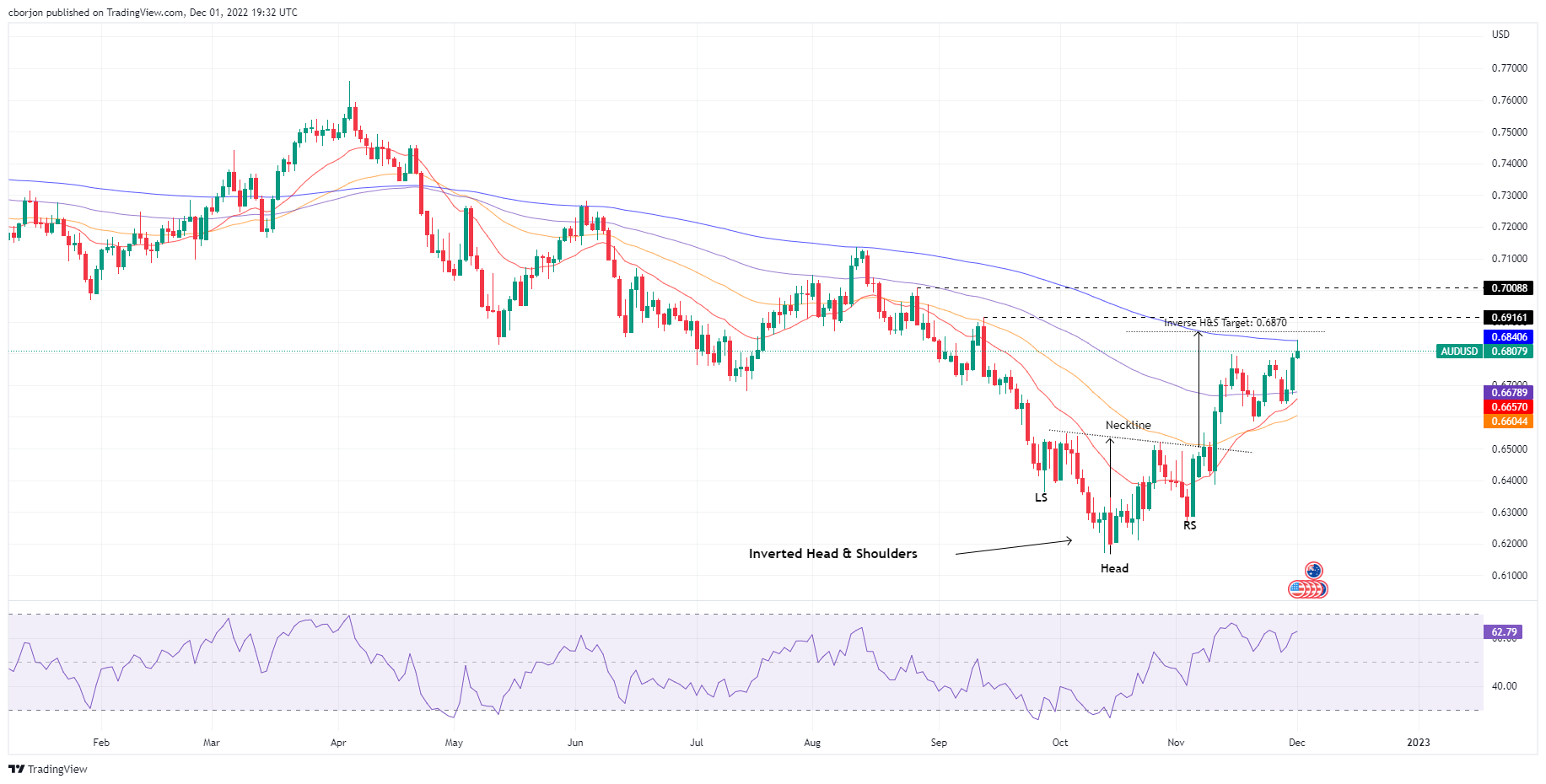
AUD/USD Price Analysis: Technical outlook
Although the AUD/USD failed to break the 200-day Exponential Moving Average (EMA) around 0.6840, its bias remains upward, further cemented by the Relative Strength Index (RSI) at bullish territory aiming upwards. However, the AUD/USD needs to hold above Wednesday’s high of 0.6801, so the pair could consolidate within the 0.6800-0.6850 area if buyers would like to push prices higher. If that scenario plays out, the AUD/USD first resistance would be the 0.6900 figure, followed by the August 26 high of 0.7000. As an alternate scenario, the AUD/USD first support would be 0.6800, followed by the November 29 high at 0.6748, above the 0.6700 figure.
Author

Christian Borjon Valencia
FXStreet
Markets analyst, news editor, and trading instructor with over 14 years of experience across FX, commodities, US equity indices, and global macro markets.