AUD/USD probes four-day uptrend around 0.7300, US ADP Employment Change eyed
- AUD/USD dribbles after one-week rebound, edges higher of late.
- Aussie banking watchdog’s action battle China’s coal import news, upbeat equities to confuse buyers.
- US politics, pre-jobs report anxiety adds to the upside filters.
- RBNZ, US data will be the key catalysts, not to forget Evergrande and China headlines.

AUD/USD bulls take a breather following four consecutive days of a north-run, near 0.7290 during the initial Asian session on Wednesday. While the upbeat performance of equities jostled with the US dollar strength to entertain the pair buyers previously, recently mixed headlines concerning the risk appetite question the traders amid a quiet start to the day at work.
The US Dollar Index (DXY) snapped a three-day downtrend on Tuesday, tracking firmer US Treasury yields and stronger data at home. However, Wall Street has its role to play amid market optimism surrounding the US stimulus and raising the debt ceiling.
Recently, the global rating giant Moody kept the US credit rating unchanged at AAA and backed concerns that the US debt limit will be raised soon to avoid the empty-pocket situation. Also positive for the mood, as well as for the AUD/USD prices is the news, shared by the Financial Times (FT), suggesting that China unloaded coals from Australia despite a ban on imports to tackle the power cut at home.
On the other hand, news that the Aussie banking regulator Australian Prudential Regulation Authority (APRA) announced measures to curb housing prices probes the AUD/USD bulls at the latest.
It’s worth noting that the US-China tussles escalate, recently over Taiwan as well as the phase one trade deal, which in turn exerts downside pressure on the market sentiment and AUD/USD.
Talking about the data, US PMIs, namely the ISM Services PMI and Markit Services PMI, printed firmer results for September but the US trade deficit widened to the record in August. On the other hand, the Reserve Bank of Australia’s (RBA) cautious optimism probed the pair traders despite inaction by the Aussie central bank.
Given the mixed concerns and a light calendar at home, with just TD Securities Inflation for September, AUD/USD traders will pay close attention to the qualitative catalysts for fresh impulse in Asia. Also important will be the Reserve Bank of New Zealand's (RBNZ) interest rate decision as market players anticipate a rate hike.
Following that, the early signal for Friday’s US Nonfarm Payrolls (NFP), namely ADP Employment Change for September will be observed for clear direction.
Read: US ADP Employment Change September Preview: Yes, its all about the Fed
Technical analysis
AUD/USD step back from the 50-DMA resistance surrounding 0.7310, struggling to validate the bullish signal generated on the break of a monthly descending trend line, now support around 0.7260. Should the quote manage to cross the 0.7310 hurdle, the upward trajectory will aim for the key resistance line from early May, near 0.7340.
However, another failure to cross the mentioned DMA hurdle, followed by sustained trading below the resistance-turned-support line near 0.7260, should recall the bears targeting 0.7220 and the latest swing low around 0.7170.
AUD/USD: Daily chart
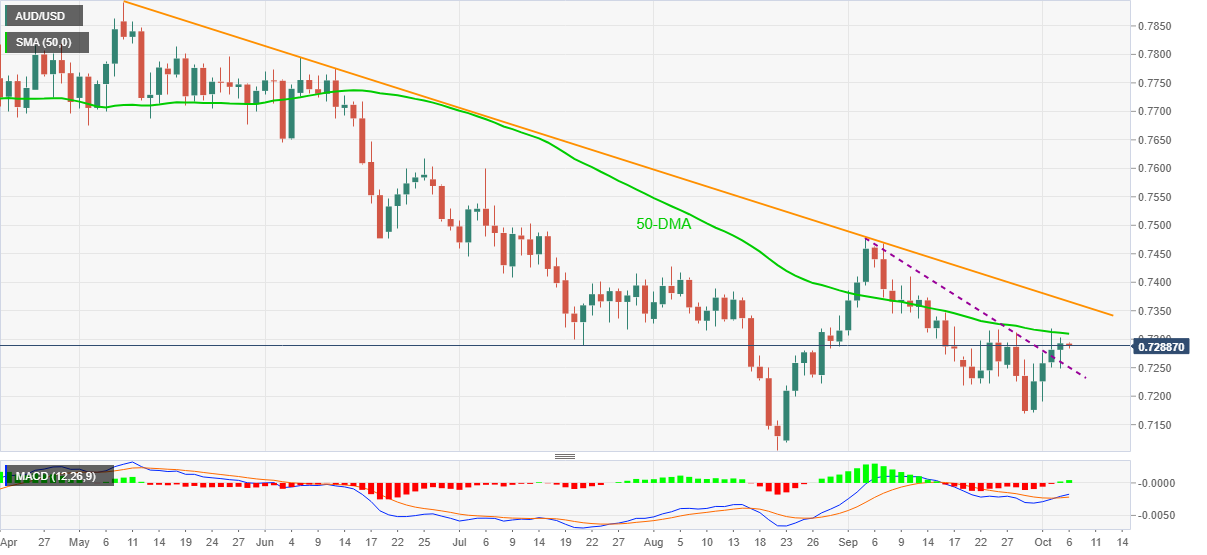
Trend: Further upside expected
Author

Anil Panchal
FXStreet
Anil Panchal has nearly 15 years of experience in tracking financial markets. With a keen interest in macroeconomics, Anil aptly tracks global news/updates and stays well-informed about the global financial moves and their implications.

















