Will the Fed deliver the hawkishness markets are pricing in?
- Fed hike bets increase after PPI and CPI reports
- Updated dot plot to be crucial for the dollar’s reaction.
- Warsh’s independence faces test amid Trump’s pressure for lower rates.
- For the dollar to extend gains, Fed needs to satisfy current hawkish bets.

Rate hike largely priced in after US inflation data
The US dollar entered the new week on a strong footing as last week’s US PPI and CPI inflation data, combined with ongoing tensions in the Middle East, prompted investors to ramp up their bets of a 25bps rate increase at Wednesday’s Fed decision.
Last Thursday, the producer price data for August revealed that the headline PPI rate jumped to 5.4% year-on-year from an upwardly revised 4.8%, while the core rate rose to 4.6% y/y from 4.3%. Although Friday’s consumer price numbers did not show similar accelerations, they remained sticky enough to lead investors to significantly increase their Fed hike bets.
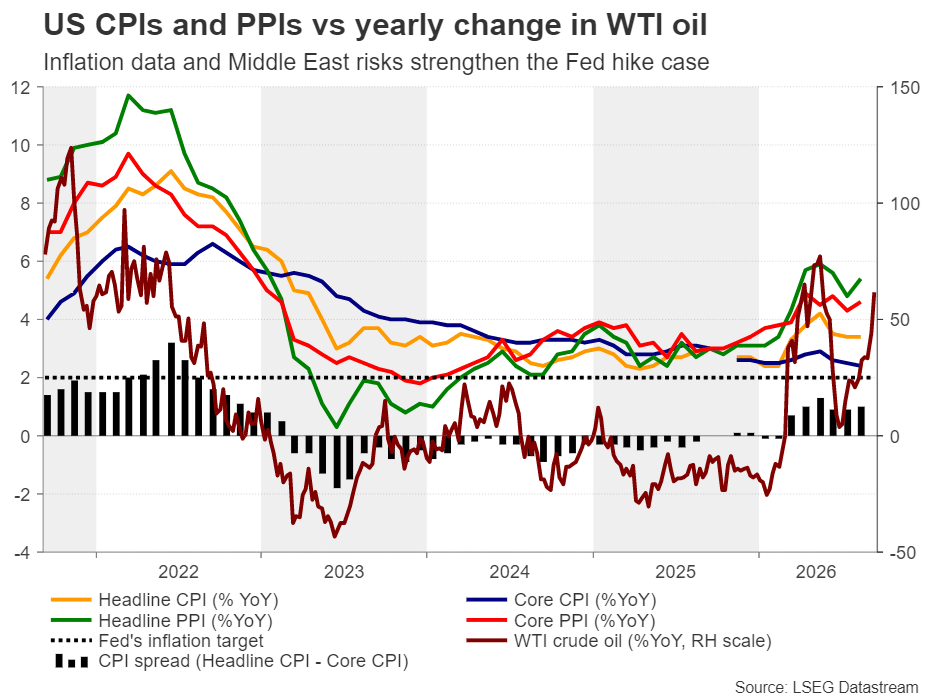
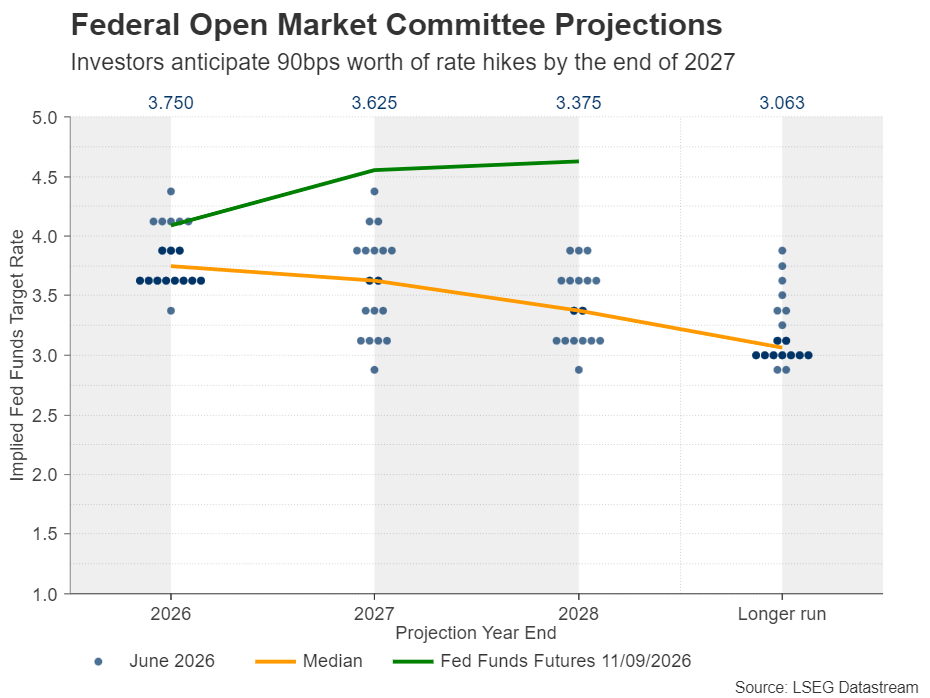
According to Fed funds futures, there is now an 87% chance of a 25bps rate increase on Wednesday, while another same-sized hike is fully priced in for December. Ahead of the data, a second one was not even seen until March 2027 and now, a third one has been pinned by then. By the end of next year, there are around 90bps worth of rate hikes baked into the cake.
Dot plot, macro projections, and Warsh’s press conference in focus
With all that in mind, investors will be sitting on the edge of their seats in anticipation of Wednesday’s decision, not only to see whether the Fed will indeed hike or not, but also to scrutinize the statement, the new macroeconomic projections, and the press conference, for evidence about how the Fed is planning to move forward. In other words, should the hike be delivered, it is unlikely that it will be the sole highlight of the evening. The updated dot plot will quickly enter the spotlight, with the new forecasts following suit.
At the press conference, investors will be eager to find out whether Fed Chair Kevin Warsh remains adamant on taming inflation, despite growing pressure from US President Trump over monetary policy. The meeting is likely to be an important test of Warsh’s independence from the Trump administration, particularly given expectations that his appointment would usher in a more dovish policy stance than under his predecessor, Jerome Powell.
Back in June, nine policymakers projected at least one rate hike in 2026, with five of them voting for two, and one member favoring three. However, the median dot indicated only one, with the 2027 projection suggesting that officials were likely to take that potential rate increase back. This means that the bar for a higher implied path on Wednesday is relatively low. The big question is whether policymakers will satisfy the latest hawkish shift in market expectations.
Jobs and growth data also support the hawkish case
Besides the stickiness revealed in last week’s inflation data, and the increasing upside risks amid the ongoing hostilities in the Middle East – and thereby the rise in oil prices – what is also supporting more rate hikes and upside revisions to macro projections is the better-than-expected jobs report for August, and the latest GDP data for Q2.
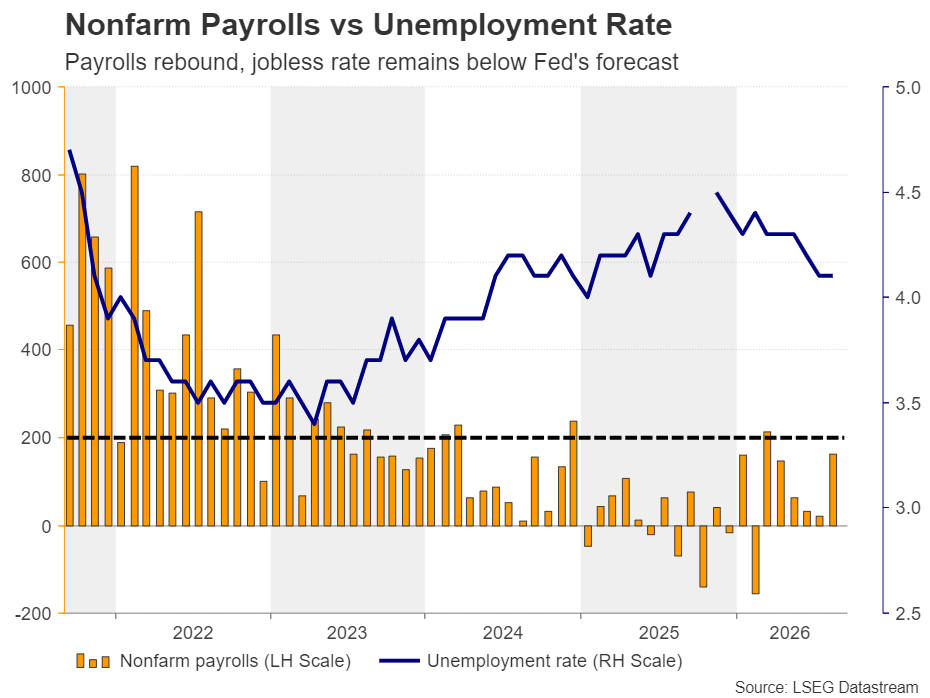
Nonfarm payrolls skyrocketed to 162k from an upwardly revised 21k, beating expectations of 55k. The unemployment rate held steady at 4.1%, below the Fed’s estimate of 4.3%. As for economic activity, although GDP slowed to 1.5% q/q SAAR in Q2 from 2.1% in Q1, underlying domestic demand remained considerably strong at 3.9%.
Thus, if the Fed appears hawkish enough, convincing market participants to maintain bets of around 90bps worth of rate hikes by the end of next year, the dollar is likely to extend its latest bullish stretch. On the other hand, anything pointing to a flatter rate path than the one anticipated by the market, even if the overall outcome has a hawkish flavor, could prompt greenback traders to liquidate some of their recently established long positions.
Euro/Dollar completes a failure swing top
From a technical standpoint, euro/dollar fell sharply on Monday, breaking below the $1.1585 key support zone and thereby completing a failure swing top formation. The pair is now headed towards the $1.1505 territory, the break of which could initially aim for the $1.1460 zone. If the bears are not willing to stop there, extensions towards $1.1350 could be possible.
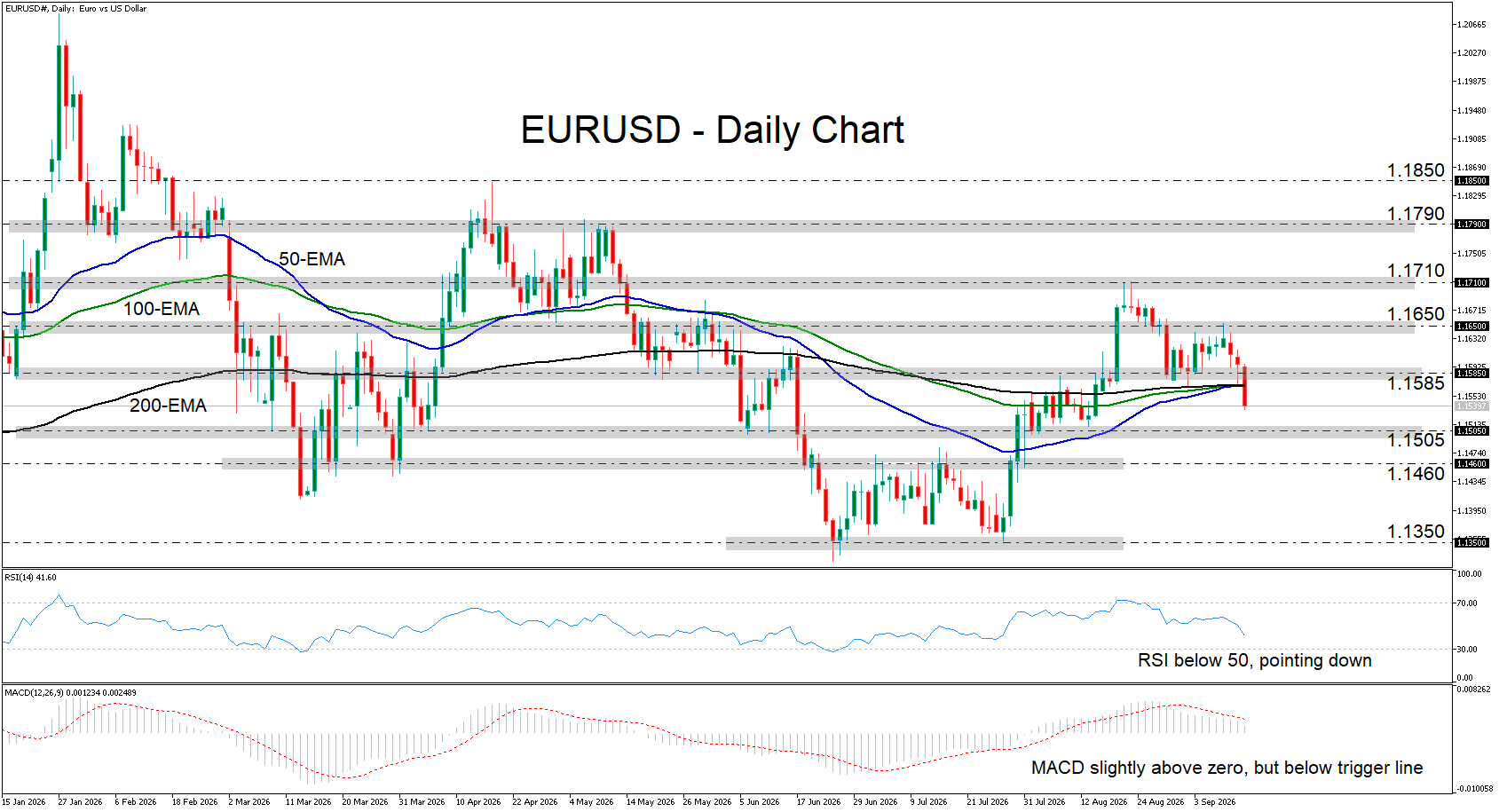
On the upside, a strong rebound above $1.1650 could cancel the bearish case, paving the way towards the $1.1710 zone. A break higher could invite more bulls into the action, likely setting the stage for advances towards $1.1790.
Author

Charalampos joined Trading Point in August 2022 as a senior market analyst. He has extensive experience in analyzing financial markets, gained through a decade-long career, with his primary focus being on the currency market.