Venezuela’s 65-billion-barrel Oil deal could reshape America’s inflation fight

The United States (US) has secured unprecedented access to part of Venezuela’s vast Oil reserves. The timing is particularly significant as the war with Iran is disrupting Middle Eastern supplies, keeping energy prices elevated and reviving concerns about inflation.
The administration of US President Donald Trump and Venezuela’s interim President Delcy Rodríguez have reached an agreement covering 17 fields containing around 65 billion barrels of proven reserves, more than one-fifth of Venezuela’s roughly 300 billion barrels.
The agreement provides for the US government to take a 35% stake in the parent company of North American Blue Energy Partners (NABEP). Washington would also have the right to purchase 20% of production at cost to replenish the Strategic Petroleum Reserve (SPR), as well as a right of first refusal on the remaining 80%.
On paper, those numbers are enormous. In practice, however, Venezuelan Oil does not solve the current energy crisis. Its importance lies more in what it could change over the coming years: Diversifying US supplies, rebuilding strategic inventories and creating a new insurance policy against Oil shocks originating in the Middle East.
Venezuela becomes a hedge against the Strait of Hormuz
The war in the Middle East shows why Washington places so much importance on Venezuelan reserves. Before the conflict, around 20 million barrels per day of Crude Oil and petroleum products passed through the Strait of Hormuz. Attacks on tankers and disruptions caused by the war with Iran have since significantly reduced these flows.
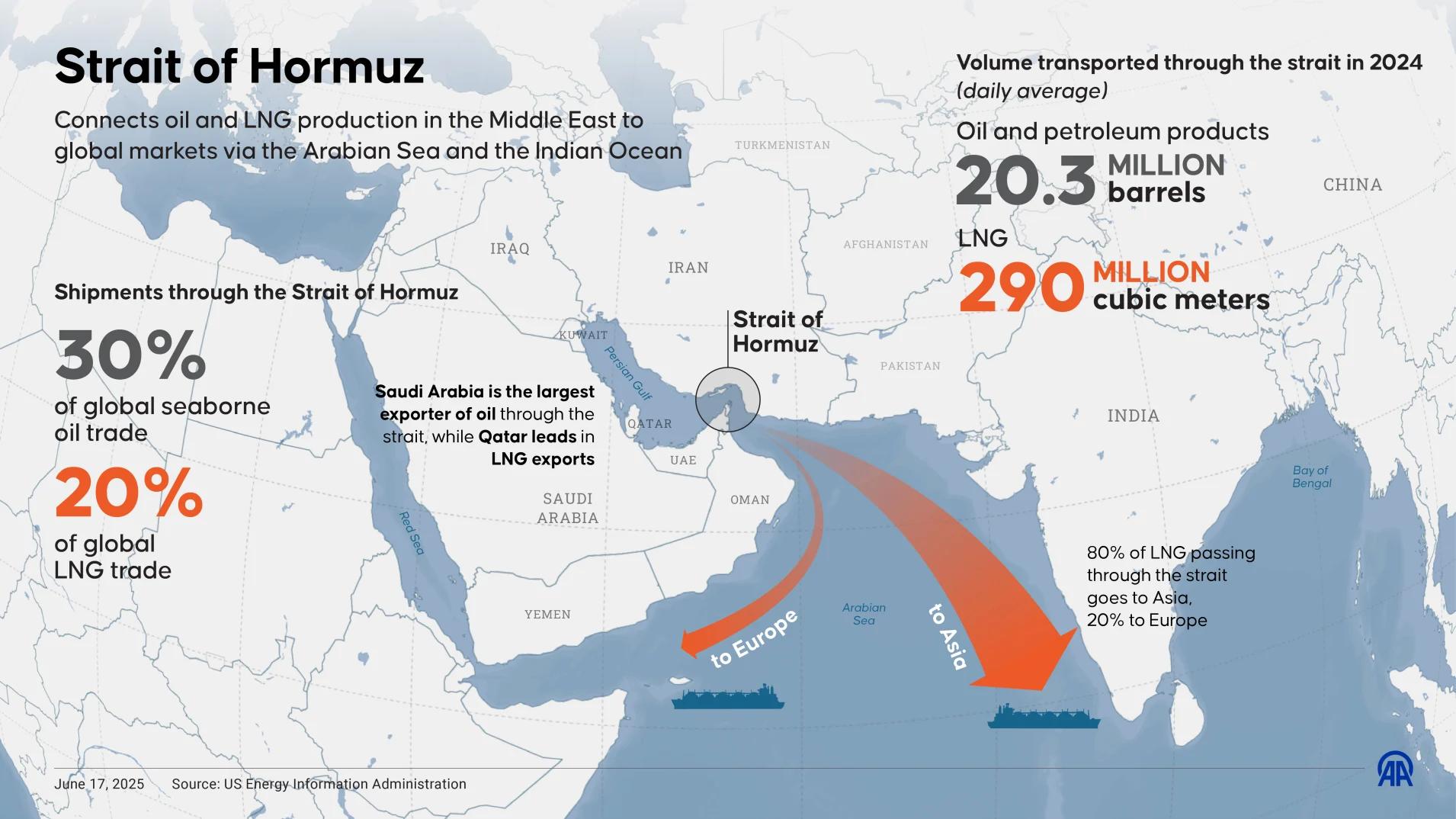
The problem extends beyond the number of barrels that become unavailable. Alternative routes are longer, maritime insurance becomes more expensive, and refiners have to source crude and refined products from much farther away. Even when the market finds ways around the disruption, energy becomes structurally more expensive.
This is precisely the exposure Washington is seeking to reduce.
US Interior Secretary Doug Burgum told Fox Business that the agreement is helping shift the “geopolitical center of the global energy markets” away from Middle Eastern chokepoints and toward the Western Hemisphere, according to the BBC.
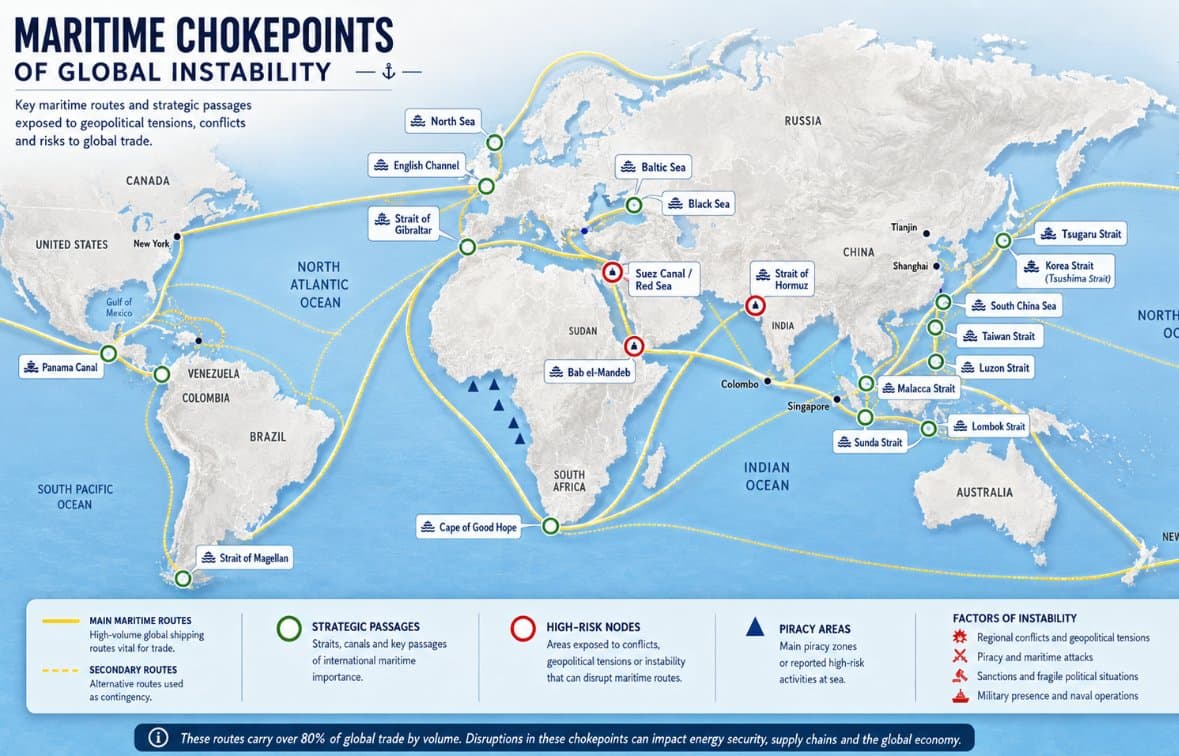
Venezuela obviously cannot replace Gulf producers. Its total Oil production remains close to 1.25 million barrels per day, far below historical levels. Geographically, however, Venezuelan Oil has an obvious strategic advantage for the United States, as it can reach US refineries without passing through Hormuz, Suez or Bab el-Mandeb.
The agreement therefore fits into a much broader shift triggered by the war. Japan is diversifying its imports toward the Americas and Africa, while Gulf producers are investing in pipelines capable of bypassing Hormuz. Global Oil flows are gradually becoming less dependent on a limited number of maritime chokepoints.
For Washington, Venezuela could become one of the most important pieces of this new energy map.
Venezuelan Oil could help rebuild the US strategic reserve
The second dimension of the agreement directly concerns US energy security. The Strategic Petroleum Reserve is Washington’s emergency stockpile for responding to major supply disruptions. However, successive drawdowns have reduced inventories to around 290 million barrels, or only about 41% of its total capacity, according to figures cited by the Institute for Energy Research.
This weakness becomes particularly important during a war disrupting one of the world’s main Oil-producing regions. The agreement with Caracas offers a potential solution as the US has the right to purchase 20% of the Oil produced from the fields covered by the agreement at cost to replenish the SPR. Washington also obtains preferential purchase rights over the rest of the production.
The logic is straightforward: Rather than rebuilding US reserves by purchasing large quantities of Oil on a tight global market, Washington could gradually rely on a source of supply over which it exercises considerably greater influence.
The type of crude produced in Venezuela also strengthens its appeal to the United States. It is predominantly heavy, sour crude, which several complex refineries on the US Gulf Coast are equipped to process.
The agreement therefore represents more than 65 billion barrels of theoretical reserves. It gives Washington the possibility of eventually turning part of those reserves into strategic supply located within the Western Hemisphere.
Why 65 billion barrels will not quickly bring prices down
This is where the spectacular scale of the agreement can become misleading. Oil reserves are not the same as Oil production. Venezuela holds the world’s largest proven reserves but currently accounts for only a small share of global production.
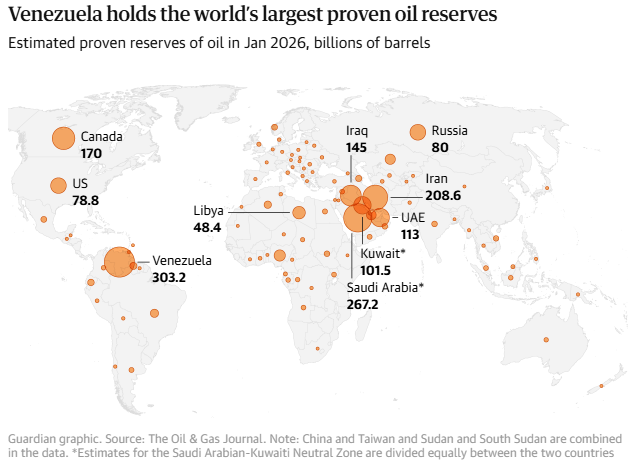
Years of underinvestment, mismanagement, sanctions and deteriorating infrastructure have severely reduced its productive capacity. The country cannot simply turn on the taps.
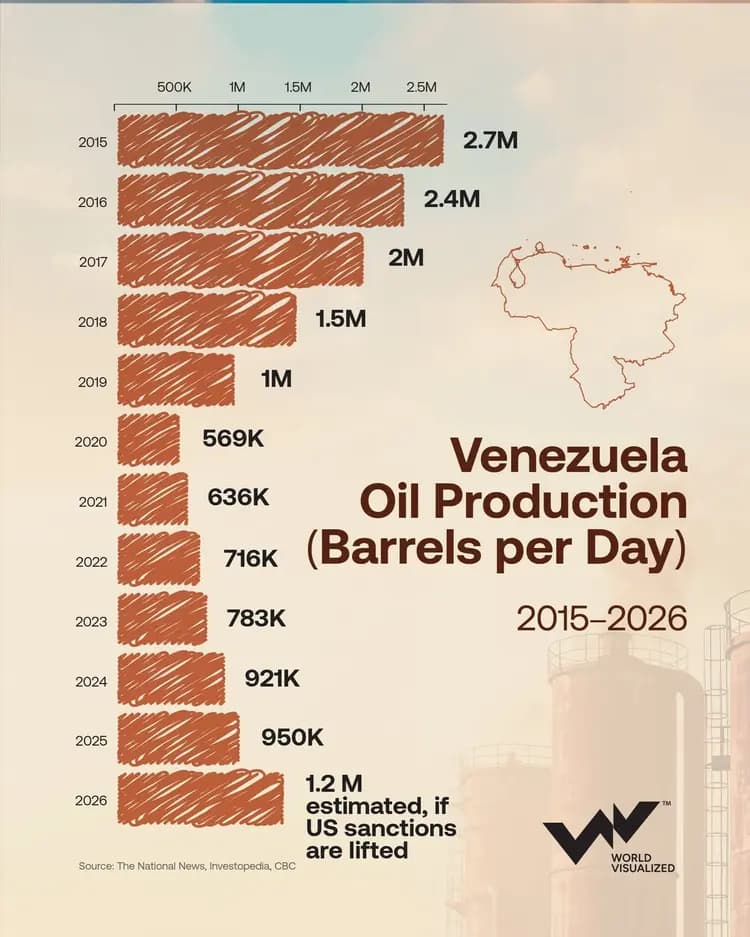
Luis Pacheco of Rice University’s Baker Institute estimates that around $100 billion of investment over eight years would be needed to restore production to levels seen three decades ago, according to the BBC. Other estimates suggest that returning existing fields to full capacity could take until the mid-2030s.
The Center for Strategic and International Studies also notes that some of the fields covered by the agreement are greenfield projects that still need to be developed, while port infrastructure and the electricity grid represent additional obstacles to a rapid increase in production.
This distinction is essential when assessing the impact on prices. The agreement can immediately change expectations about future supply, but it does not immediately create several million additional barrels per day. It is therefore unlikely, on its own, to trigger a sharp decline in US gasoline prices over the coming months.
The impact on inflation is indirect, but potentially significant
The connection with inflation operates over a longer time horizon. Oil directly influences the price of gasoline, diesel and jet fuel. However, an energy shock also spreads through transportation, agriculture, petrochemicals and supply chains.
The war with Iran already illustrates this mechanism. US gasoline prices have risen sharply since the conflict began, while the disruption to Hormuz is helping keep energy costs elevated.
This creates a problem for the Federal Reserve (Fed), as an Oil shock can simultaneously increase inflation and slow economic activity. The US central bank cannot produce more Oil by raising interest rates, but it also cannot ignore a persistent increase in energy prices if it begins to spread into other components of inflation.
The real macroeconomic importance of Venezuela therefore becomes clearer when considering future scenarios. If US investment gradually succeeds in increasing Venezuelan production, the global market would gain another major source of supply outside areas directly exposed to Middle Eastern conflicts.
That does not guarantee cheap Oil. However, a more diversified global supply could reduce the size of the geopolitical risk premium and lower the probability that a regional disruption develops into a global inflationary shock.
The biggest risk may not be underground
Technical difficulties are not the only threats facing the agreement. Its political and legal structure has attracted strong criticism in Venezuela. Rodríguez leads an interim government following the capture of Nicolás Maduro by US forces in January, and some legal experts have raised questions over her authority to commit national Oil resources for several decades.
The agreement has also attracted criticism from both the Venezuelan opposition and some former supporters of Chavismo, who view the access granted to Washington as a loss of sovereignty.
This uncertainty matters for investors. Developing heavy Oil fields requires tens of billions of dollars and an investment horizon measured in decades. Major Oil companies will therefore need sufficiently strong guarantees that a future government will not challenge or overturn the contracts.
The existence of 65 billion barrels is not enough, as Washington still needs to convince the private sector that those reserves can be developed profitably and sustainably.
An insurance policy against the next Oil crisis
The agreement between Washington and Caracas therefore does not solve the Oil shock caused by the war in the Middle East. Its immediate impact is likely to be more geopolitical than economic.
Over the medium and long term, however, it could change the US energy equation. A sustained increase in Venezuelan production would give the United States more Oil from within its own hemisphere, help rebuild the SPR, and reduce its exposure to vulnerable Middle Eastern shipping routes.
For inflation, the effect works primarily as an insurance policy. The best way to prevent a regional war from becoming a global energy shock is to have more production capacity in regions that are not exposed to the conflict.
Venezuela’s 65 billion barrels probably will not do much to lower gasoline prices tomorrow. But if those reserves gradually turn into actual production, they could make the next Middle Eastern shock considerably less inflationary.
Author

Ghiles Guezout
FXStreet
Ghiles Guezout is a Market Analyst with a strong background in stock market investments, trading, and cryptocurrencies. He combines fundamental and technical analysis skills to identify market opportunities.