Reserve Bank of New Zealand Preview: Set for the first lift-off since the pandemic
- The Reserve Bank of New Zealand set to hike OCR for the first time since the pandemic.
- RBNZ to hint at gradual rate increases amid rising price pressure and a strong labor market.
- NZD/USD could rebound on hawkish forward guidance.

NZD/USD is snapping its three-day recovery rally in the lead-up to the eagerly anticipated rate hike by the Reserve Bank of New Zealand on Wednesday. The South Pacific Island nation is recovering from the local Delta covid variant outbreak, with rising price pressures and a tight labor market, which could lead the RBNZ for its first rate liftoff since the pandemic began in March 2020.
RBNZ unlikely to defer a rate hike
The RBNZ is widely expected to raise the Official Cash Rate (OCR) by 25 basis points (bps) from a record low of 0.25% to 0.50%. The central will hike for the first time in nine straight monetary policy meetings.
The rate decision will be announced on Wednesday at 0200 GMT. Governor Adrian Orr will hold a press conference at this review, which will also see fresh economic projections.
Back in July, the central bank ended its asset purchases programme, suggesting a well-telegraphed tightening plan in its August meeting.
However, a fresh Delta covid variant outbreak in Auckland in August sent the country back under lockdown restrictions, holding off the RBNZ to announce a 25bps rate hike that month.
With the RBNZ heading towards a rate increase, New Zealand will emerge as the first Asia-Pac region to embark upon a tightening journey after the pandemic began.
Markets are pricing in an 80% probability of a rate hike this week, given August’s hawkish hold. Another tightening at the November meeting will be on the cards. Markets also see a 4% probability to a 50 basis-point rise on Wednesday, per Bloomberg.
The economy has bounced back from the recent lockdown-led slowdown, with a 4% unemployment rate and solid 1.6% growth in the GDP in the second quarter. New Zealand’s inflation for Q2 rose by 3.3%, breaching the central bank’s 1-3% target range while suggesting that the time may be ripe for policy tightening.
Prime Minister Jacinda Ardern’s decision to lift a national lockdown outside the largest city Auckland, also adds credence to the expectations of an RBNZ rate increase.
However, the hawks could be caught off guard if the central bank calls for more gradual rate increases than previously signaled, in the face of growing China worries, looming covid risks and inflation fears.
In such a scenario, the November rate hike bets could go for a toss, leaving investors contemplating their bullish view on the kiwi dollar.
However, with the risk sentiment playing a key role in driving financial markets lately, the reaction to the RBNZ decision could also be influenced by the persisting mood and dynamics in the safe-haven US dollar.
NZD/USD technical outlook
NZD/USD is challenging the critical support at 0.6925, the confluence of the upward-sloping 21-Simple Moving Average (SMA) and the rising trendline on the four-hour chart, suggesting the bulls could attempt a bounce back towards 0.7000. The renewed uptrend could kick in if the RBNZ meets expectations, with a rate hike. The currency pair could then head towards the 0.7015 region, where the 100 and 200-SMAs hover.
A dovish rate hike by the NZ central bank could call for the resumption of the downside in the kiwi. The bears will then proceed towards the five-week lows of 0.6859, although the 0.6900 would be a tough nut to crack for the kiwi sellers.
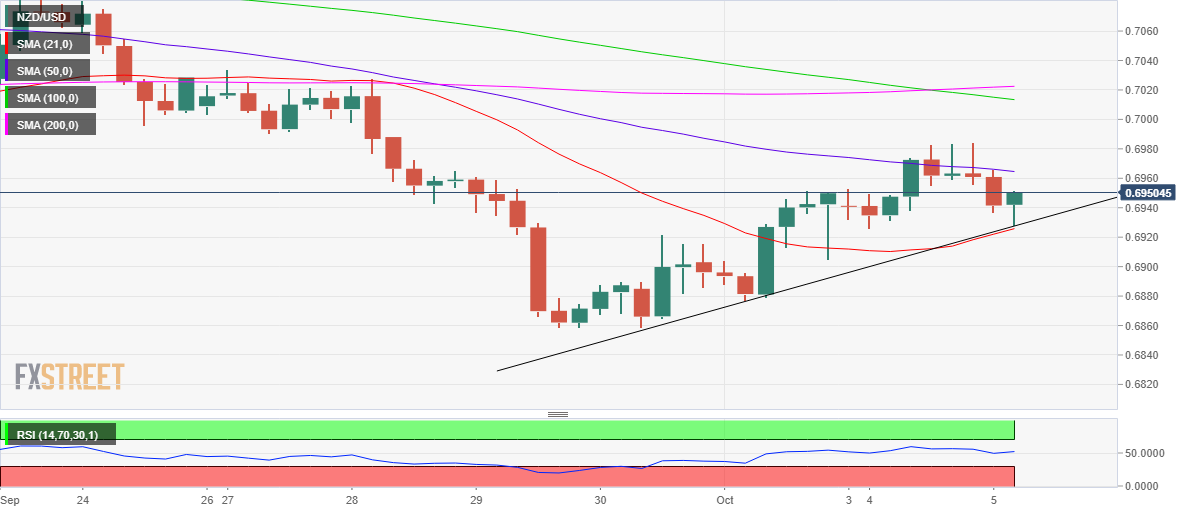
NZD/USD: Four-hour chart
More: Sentiment will continue to play a crucial role in trading
Author

Dhwani Mehta
FXStreet
Residing in Mumbai (India), Dhwani is a Senior Analyst and Manager of the Asian session at FXStreet. She has over 10 years of experience in analyzing and covering the global financial markets, with specialization in Forex and commodities markets.

















