Gold gets squeezed by 5% Treasury yields as FOMC week begins
- Gold hits one-month low as 5% Treasury yields bite.
- Oil shock lifts Fed hike odds as WTI clears $100.
- Fed, BoE and BoJ decisions headline central-bank-heavy week.

Gold (XAU/USD) begins the week on the wrong foot, down some 0.85% on Monday after reaching a one-month low of $4,253, in a week that will feature the Federal Open Market Committee (FOMC) monetary policy decision. At the time of writing, XAU/USD trades at $4,310.
XAU/USD drops near $4,300 as Dollar strength, Oil shock and global rate risks weigh
Broad US Dollar strength and elevated US Treasury yields, driven by surging energy prices, keep the non-yielding metal under pressure on Monday. Houthi attacks on Saudi Arabia’s East-West pipeline triggered a preventive shutdown, shrinking Oil production by around 7 million barrels per day
West Texas Intermediate (WTI), the US crude benchmark, rose above the $100 threshold and, at the time of writing, is posting gains of over 1.50%. Speculation that inflation could aim higher, following last week’s US PPI and CPI reports, pushed US Treasury yields higher, with the 10-year rising above 5% for the first time since 2023.
The US Dollar Index (DXY), which tracks the performance of the American currency against the other six, is up 0.32% at 99.41.
Prime Terminal data shows that the odds of a quarter-point rate hike by the Federal Reserve (Fed) on Wednesday are 93%. Also, a Reuters poll following the release of US inflation data revealed that the majority of the analysts foresee a rate increase by the US central bank and expect at least another increase by the end of March 2027
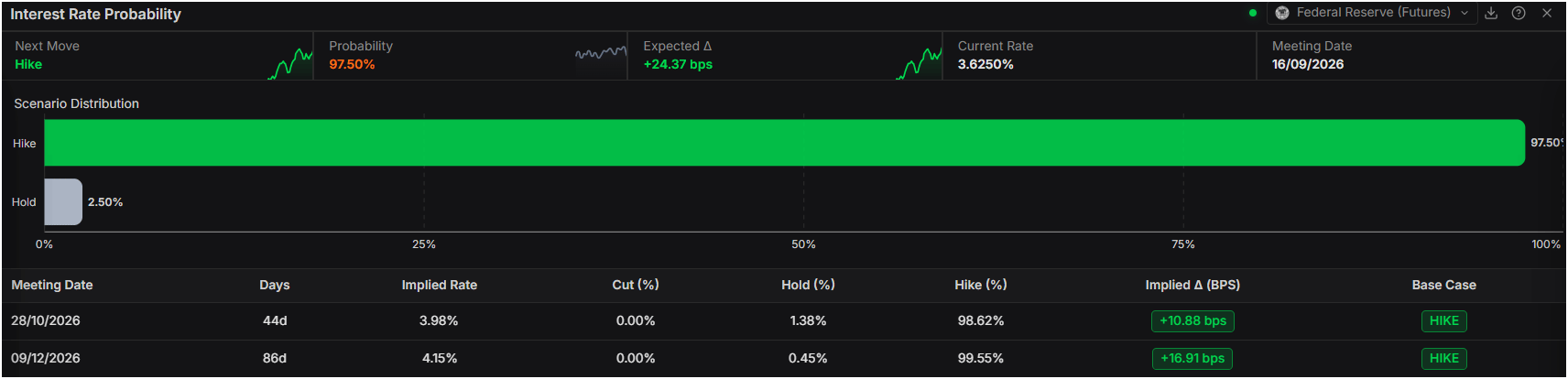
This week, it is a central bank bonanza. Besides the Federal Reserve’s decision, the Bank of England is projected to keep the Bank Rate unchanged at 3.75%, even though the 6-3 vote split is expected to repeat for the third time. On Friday, the Bank of Japan is expected to raise rates by 25 basis points to 1.25%.
This is another reason why Bullion prices are under downward pressure. Even though Gold is a great asset as an inflation hedge, rising global bond yields dent its appeal.
XAU/USD Price Forecast: Gold tests two-month lows, hovers around $4,350
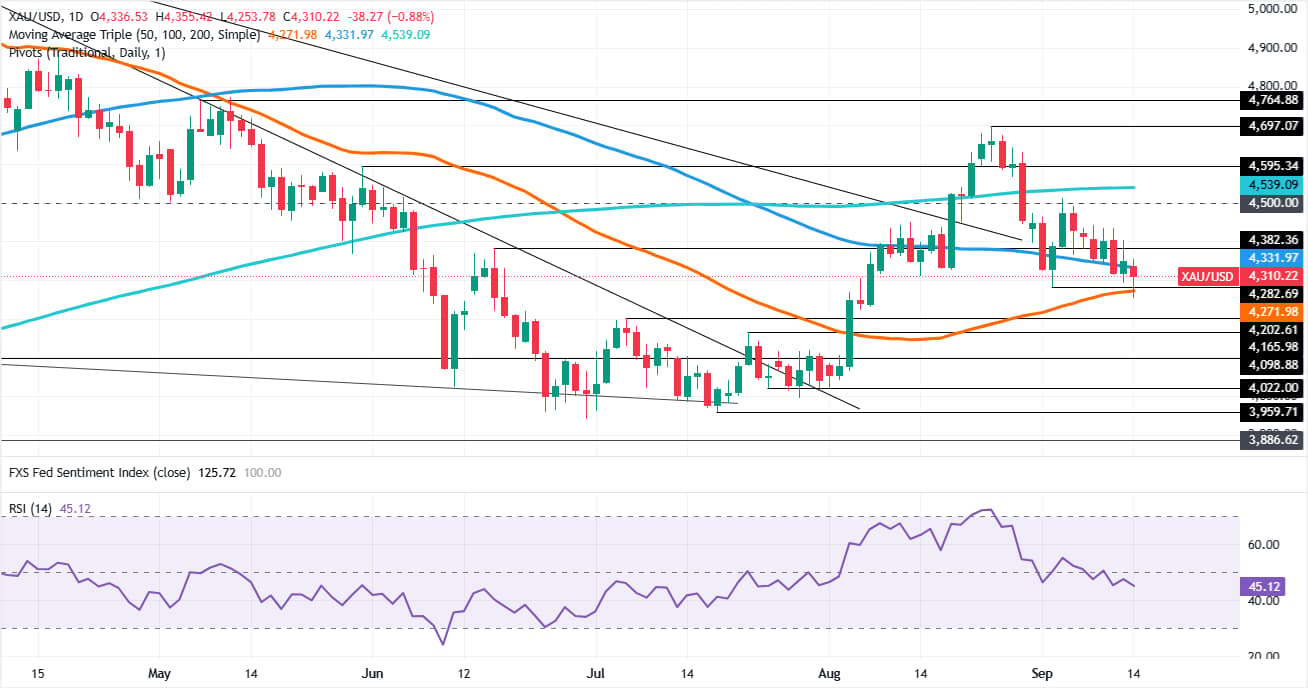
After falling to a five-week low, it seems that Gold is forming a hammer candle chart pattern after testing the 50-day Simple Moving Average (SMA) at $4,271 and reclaiming the $4,300 figure. If XAU closes Monday’s session above the 100-day SMA of $4,351, it opens the door for further upside.
The Relative Strength Index (RSI) remains bearish, indicating further downside. Hence, mixed signals between the RSI and price action can pave the way for some consolidation.
On the upside, the first resistance is the psychological $4,400. Breaking this point opens up psychological targets at $4,450 and $4,500, before reaching the 200-day SMA at $4,539.
On the downside, XAU/USD needs to drop below the 100-day SMA and break $4,300. Below that are September’s second low of $4,282, then the 50-day SMA at $4,271.
Gold FAQs
Gold has played a key role in human’s history as it has been widely used as a store of value and medium of exchange. Currently, apart from its shine and usage for jewelry, the precious metal is widely seen as a safe-haven asset, meaning that it is considered a good investment during turbulent times. Gold is also widely seen as a hedge against inflation and against depreciating currencies as it doesn’t rely on any specific issuer or government.
Central banks are the biggest Gold holders. In their aim to support their currencies in turbulent times, central banks tend to diversify their reserves and buy Gold to improve the perceived strength of the economy and the currency. High Gold reserves can be a source of trust for a country’s solvency. Central banks added 1,136 tonnes of Gold worth around $70 billion to their reserves in 2022, according to data from the World Gold Council. This is the highest yearly purchase since records began. Central banks from emerging economies such as China, India and Turkey are quickly increasing their Gold reserves.
Gold has an inverse correlation with the US Dollar and US Treasuries, which are both major reserve and safe-haven assets. When the Dollar depreciates, Gold tends to rise, enabling investors and central banks to diversify their assets in turbulent times. Gold is also inversely correlated with risk assets. A rally in the stock market tends to weaken Gold price, while sell-offs in riskier markets tend to favor the precious metal.
The price can move due to a wide range of factors. Geopolitical instability or fears of a deep recession can quickly make Gold price escalate due to its safe-haven status. As a yield-less asset, Gold tends to rise with lower interest rates, while higher cost of money usually weighs down on the yellow metal. Still, most moves depend on how the US Dollar (USD) behaves as the asset is priced in dollars (XAU/USD). A strong Dollar tends to keep the price of Gold controlled, whereas a weaker Dollar is likely to push Gold prices up.
Author

Christian Borjon Valencia
FXStreet
Markets analyst, news editor, and trading instructor with over 14 years of experience across FX, commodities, US equity indices, and global macro markets.
















