AUD/USD Price Forecast: Edges higher to mid-0.6500s; remains close to three-week top
- AUD/USD regains positive traction and draws support from a combination of factors.
- The RBA’s hawkish stance benefits the AUD amid a positive risk tone and bearish USD.
- Last week’s breakout through the 100-day SMA backs the case for further appreciation.

The AUD/USD pair attracts some dip-buyers during the Asian session on Tuesday and stalls the previous day's modest pullback from a nearly three-week top. Spot prices currently trade around mid-0.6500s, up over 0.10% for the day, and seem poised to build on the recent goodish recovery move from the lowest level since August 22, touched last month.
The Australian Dollar (AUD) continues to be underpinned by diminishing odds for further policy easing by the Reserve Bank of Australia (RBA). The US Dollar (USD), on the other hand, remains depressed on the back of rising bets for another interest rate cut by the US Federal Reserve (Fed) this month. Apart from this, a positive risk tone is seen denting the Greenback's safe-haven status and benefiting the risk-sensitive Aussie.
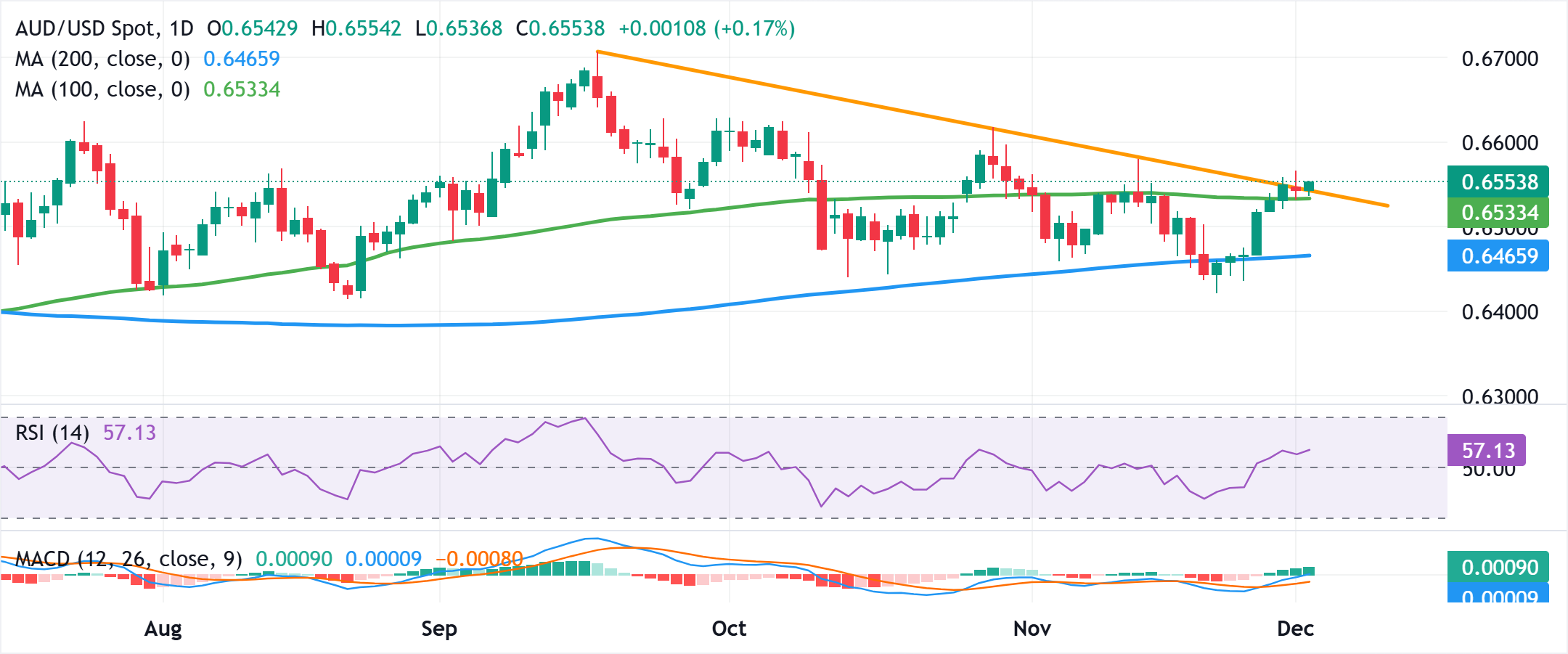
From a technical perspective, the AUD/USD pair finds acceptance above the 100-day Simple Moving Average (SMA) and looks to build on the momentum beyond a descending trend-line hurdle extending from the September swing high. The outlook is reinforced by the fact that oscillators on the daily chart have just started gaining positive traction. This, in turn, backs the case for a move towards reclaiming the 0.6600 mark.
A sustained strength beyond the latter should pave the way for a further near-term appreciating move and lift the AUD/USD pair to the next relevant hurdle near the 0.6660-0.6665 region. The momentum could extend further towards testing the year-to-date high, or levels just above the 0.6700 mark, touched in September.
On the flip side, the 0.6535 area, or the 100-day SMA, now seems to have emerged as an immediate support. This should help limit the downside for the AUD/USD pair ahead of he 0.6500 psychological mark. A convincing break below the latter might expose the 200-day SMA pivotal support, currently pegged near the 0.6465 zone. Failure to defend the said support levels might shift the short-term bias in favor of bearish traders.
AUD/USD daily chart
Australian Dollar FAQs
One of the most significant factors for the Australian Dollar (AUD) is the level of interest rates set by the Reserve Bank of Australia (RBA). Because Australia is a resource-rich country another key driver is the price of its biggest export, Iron Ore. The health of the Chinese economy, its largest trading partner, is a factor, as well as inflation in Australia, its growth rate and Trade Balance. Market sentiment – whether investors are taking on more risky assets (risk-on) or seeking safe-havens (risk-off) – is also a factor, with risk-on positive for AUD.
The Reserve Bank of Australia (RBA) influences the Australian Dollar (AUD) by setting the level of interest rates that Australian banks can lend to each other. This influences the level of interest rates in the economy as a whole. The main goal of the RBA is to maintain a stable inflation rate of 2-3% by adjusting interest rates up or down. Relatively high interest rates compared to other major central banks support the AUD, and the opposite for relatively low. The RBA can also use quantitative easing and tightening to influence credit conditions, with the former AUD-negative and the latter AUD-positive.
China is Australia’s largest trading partner so the health of the Chinese economy is a major influence on the value of the Australian Dollar (AUD). When the Chinese economy is doing well it purchases more raw materials, goods and services from Australia, lifting demand for the AUD, and pushing up its value. The opposite is the case when the Chinese economy is not growing as fast as expected. Positive or negative surprises in Chinese growth data, therefore, often have a direct impact on the Australian Dollar and its pairs.
Iron Ore is Australia’s largest export, accounting for $118 billion a year according to data from 2021, with China as its primary destination. The price of Iron Ore, therefore, can be a driver of the Australian Dollar. Generally, if the price of Iron Ore rises, AUD also goes up, as aggregate demand for the currency increases. The opposite is the case if the price of Iron Ore falls. Higher Iron Ore prices also tend to result in a greater likelihood of a positive Trade Balance for Australia, which is also positive of the AUD.
The Trade Balance, which is the difference between what a country earns from its exports versus what it pays for its imports, is another factor that can influence the value of the Australian Dollar. If Australia produces highly sought after exports, then its currency will gain in value purely from the surplus demand created from foreign buyers seeking to purchase its exports versus what it spends to purchase imports. Therefore, a positive net Trade Balance strengthens the AUD, with the opposite effect if the Trade Balance is negative.
Author

Haresh Menghani
FXStreet
Haresh Menghani is a detail-oriented professional with 10+ years of extensive experience in analysing the global financial markets.