|

AUD/USD Price Analysis: Bears brace for 0.7200 at three-week low

  • AUD/USD holds lower ground near monthly low, prints three-day downtrend.
  • Sustained trading below 200-DMA, descending RSI, not oversold, back the bears.
  • 78.6% Fibonacci retracement can trigger corrective pullback, two-month-old hurdle guards recovery moves.

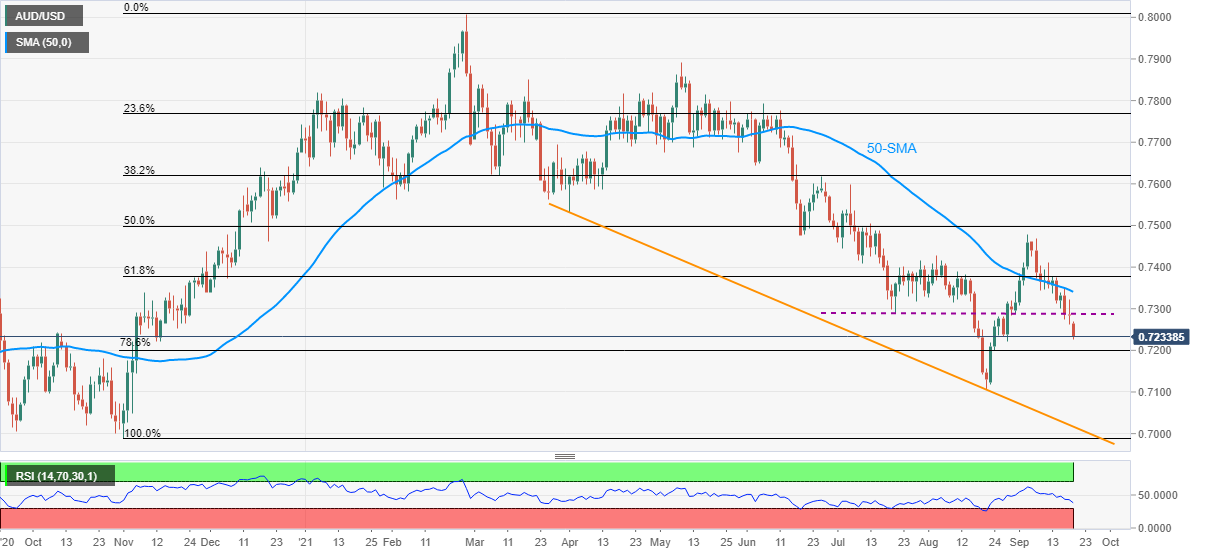
AUD/USD remains pressured around the monthly low of 0.7226, down 0.68% intraday ahead of Monday’s European session.

In doing so, the Aussie pair extends Friday’s downside break of one-month-old horizontal support, now resistance, amid a bearish RSI line.

Given the absence of oversold RSI, AUD/USD prices can continue extending the south-run towards the 0.7200 threshold, comprising 78.6% Fibonacci retracement level of November 2020 to February 2021 upside.

It should be noted, however, that any further downside past 0.7200 may be challenged by the RSI conditions, likely to turn oversold around then, if not then the yearly low near 0.7105 and a descending support line from April close to 0.7015 will be in focus.

Meanwhile, the corrective pullback will be ignored unless crossing a horizontal area comprising July’s low, surrounding 0.7290.

Even so, 50-DMA and 61.8% Fibonacci retracement levels, respectively around 0.7340 and 0.7340, challenge the AUD/USD bulls.

AUD/USD: Daily chart
Trend: Further weakness expected

Additional important levels

Overview
Today last price0.7231
Today Daily Change-0.0053
Today Daily Change %-0.73%
Today daily open0.7284
 
Trends
Daily SMA200.7332
Daily SMA500.7346
Daily SMA1000.7507
Daily SMA2000.7605
 
Levels
Previous Daily High0.7323
Previous Daily Low0.7262
Previous Weekly High0.7377
Previous Weekly Low0.7262
Previous Monthly High0.7427
Previous Monthly Low0.7106
Daily Fibonacci 38.2%0.7285
Daily Fibonacci 61.8%0.73
Daily Pivot Point S10.7256
Daily Pivot Point S20.7228
Daily Pivot Point S30.7194
Daily Pivot Point R10.7317
Daily Pivot Point R20.7351
Daily Pivot Point R30.7379

Author

Anil Panchal

Anil Panchal

FXStreet

Anil Panchal has nearly 15 years of experience in tracking financial markets. With a keen interest in macroeconomics, Anil aptly tracks global news/updates and stays well-informed about the global financial moves and their implications.


More from Anil Panchal
Share:

Editor's Picks

GBP/USD clings to 1.3500 amid marginal losses

GBP/USD alternates gains with losses around the 1.3500 neighbourhood on Tuesday. Indeed, Cable struggles to further extend its incipient recovery in a context of continuous instability in the Middle East and modest gains in the Greenback.

EUR/USD alternates gains with losses near 1.1540

EUR/USD navigates a tight range near 1.1550 in the latter part of Tuesday’s NA session. The US Dollar’s vacillating price action accompanies the pair while market participants gear up for the crucial US inflation data due on Wednesday.

Gold loses the grip below $4,400

Gold retreats from its earlier tops and briefly revisited the $4,350 region per troy ounce on Tuesday. The yellow metal’s modest retracement follows lacklustre gains in the US Dollar and declining US Treasury yields across the curve, all amid steady uncertainty from the geopolitical landscape.

Shiba Inu Price Forecast: SHIB extends sell-off despite surging futures Open Interest
Shiba Inu (SHIB) maintains a bearish outlook on Tuesday, as it edges lower at $0.00000450. This marks the seventh day the meme coin has sustained a sell-off, weighed down by a weak technical structure. Shiba Inu derivatives continue to gain momentum, with perpetual futures Open Interest (OI) rising to 11.08 trillion SHIB on Tuesday, from 10.46 trillion the day before.
The inflation narrative is still way more important than the employment story
Core bonds sold off yesterday with the belly of the curve slightly underperforming in the US while European curves showed more of a bear flattening. Daily changes on the US curve varied between +4.7 bps (2-yr) and +6.4 bps (7-yr).
9-3: Is the Federal Reserve’s vote tally Warsh's new forward guidance?
The rate did not move. Neither did the statement, and that’s the more interesting fact. Set the July 29 Federal Open Market Committee (FOMC) statement beside the one issued on June 17, and the two documents are identical apart from a single verb and a paragraph at the bottom naming three dissenters.














