AUD/USD hits fresh YTD high on hopes of Israel-Iran de-escalation
- The Australian Dollar hits a fresh YTD high as the US Dollar (USD) extends its decline.
- AUD/USD breaks above 0.6500, as Fibonacci resistance firms at 0.6550.
- Chinese Retail Sales and a potential de-escalation in the Israel-Iran conflict support gains, but upside risks remain.

The Australian Dollar (AUD) strengthened against the US Dollar (USD) on Monday, buoyed by improved risk sentiment amid easing geopolitical tensions.
Reports from The Wall Street Journal indicate that Iran is signaling openness to negotiations with the United States (US), prompting optimism about a potential de-escalation in the recent Israel-Iran tensions.
Diplomatic efforts are gaining momentum as international stakeholders, including the United States, Saudi Arabia, and the United Nations, continue to urge restraint and dialogue to prevent further escalation.
Additionally, economic data from China released early in the Asian trading session provided mixed signals but overall helped stabilize market sentiment.
While China's Industrial Production and Fixed Asset Investment figures for May fell short of expectations, posting annual declines, robust Retail Sales data mitigated concerns about broader economic weakness.
Given that China is Australia's largest trading partner, shifts in Chinese economic activity have a direct impact on Australian economic prospects.
Further supporting the AUD/USD pair was notable weakness in the US Dollar following a disappointing Empire State Manufacturing Index report.
The June reading came in at -16.0, markedly below market expectations of -5.5, and representing its weakest performance since March.
The significant miss underscores mounting concerns about contraction within the US manufacturing sector and adds uncertainty to the outlook for US economic momentum, placing downward pressure on the USD.
AUD/USD technical analysis signals rising bullish momentum
The daily chart shows how price action has been fluctuating within a rising wedge pattern that started forming in mid-May.
This pattern has been providing strong levels of support and resistance. Recently, after rising above 0.6500, AUD/USD has continued to gain, and prices are now testing the 38.2% Fibonacci retracement level, which is around 0.6550, from the move between September and January.
The Relative Strength Index (RSI) is currently at 59 and trending upward, indicating an increase in bullish momentum, although it has not yet reached overbought conditions.
AUD/USD daily chart
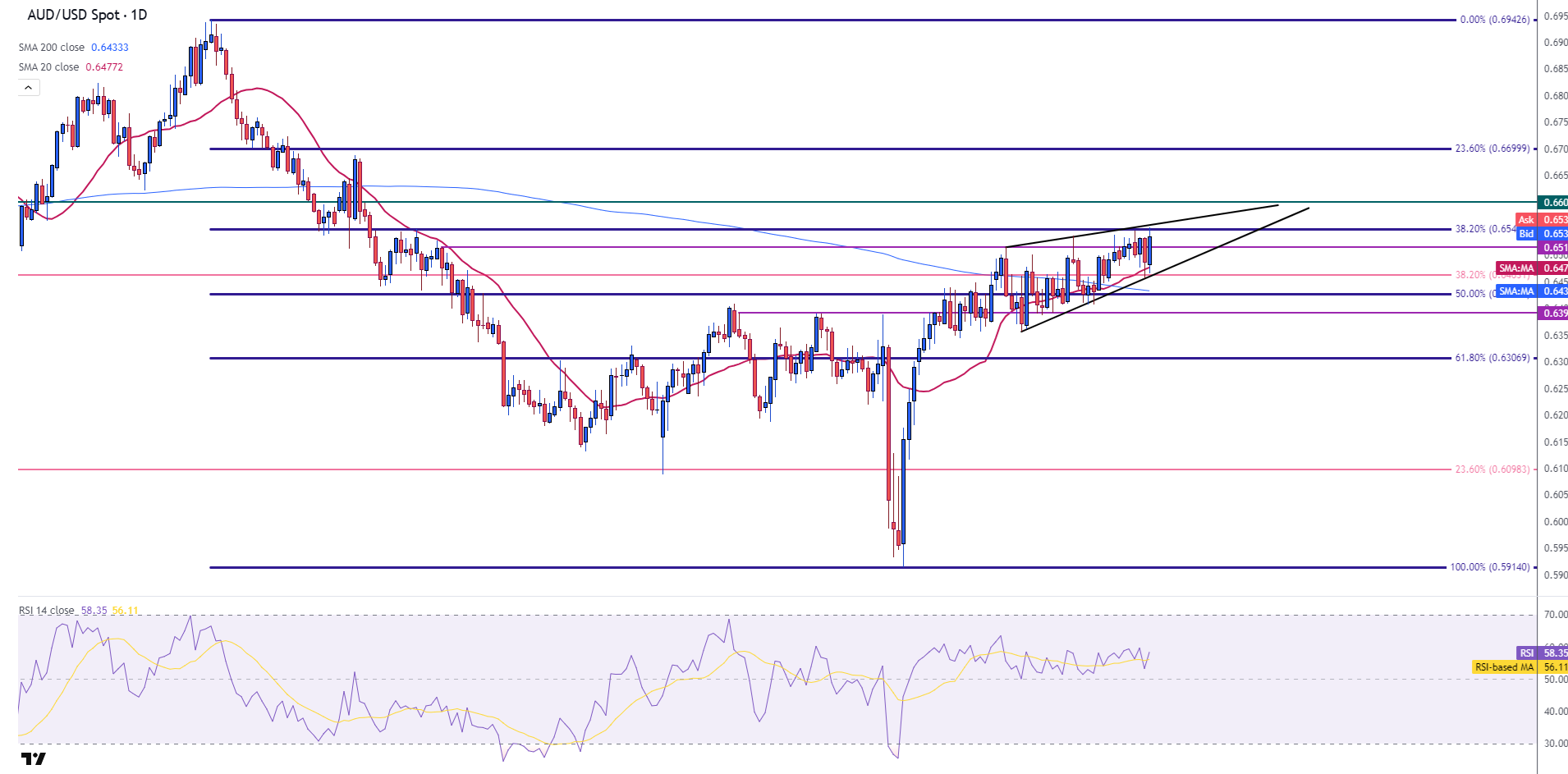
If the price fails to break higher, the wedge could lead to a downward resolution, targeting support at the starting point of the upper boundary of the wedge, which is currently at 0.6516. Below that is the 0.6500 psychological level, a break of which could trigger a deeper pullback to the 200-day Simple Moving Average (SMA) at 0.6433.
On the other hand, if there is a breakout above the wedge, it could pave the way for a move toward the 0.6600 psychological level and toward the 23.6% Fibonacci level at 0.6699.
Australian Dollar FAQs
One of the most significant factors for the Australian Dollar (AUD) is the level of interest rates set by the Reserve Bank of Australia (RBA). Because Australia is a resource-rich country another key driver is the price of its biggest export, Iron Ore. The health of the Chinese economy, its largest trading partner, is a factor, as well as inflation in Australia, its growth rate and Trade Balance. Market sentiment – whether investors are taking on more risky assets (risk-on) or seeking safe-havens (risk-off) – is also a factor, with risk-on positive for AUD.
The Reserve Bank of Australia (RBA) influences the Australian Dollar (AUD) by setting the level of interest rates that Australian banks can lend to each other. This influences the level of interest rates in the economy as a whole. The main goal of the RBA is to maintain a stable inflation rate of 2-3% by adjusting interest rates up or down. Relatively high interest rates compared to other major central banks support the AUD, and the opposite for relatively low. The RBA can also use quantitative easing and tightening to influence credit conditions, with the former AUD-negative and the latter AUD-positive.
China is Australia’s largest trading partner so the health of the Chinese economy is a major influence on the value of the Australian Dollar (AUD). When the Chinese economy is doing well it purchases more raw materials, goods and services from Australia, lifting demand for the AUD, and pushing up its value. The opposite is the case when the Chinese economy is not growing as fast as expected. Positive or negative surprises in Chinese growth data, therefore, often have a direct impact on the Australian Dollar and its pairs.
Iron Ore is Australia’s largest export, accounting for $118 billion a year according to data from 2021, with China as its primary destination. The price of Iron Ore, therefore, can be a driver of the Australian Dollar. Generally, if the price of Iron Ore rises, AUD also goes up, as aggregate demand for the currency increases. The opposite is the case if the price of Iron Ore falls. Higher Iron Ore prices also tend to result in a greater likelihood of a positive Trade Balance for Australia, which is also positive of the AUD.
The Trade Balance, which is the difference between what a country earns from its exports versus what it pays for its imports, is another factor that can influence the value of the Australian Dollar. If Australia produces highly sought after exports, then its currency will gain in value purely from the surplus demand created from foreign buyers seeking to purchase its exports versus what it spends to purchase imports. Therefore, a positive net Trade Balance strengthens the AUD, with the opposite effect if the Trade Balance is negative.
Author

Tammy Da Costa, CFTe®
FXStreet
Tammy is an economist and market analyst with a deep passion for financial markets, particularly commodities and geopolitics.