AUD/USD edges higher as EU-US trade tensions, Fed independence and RBA Minutes come into focus
- AUD/USD edges higher as RBA Minutes receive focus.
- EU-US trade tensions pressure the US Dollar as political pressure on the Fed increases.
- AUD/USD technical analysis: Uptrend holds within a rising wedge, above key moving averages.


The Australian Dollar (AUD) is extending its gains against the US Dollar (USD) on Monday as EU-US trade tensions escalate and concerns over the independence of the Federal Reserve (Fed) rise.
At the time of writing, AUD/USD is trading above 0.6520 as focus shifts to the release of the Minutes from the July Reserve Bank of Australia's policy meeting.
RBA Minutes in focus as markets look for clues on potential size of August rate cut
The Reserve Bank of Australia (RBA) is set to release the Minutes from its July policy meeting on Tuesday, the meeting at which it surprised markets by holding the cash rate steady at 3.85%.
The Minutes will offer deeper insight into the central bank’s decision-making process, including differing views among policymakers and their assessment of the inflation and growth outlook.
With inflation still elevated and economic momentum showing signs of strain, markets have turned their attention to the August meeting, where a rate cut is widely anticipated. A 25-basis-point reduction is mostly priced in, but growing speculation around a more aggressive 50-basis-point cut could shift sentiment. If expectations for a larger cut gain traction, the widening yield differential may lend support to the US Dollar against the Australian Dollar.
EU-US trade tensions pressure US Dollar as political pressure on Fed increases
Meanwhile, escalating trade tensions between the European Union (EU) and the United States (US) are adding pressure to the US Dollar. President Trump has signaled that even if a trade agreement is reached, the EU could still face a broad-based tariff ranging between 15% and 20% on a wide array of exports to the US.
These proposed tariffs would be in addition to the current sector-specific levies, which include a 25% duty on autos and auto parts, as well as a 50% tariff on steel and aluminum. Trump has also suggested that industries such as pharmaceuticals and semiconductors may soon face substantial fees.
This tariff rhetoric has stirred concerns within the Fed, which remains cautious about adjusting interest rates before the full inflationary impact of trade policy becomes clear. However, questions around Fed independence have introduced a fresh layer of uncertainty. Speaking to CNBC on Monday, Treasury Secretary Scott Bessent suggested that it might be time to reevaluate the institution itself, questioning whether it has been effective in fulfilling its mandate.
Despite political pressure on the Fed to ease monetary policy, market expectations remain mixed. According to the CME FedWatch Tool, there is currently a 56.2% probability of a 0.25% rate cut at the September meeting, while the odds of holding rates steady have risen to 42.3%.
AUD/USD technical analysis: Uptrend holds within a rising wedge, above key moving averages
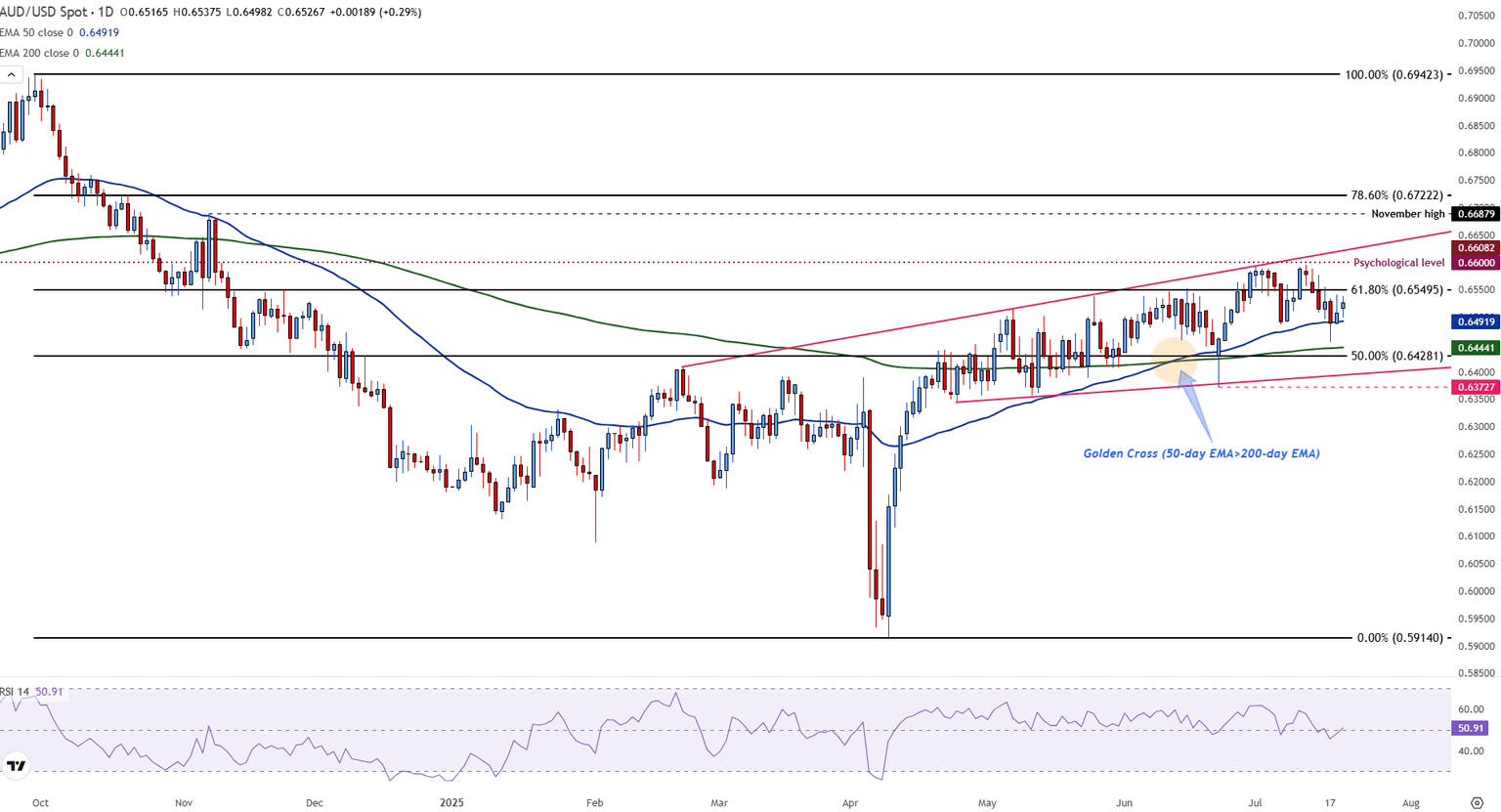
The AUD/USD daily chart indicates that the uptrend currently remains intact, supported by a recent Golden Cross.
This forms when the 50-day Exponential Moving Average (EMA) crosses above the 200-day EMA, signaling upward momentum.
Price action is currently moving within a rising wedge pattern, which has recently provided support and resistance for the pair.
Prices currently remain supported by both the 50-day EMA near 0.6492 and the 200-day EMA at 0.6444, reinforcing near-term bullish sentiment.
AUD/USD daily chart
Key resistance lies at the 61.8% Fibonacci retracement level of the September-April decline around 0.6550.
Further upside targets at the psychological level of 0.6600 and the November high around 0.6688.
On the downside, strong support is at the 50% Fibonacci level at 0.6428, which aligns closely with the wedge’s lower boundary.
A break below this area could shift momentum bearish, especially if price falls under the 200-day EMA.
The Relative Strength Index (RSI) is currently neutral at 51, indicating a lack of strong momentum in either direction.
Central banks FAQs
Central Banks have a key mandate which is making sure that there is price stability in a country or region. Economies are constantly facing inflation or deflation when prices for certain goods and services are fluctuating. Constant rising prices for the same goods means inflation, constant lowered prices for the same goods means deflation. It is the task of the central bank to keep the demand in line by tweaking its policy rate. For the biggest central banks like the US Federal Reserve (Fed), the European Central Bank (ECB) or the Bank of England (BoE), the mandate is to keep inflation close to 2%.
A central bank has one important tool at its disposal to get inflation higher or lower, and that is by tweaking its benchmark policy rate, commonly known as interest rate. On pre-communicated moments, the central bank will issue a statement with its policy rate and provide additional reasoning on why it is either remaining or changing (cutting or hiking) it. Local banks will adjust their savings and lending rates accordingly, which in turn will make it either harder or easier for people to earn on their savings or for companies to take out loans and make investments in their businesses. When the central bank hikes interest rates substantially, this is called monetary tightening. When it is cutting its benchmark rate, it is called monetary easing.
A central bank is often politically independent. Members of the central bank policy board are passing through a series of panels and hearings before being appointed to a policy board seat. Each member in that board often has a certain conviction on how the central bank should control inflation and the subsequent monetary policy. Members that want a very loose monetary policy, with low rates and cheap lending, to boost the economy substantially while being content to see inflation slightly above 2%, are called ‘doves’. Members that rather want to see higher rates to reward savings and want to keep a lit on inflation at all time are called ‘hawks’ and will not rest until inflation is at or just below 2%.
Normally, there is a chairman or president who leads each meeting, needs to create a consensus between the hawks or doves and has his or her final say when it would come down to a vote split to avoid a 50-50 tie on whether the current policy should be adjusted. The chairman will deliver speeches which often can be followed live, where the current monetary stance and outlook is being communicated. A central bank will try to push forward its monetary policy without triggering violent swings in rates, equities, or its currency. All members of the central bank will channel their stance toward the markets in advance of a policy meeting event. A few days before a policy meeting takes place until the new policy has been communicated, members are forbidden to talk publicly. This is called the blackout period.
Author
Tammy Da Costa, CFTe®
FXStreet
Tammy is an economist and market analyst with a deep passion for financial markets, particularly commodities and geopolitics.