AUD/USD drops on Fed’s hawkish cut, Aussie jobs data eyed
- AUD/USD falls from 0.6707 to 0.6652 as Dollar rebounds on Fed decision and Powell’s guarded outlook.
- SEP projects fed funds rate at 3.6% by year-end, with inflation seen easing toward 2% only by 2028.
- Australia expected to add 22K jobs in August, jobless rate steady at 4.2%; US jobless claims next on docket.


The Australian Dollar reversed course on Wednesday, tumbled over 0.48% as the Greenback staged a recovery following the Fed’s decision to cut rates by 25 basis points. Although it usually would be negative for the Dollar, the AUD/USD fell from around 0.6707 to current levels at around 0.6652.
Aussie slides after Fed delivers 25 bps cut with cautious tone; traders eye upcoming Australian jobs report
The decision by the Federal Reserve was not unanimous as Governor Stephen Miran, appointed by US President Donald Trump, voted for a 50 basis points reduction.
The Fed’s statement acknowledged downside risks to the labor market, noting that while unemployment remains low, it has edged higher. On inflation, the central bank said that pressured edged up and remain “somewhat elevated.”
The Summary of Economic Projections (SEP) revealed that most officials estimate the fed funds rates to end at 3.6% in 2025, GDP growth at 1.6% and the Unemployment Rate at 4.5%. Inflation is projected to end at 3%, the Core PCE is foreseen to remain at 3.1% and officials estimate that inflation will hit their 2% target in 2028.
In his presser, Fed Chair Jerome Powell said labor demand “has softened” while inflation remains “somewhat elevated.” He noted that the balance of risks has “shifted” and emphasized that monetary policy is well positioned to respond as needed, though he cautioned that the labor market is “not solid.”
Addressing speculation about a larger move, Powell dismissed the notion, saying there was “no widespread support for a 50-basis-point cut today,” and stressed that the Fed is not in a rush to ease policy.
On the Aussie’s front, traders are eyeing employment data. The Australian Bureau of Statistics (ABS) is expected to announce that the country added 22K new job positions in the month, while the Unemployment Rate is forecast to remain stable at 4.2%. If you are looking for a preview, click here: Australia unemployment rate expected to remain at 4.2% as job market struggles persist
On the US front, the docket will feature the Philadelphia Fed Index, and Initial Jobless Claims for the week ending September 13, with estimates of 240K people filing for new unemployment benefits.
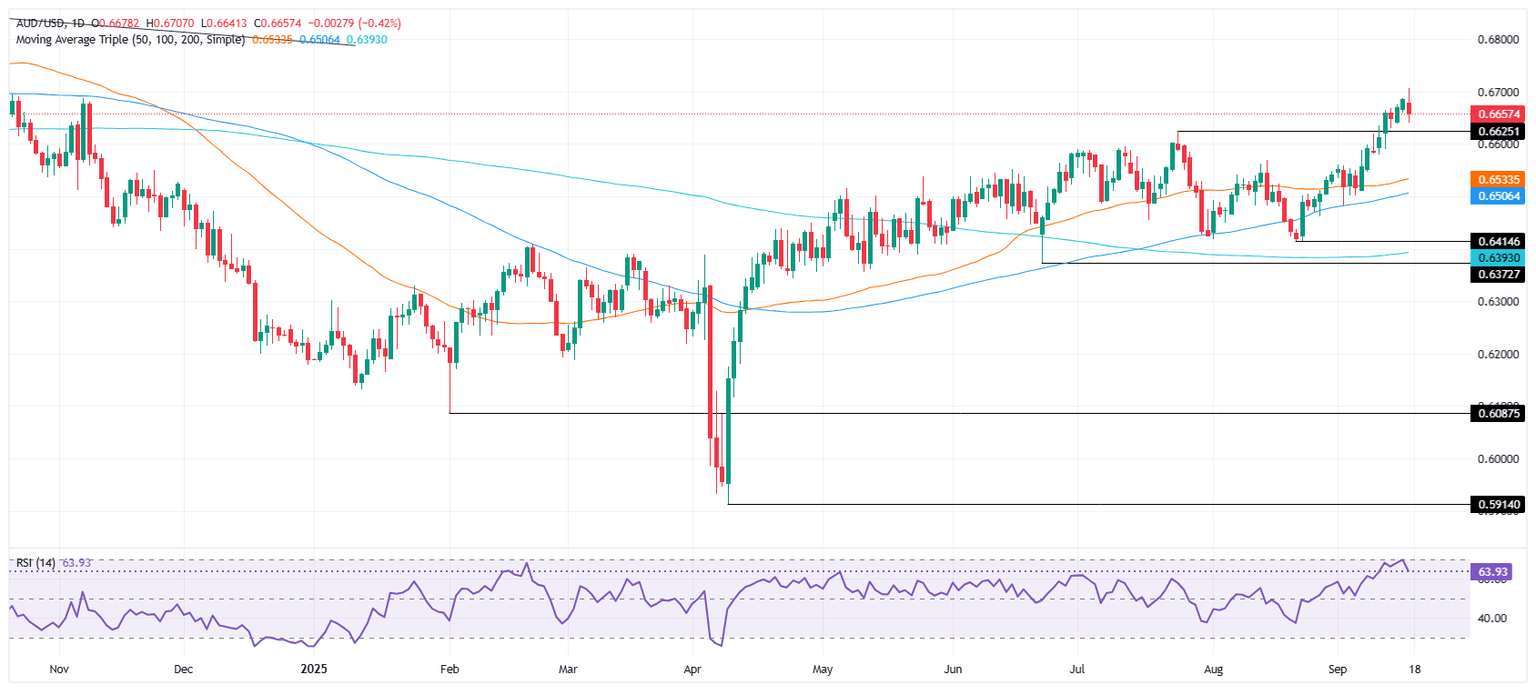
AUD/USD Price Forecast: Upside remains above 0.6625
From a technical view, the AUD/USD remains upward biased if it remains above the previous cycle high of 0.6625, the July 24 peak. Although the Relative Strength Index (RSI) turned flat, shows that bullish momentum remains.
On the upside, key resistance levels lie at 0.6700 and the yearly peak of 0.6707 hit on September 17. On further strength, the next area of supply will be October 21, 2024 peaj at 0.6723. On the flip side, if the Aussie tumbles below 0.6625, up next lies 0.6600 and the 20-day SMA at 0.6575.
Australian Dollar FAQs
One of the most significant factors for the Australian Dollar (AUD) is the level of interest rates set by the Reserve Bank of Australia (RBA). Because Australia is a resource-rich country another key driver is the price of its biggest export, Iron Ore. The health of the Chinese economy, its largest trading partner, is a factor, as well as inflation in Australia, its growth rate and Trade Balance. Market sentiment – whether investors are taking on more risky assets (risk-on) or seeking safe-havens (risk-off) – is also a factor, with risk-on positive for AUD.
The Reserve Bank of Australia (RBA) influences the Australian Dollar (AUD) by setting the level of interest rates that Australian banks can lend to each other. This influences the level of interest rates in the economy as a whole. The main goal of the RBA is to maintain a stable inflation rate of 2-3% by adjusting interest rates up or down. Relatively high interest rates compared to other major central banks support the AUD, and the opposite for relatively low. The RBA can also use quantitative easing and tightening to influence credit conditions, with the former AUD-negative and the latter AUD-positive.
China is Australia’s largest trading partner so the health of the Chinese economy is a major influence on the value of the Australian Dollar (AUD). When the Chinese economy is doing well it purchases more raw materials, goods and services from Australia, lifting demand for the AUD, and pushing up its value. The opposite is the case when the Chinese economy is not growing as fast as expected. Positive or negative surprises in Chinese growth data, therefore, often have a direct impact on the Australian Dollar and its pairs.
Iron Ore is Australia’s largest export, accounting for $118 billion a year according to data from 2021, with China as its primary destination. The price of Iron Ore, therefore, can be a driver of the Australian Dollar. Generally, if the price of Iron Ore rises, AUD also goes up, as aggregate demand for the currency increases. The opposite is the case if the price of Iron Ore falls. Higher Iron Ore prices also tend to result in a greater likelihood of a positive Trade Balance for Australia, which is also positive of the AUD.
The Trade Balance, which is the difference between what a country earns from its exports versus what it pays for its imports, is another factor that can influence the value of the Australian Dollar. If Australia produces highly sought after exports, then its currency will gain in value purely from the surplus demand created from foreign buyers seeking to purchase its exports versus what it spends to purchase imports. Therefore, a positive net Trade Balance strengthens the AUD, with the opposite effect if the Trade Balance is negative.
Author
Christian Borjon Valencia
FXStreet
Markets analyst, news editor, and trading instructor with over 14 years of experience across FX, commodities, US equity indices, and global macro markets.