|

AUD/USD defies hawkish Fed officials, surges on soft USD and falling bond yields

  • Hawkish comments by Fed policymakers capped the Australian Dollar rally.
  • China’s economic data foreseeing solid growth is a tailwind for the AUD/USD.
  • RBA minutes showed that their latest meeting decision was a hawkish hold.

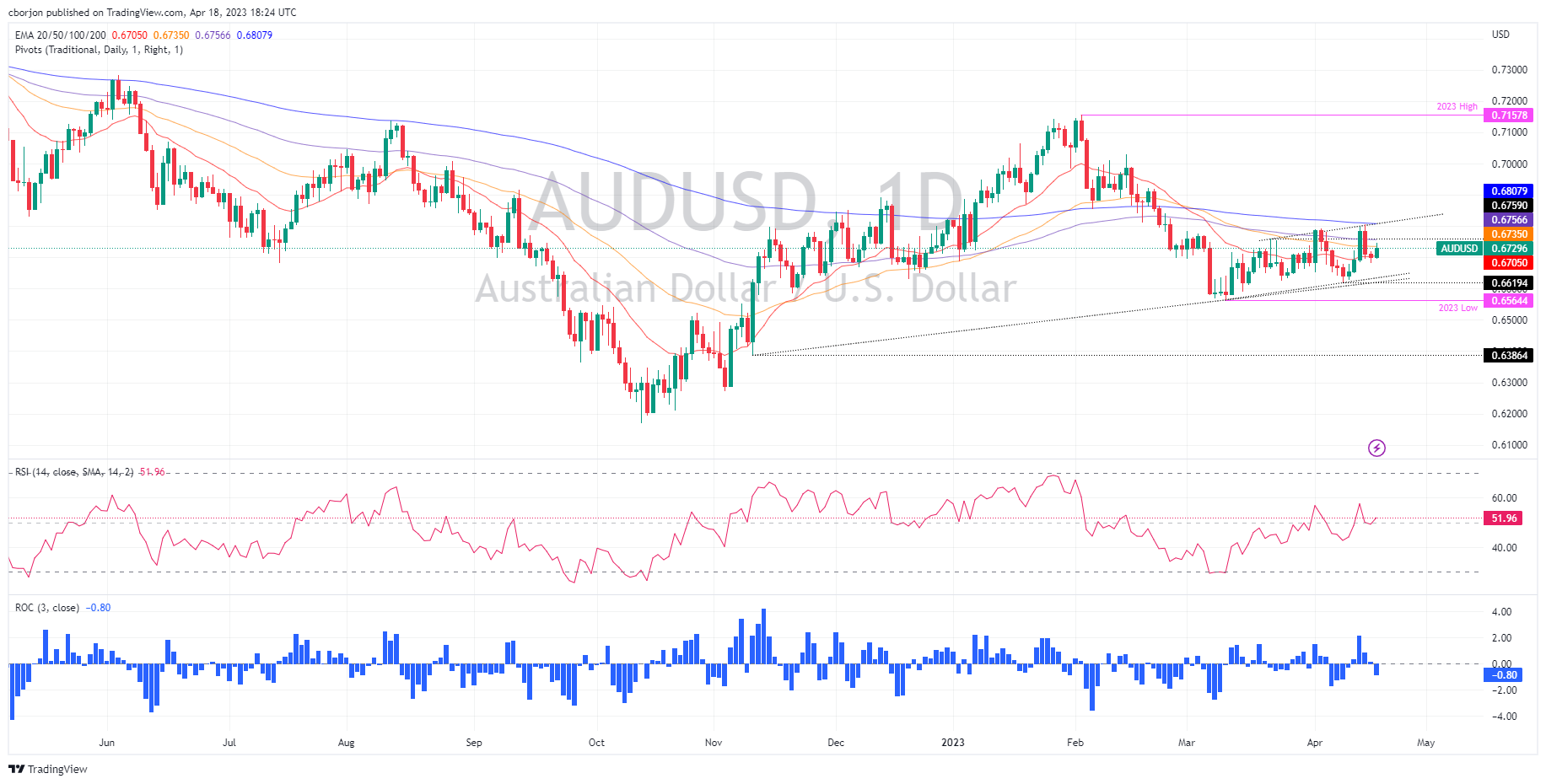
AUD/USD caps its two-day downtrend at around the 20-day EMA and climbs toward the 50-day EMA, bolstered by a soft US Dollar (USD), which is undermined by falling US Treasury bond yields. Federal Reserve officials continued reinforcing their hawkish posture, but investors have ignored it. At the time of writing, the AUD/USD is trading at 0.6726.

Despite a sour sentiment, the Australian Dollar gains on a soft US Dollar

After falling to weekly lows at around 0.6681, buyers entered the market as the AUD/USD reclaimed 0.6700. On Tuesday, two Fed officials reiterated that the Fed needs to raise rates, coinciding that a recession is not the baseline scenario for both. However, St. Louis Fed President James Bullard expects the Federal Funds Rate (FFR) to end between the 5.50%-5.75% range.

Most US Treasury bond yields dropped, except for the 2-year, which sits at 4.218%, erasing its earlier losses, following Monday’s gains of 10 bps. Hence, the greenback remains pressured, as shown by the performance of a basket of six currencies vs. the US Dollar, namely the US Dollar Index, down 0.34% at 101.752.

Although market participants are bracing for a 25 bps rate hike by the Federal Reserve, as shown by the CME FedWatch Tool odds at 86.7% chance, the US Dollar could not extend its gains to three consecutive days.

The US economic agenda featured Housing Starts for March, which decreased by 0.80% MoM after a 7.3% surge in the prior’s month. In the meantime, Building Permits plunged 8.8%, missing estimates of a gain of 1.45%, though figures for February.

On the Australian front, China’s data underpinned the Australian Dollar (AUD). China’s GDP grew 4.5% YoY in Q1, crushing the latest 2022 quarter of 2.9%. Retail Sales jumped 10.6%, while Industrial Production missed estimates of 4% at 3.9%.

Furthermore, the Reserve Bank of Australia (RBA) monetary policy minutes showed that the board discussed a possible 25 bps rate hike, though they decided to keep rates unchanged at 3.60%. Of note, the minutes included comments that inflation “remained too high and the labor market was very tight,” a signal that the RBA kept the door open for further tightening.

AUD/USD Technical Analysis
AUD/USD

Even though the AUD/USD fall was capped at the 20-day EMA, the pair remains neutral to downward biased. For a bullish resumption, the AUD/USD must break the 50-day EMA at 0.6735, exposing the 100-day EMA at 0.6756. Once cleared, the 0.6800 psychological level would be up for grabs. Contrarily, if AUD/USD slides back below 0.6700, expect a bearish continuation. The first support would be the weekly low of 0.6681, followed by a one-and-a-half-month upslope support trendline at 0.6630. Break below, and 0.6600 will be next.

AUD/USD

Overview
Today last price0.6728
Today Daily Change0.0027
Today Daily Change %0.40
Today daily open0.6701
 
Trends
Daily SMA200.6695
Daily SMA500.6744
Daily SMA1000.68
Daily SMA2000.6744
 
Levels
Previous Daily High0.6719
Previous Daily Low0.6681
Previous Weekly High0.6806
Previous Weekly Low0.662
Previous Monthly High0.6784
Previous Monthly Low0.6564
Daily Fibonacci 38.2%0.6696
Daily Fibonacci 61.8%0.6705
Daily Pivot Point S10.6682
Daily Pivot Point S20.6662
Daily Pivot Point S30.6644
Daily Pivot Point R10.672
Daily Pivot Point R20.6739
Daily Pivot Point R30.6758
 

Author

Christian Borjon Valencia

Markets analyst, news editor, and trading instructor with over 14 years of experience across FX, commodities, US equity indices, and global macro markets.


More from Christian Borjon Valencia
Share:

Editor's Picks

AUD/USD consolidates above 0.7000/two-month low; bearish potential intact

The AUD/USD pair oscillates in a narrow range during the Asian session, and moves little following the release of mixed inflation figures from China. Spot prices currently trade around the 0.7025 region, nearly unchanged for the day, and remain within striking distance of a nearly two-month low set on Tuesday. Renewed hostilities between the US and Iran temper hopes for a deal to end the over three-month-old war.

Japanese Yen languishes despite wholesale inflation accelerates in May

USD/JPY flatlines after experiencing volatility, trading around 160.40 during the Asian hours on Wednesday. The pair continues to hold its ground, reflecting a struggling Japanese Yen that has failed to find support despite a massive acceleration in wholesale inflation. Driven by surging energy costs linked to the ongoing Middle East conflict, Japan’s Producer Price Index jumped 6.3% year-over-year in May. This hot printing comfortably outpaced April’s upwardly revised 5.3% figure and surpassed market consensus of 5.5%, marking the fastest pace of wholesale price growth in three years.

$4,200: Gold retains bearish bias near March low ahead of US CPI

Gold recovers slightly after touching a fresh low since March 23, though it retains a bearish bias near the $4,200 mark through the early European session. Renewed hostilities between the US and Iran fuel inflationary concerns and bolster bets for more hawkish central banks, which is seen as a key factor driving flows away from the non-yielding yellow metal. Furthermore, the decline could be attributed to technical selling following the recent breakdown below the very important 200-day SMA.

Cardano's downtrend deepens despite on-chain bottoming signals

Cardano edges lower to $0.1600 signaling a potential extension of the 30% loss from last week. The altcoin remains under intense selling pressure, weighing on its retail support. Still, a spike in dormant supply re-entering circulation signals that the selling pressure has run its course, a pattern that often precedes a rebound.

US CPI data set to show inflation at three-year high in May, backing Fed hawkish tilt

The US Bureau of Labor Statistics will publish the May Consumer Price Index (CPI) data on Wednesday. The report is expected to show another step up in consumer inflation, driven by the persistently high Oil prices due to the ongoing crisis in the Middle East.

The US economy defies the rules: 100 days into the Oil shock and the recession signal is still missing

More than three months after the start of the Iran war and the resulting disruption to global energy markets, the US economy continues to display remarkable resilience. The conflict has triggered a sharp rise in Oil prices, reignited inflationary pressures and fueled widespread concerns about a potential economic slowdown.














