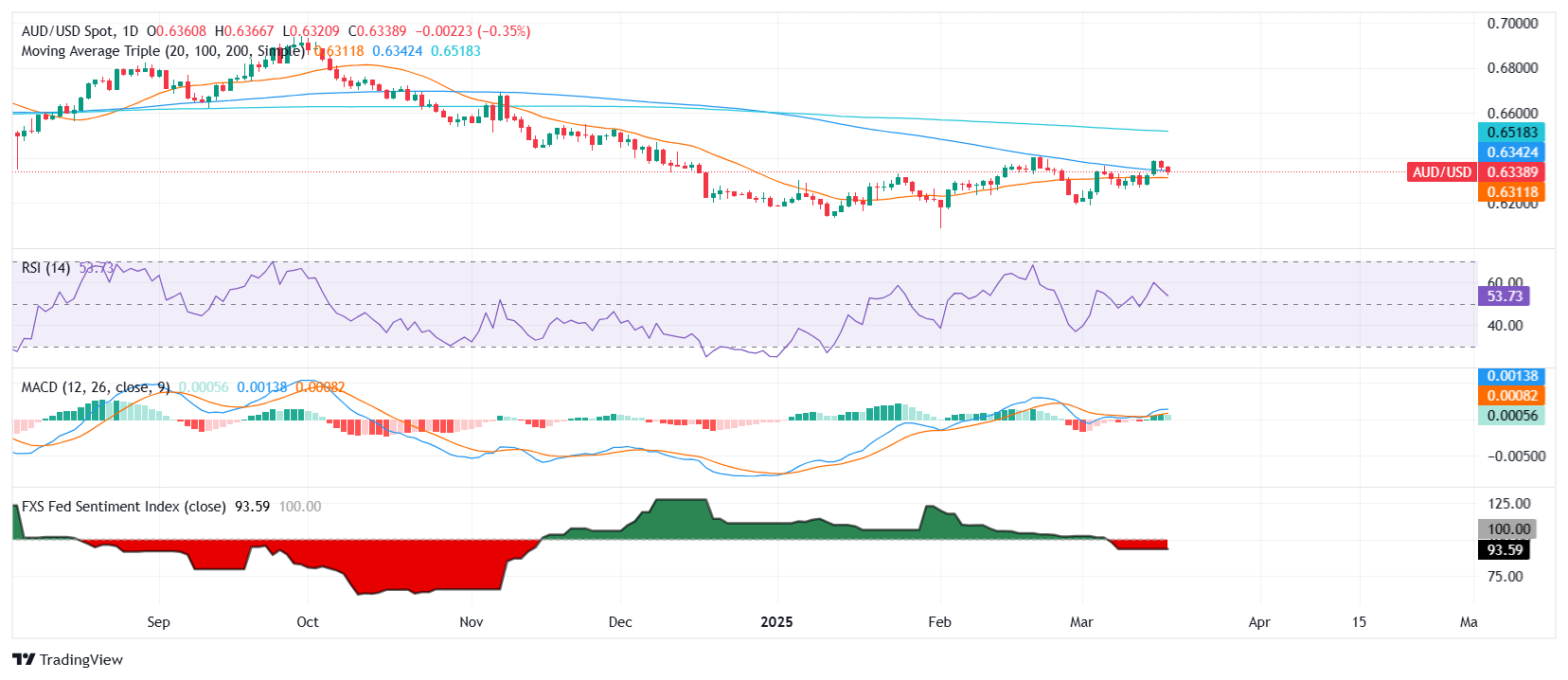
AUD/USD trims losses as Powell signals patience, Fed sentiment remains dovish
- AUD/USD rebounds from 0.6330 as the US Dollar loses momentum post-Powell’s cautious remarks.
- The Federal Reserve leaves interest rates unchanged at 4.5%, aligning with market expectations.
- FOMC dot plot signals rate cuts ahead, with the 2025 median forecast revised lower to 3.375%.
- Fed Sentiment Index remains dovish, contributing to a mild USD pullback.


The AUD/USD pair initially fell below 0.6330 following the Federal Reserve’s (Fed) monetary policy decision but later trimmed part of its losses as the US Dollar (USD) lost ground post-Powell’s press conference. The Fed left interest rates unchanged at 4.5%, reinforcing a cautious approach amid inflation and economic uncertainties.
The latest FOMC dot plot signaled a gradual policy easing ahead, with the median rate forecast for 2025 revised down to 3.375% from 3.875%. GDP expectations were also adjusted lower to 1.7% from 2.1%, while unemployment projections rose to 4.4%, indicating potential labor market softening. Additionally, the Fed announced a slower pace of balance sheet runoff starting in April, modifying its quantitative tightening strategy.
Despite the initial USD strength, the Aussie pair rebounded as Federal Reserve Chair Jerome Powell reinforced the Fed’s patient approach to policy adjustments. Powell emphasized that monetary policy is not on a predetermined course and that the Fed will wait for clearer economic signals before making changes. He also acknowledged the difficulty in assessing the inflationary impact of tariffs, adding uncertainty to the outlook.
Additionally, Powell commented that forecasters have slightly raised their expectations for a potential recession, but the probability remains low. This, combined with a dovish shift in the Fed Sentiment Index, contributed to a mild pullback in the US Dollar, allowing AUD/USD to recover from session lows.
AUD/USD daily chart
Author
Patricio Martín
FXStreet
Patricio is an economist from Argentina passionate about global finance and understanding the daily movements of the markets.