|

AUD/USD attempting to correct from US session lows

  • AUD/USD has started to correct but is slowing in Asia.
  • AUD/USD bulls stepped in at US session lows, a steeper correction is eyed toward a 50% mean reversion. 

AUD/USD is flat at around 0.6700 in Tokyo, correcting from the US session lows.  In the US data, prices are rising, but more slowly than expected. The PPI data for April increased 0.2% MoM with annual growth now at 2.3% YoY. Petrol prices in the US lifted more slowly than expected, while food prices actually fell. Core prices are now up 3.4% YoY. ´´The data indicates ongoing price pressures in core services,´´ analysts at ANZ Bank explained. 

Elsewhere, the number of Americans filing new claims for unemployment benefits leaped to a 1-1/2-year high last week, and producer prices rebounded modestly in April. US Weekly Initial Unemployment Claims Rose +22,000 to 264,000, showing a weaker labor market than expectations of 245,000.

Domestically, the analysts at ANZ Bank explained that the Western Australian budget estimates a AUD4.2bn surplus in 2022-23, the same as the federal budget.

´´This is AUD 1.8bn larger than was expected in the Mid-Year Financial Projections Statement, published in December 2022. The state treasury forecasts a smaller net operating surplus of AUD3.3bn in 2023-24, AUD1bn lower than in the mid-year update,´´ the analysts explained, adding, ´´the smaller surplus reflects the increase in expenses to provide cost-of-living support and additional investment in front-line service delivery in the health, education and disability services sectors.´´

AUD/USD technical analysis
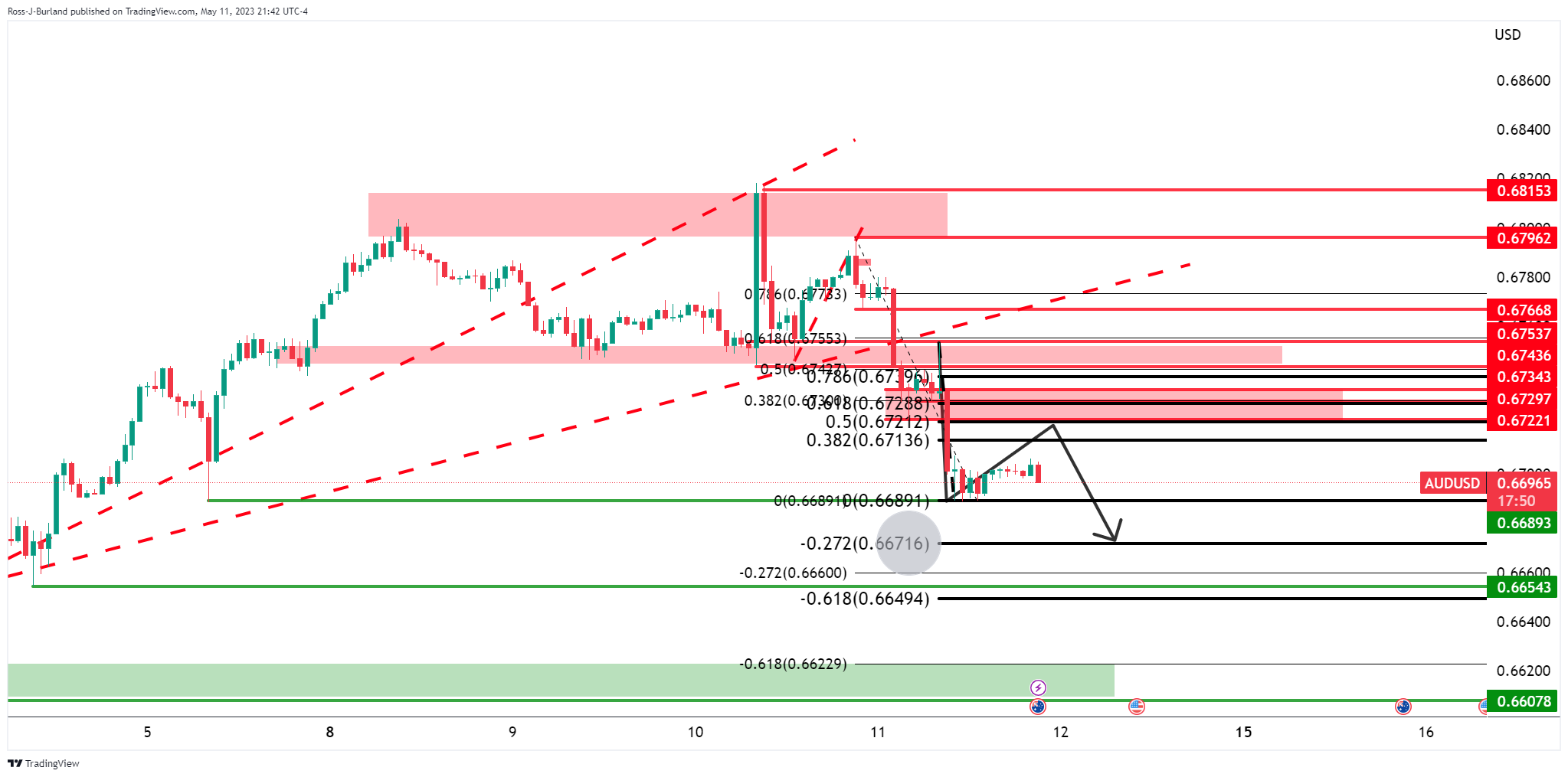
A drive into the hourly resistance could equate to a downside continuation towards 0.6670 initially. 

Author

Ross J Burland

Ross J Burland, born in England, UK, is a sportsman at heart. He played Rugby and Judo for his county, Kent and the South East of England Rugby team.


More from Ross J Burland
Share:

Editor's Picks

AUD/USD edges higher as hot CPI inflation and hawkish RBA lift rate hike bets

The AUD/USD pair gathers strength to near 0.7035 during the Asian trading hours on Friday. The Australian Dollar edges higher against the US Dollar as hotter Australian CPI inflation data has bolstered expectations of Reserve Bank of Australia rate hikes.

USD/JPY meets support near 157.00

USD/JPY retreats for the third consecutive day on Friday, revisiting the 157.00 region before attempting some recovery as investors continue to assess the latest BoJ meeting, where the central bank left rates unchanged, as widely anticipated.

Gold sinks to fresh yearly lows despite risk-off mood as Fed rate hike bets weigh

Gold slips to fresh year-to-date lows on Friday. The metal struggles despite a risk-off mood across markets, as expectations of further Federal Reserve (Fed) interest rate hikes continue to dominate price action, leaving Gold on track to end the month in negative territory.


Ripple Price Forecast: XRP bulls defend $1.20 as sell-side pressure triggers liquidations
Ripple (XRP) trades around $1.25 on Friday, rising from a short-term support level established at $1.20. This minor upward correction follows a sharp sell-off, triggered amid reports of a hack attack on the Binance exchange that impacted approximately $6.3 billion. The attack drove the broader crypto market on edge, as Binance suspended both deposits and withdrawals to contain the situation.
BoJ recap: A pause for now... but Japan has entered a new inflation phase
The Bank of Japan left its short-term policy rate unchanged at 1.25% but delivered a distinctly hawkish message on the risk of an inflation overshoot. The decision passed by 8-1, with board member Takata dissenting in favour of an increase to 1.5%, while Governor Kazuo Ueda stressed that the Bank would continue adjusting policy as needed.
The 2% inflation target came from a throwaway remark. It now moves trillions
The Federal Reserve's 2% inflation goal grew out of an off-the-cuff remark by a New Zealand politician in 1988. Bond investors still price long-term US debt as if 2% holds, so a change in how the Fed measures inflation would move markets.















