AUD/NZD price analysis: Aussie holds near 1.0900 as bullish tone persists
- AUD/NZD trades around the 1.0900 zone with limited movement in Wednesday’s session.
- Mixed signals from momentum indicators, though shorter-term averages favor buyers.
- Key support levels sit below, while resistance aligns near recent highs.

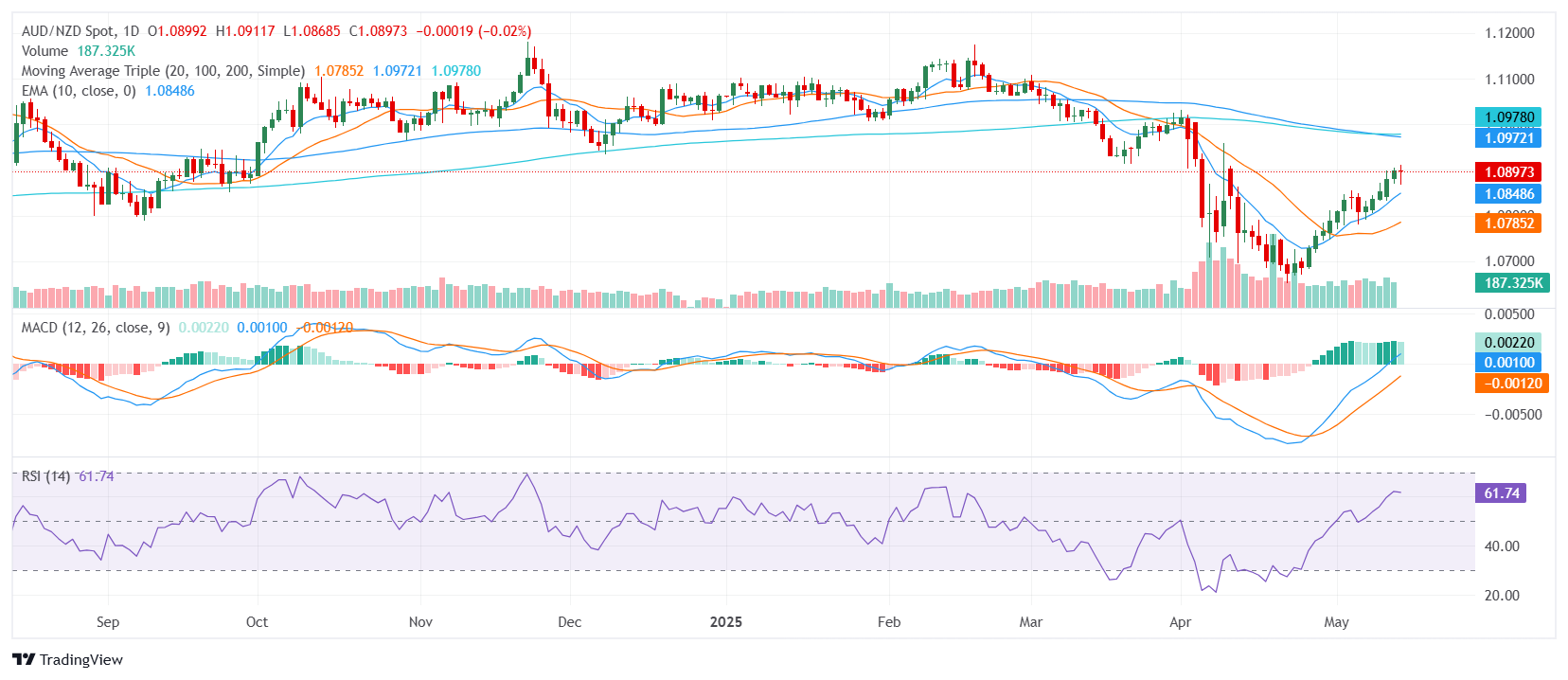
The AUD/NZD pair held near the 1.0900 zone on Wednesday, reflecting a steady bullish tone as the market heads into the Asian session. Price action remains close to the top of its daily range, suggesting that buyers maintain control despite some mixed momentum signals. The broader technical outlook remains supported by shorter-term moving averages, though longer-term resistance levels continue to pose a challenge.
From a technical perspective, the pair presents a cautiously bullish outlook. The Relative Strength Index is in the 60s, indicating neutral conditions without immediate overbought pressure. The Moving Average Convergence Divergence confirms the broader uptrend with a buy signal, reinforcing the positive tone. However, both the Williams Percent Range and Stochastic RSI Fast are signaling overbought conditions, highlighting the potential for a near-term pullback if recent gains fail to hold.
The moving averages provide a more supportive backdrop. The 10-day Exponential and Simple Moving Averages, both positioned near current price levels, reinforce the buy sentiment, reflecting solid short-term support. The 20-day Simple Moving Average also supports the bullish tone, though the 100-day and 200-day Simple Moving Averages remain above current levels, suggesting that broader selling pressure may still limit upside potential over the medium term.
Support levels are located near 1.0870, 1.0870, and 1.0860. Resistance is found at 1.0910, 1.0920, and 1.0950. A break above the immediate resistance zone could confirm a broader breakout, while a move below support might trigger a short-term correction, potentially testing the lower end of the recent range.
Daily Chart
Author

Patricio Martín
FXStreet
Patricio is an economist from Argentina passionate about global finance and understanding the daily movements of the markets.