AUD/NZD Price Analysis: Aussie extends gains near 1.0800 as bullish momentum builds
- AUD/NZD trades near the 1.0800 zone after modest gains in Thursday’s session.
- Short-term indicators support the bullish bias, despite mixed long-term signals.
- Immediate support holds below, while resistance aligns near recent highs.

The AUD/NZD pair climbed higher on Thursday, trading near the 1.0800 area after the European session, reflecting a steady bullish tone as the market approaches the Asian session. The pair remains close to the top of its daily range, suggesting that buyers maintain control despite some mixed signals from longer-term averages. Short-term momentum appears supportive, with the pair finding consistent demand on dips.
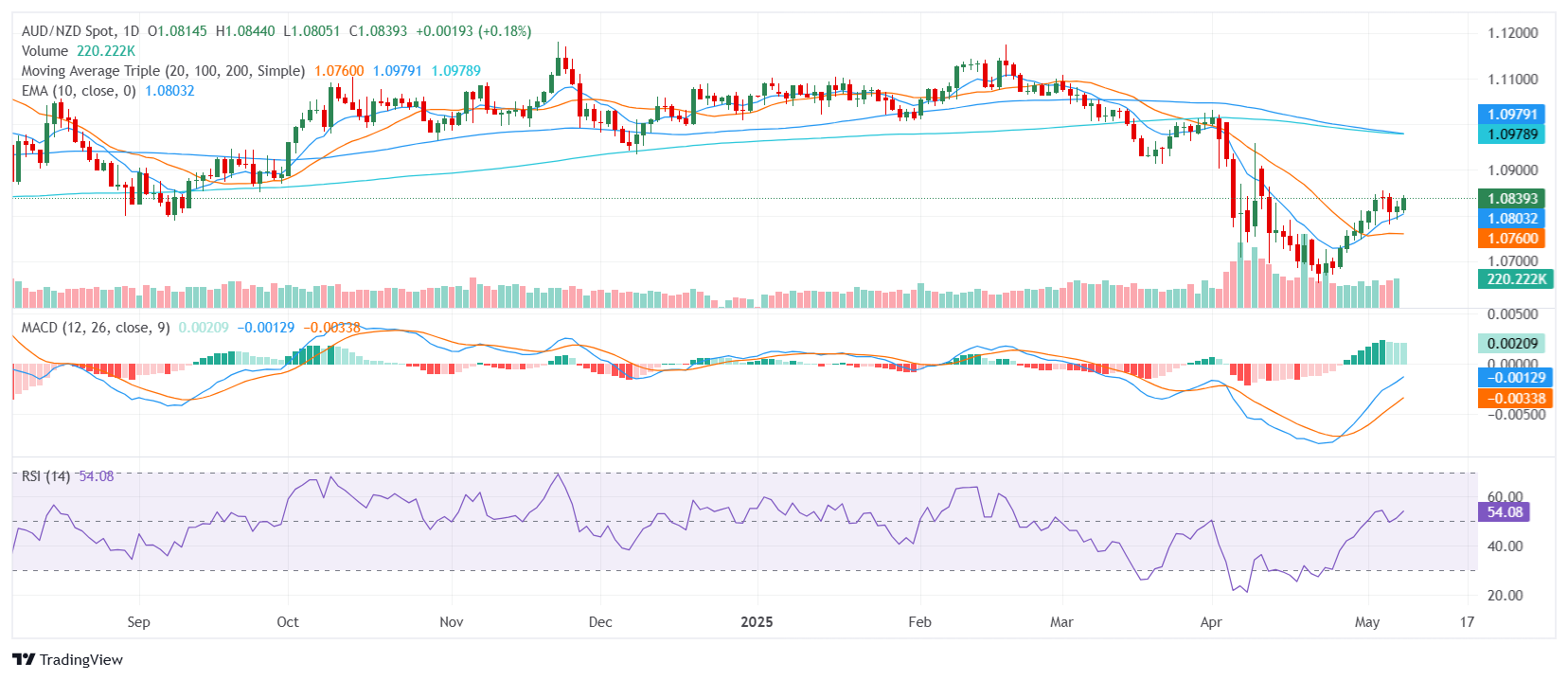
Technically, the AUD/NZD is flashing a bullish signal overall. The Relative Strength Index remains neutral near 53, indicating balanced momentum without immediate overbought pressure. The Moving Average Convergence Divergence supports the current uptrend with a confirmed buy signal, while the Stochastic RSI Fast and Commodity Channel Index remain neutral, reflecting a stable upward trajectory without immediate exhaustion.
Shorter-term moving averages also reinforce the positive outlook. The 10-day Exponential and Simple Moving Averages, both positioned near current price levels, are trending higher and provide immediate dynamic support. The 20-day Simple Moving Average sits just below, further underpinning the bullish case. However, the longer-term 100-day and 200-day Simple Moving Averages remain well above, suggesting that broader selling pressure may still cap gains in the medium term.
Support levels are noted at 1.0836, 1.0823, and 1.0815. Resistance stands at 1.0867, 1.0888, and 1.0927. A break above the immediate resistance zone could confirm a broader breakout, while a drop below support might trigger a short-term correction.
Daily Chart
Author

Patricio Martín
FXStreet
Patricio is an economist from Argentina passionate about global finance and understanding the daily movements of the markets.