|

AUD/JPY technical analysis: 50% Fibo. can trigger pullback amid oversold RSI levels

  • Repeated failures to slip beneath 50% Fibo and RSI conditions favor pullback.
  • A downward sloping trend-line since mid-April can the limit upside.

AUD/JPY seesaws near 75.90 ahead of Australian employment data on early Thursday.

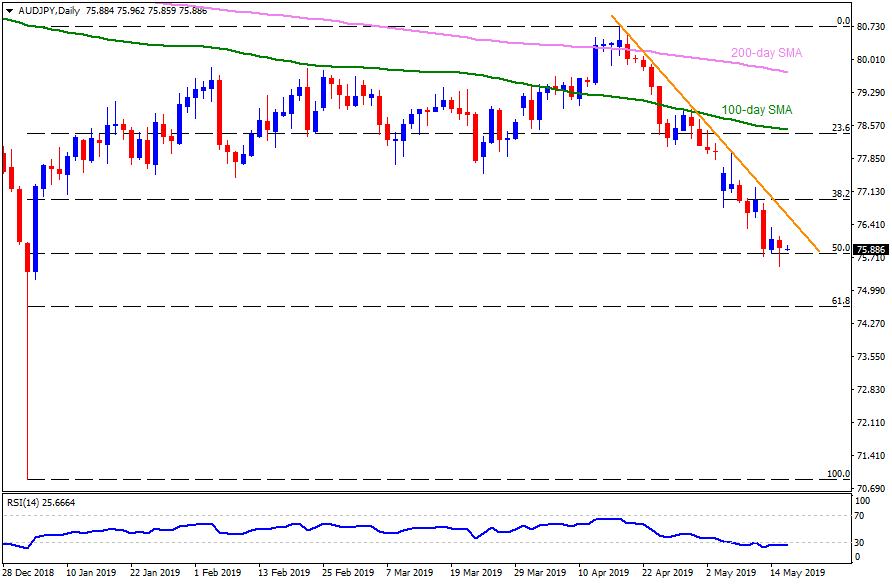
The 50% Fibonacci retracement level of January to April upside, near 75.80, acts as immediate support for the pair while 14-day relative strength index (RSI) signals oversold conditions.

Given the nearness to important support and RSI levels, chances of the pair’s pullback to 76.30 are much brighter. However, a month-old descending trend-line at 76.75 could question further upside.

If prices manage to rise past-76.75, buyers’ can again aim for 77.45/50 resistance-area comprising multiple lows marked during January and March.

Meanwhile, a downside break of 75.80 highlights January 04 low near 75.25 as the key level ahead of shifting market attention to July 2016 bottom surrounding 74.50.

Additionally, pair’s sustained declines under 74.50 might not refrain from visiting 2016 low near 72.40.

AUD/JPY daily chart
Trend: Pullback expected

Additional important levels

Overview
Today last price75.9
Today Daily Change-22 pips
Today Daily Change %-0.29%
Today daily open76.12
 
Trends
Daily SMA2078.21
Daily SMA5078.69
Daily SMA10078.54
Daily SMA20079.76
Levels
Previous Daily High76.37
Previous Daily Low75.78
Previous Weekly High78.05
Previous Weekly Low76.34
Previous Monthly High80.75
Previous Monthly Low78.11
Daily Fibonacci 38.2%76.14
Daily Fibonacci 61.8%76.01
Daily Pivot Point S175.81
Daily Pivot Point S275.5
Daily Pivot Point S375.22
Daily Pivot Point R176.4
Daily Pivot Point R276.68
Daily Pivot Point R376.99

Author

Anil Panchal

Anil Panchal

FXStreet

Anil Panchal has nearly 15 years of experience in tracking financial markets. With a keen interest in macroeconomics, Anil aptly tracks global news/updates and stays well-informed about the global financial moves and their implications.


More from Anil Panchal
Share:

Editor's Picks

EUR/USD flirts with daily highs, retargets 1.1900

EUR/USD regains upside traction, returning to the 1.1880 zone and refocusing its attention to the key 1.1900 barrier. The pair’s slight gains comes against the backdrop of a humble decline in the US Dollar as investors continue to assess the latest US CPI readings and the potential Fed’s rate path.

GBP/USD remains well bid around 1.3650

GBP/USD maintains its upside momentum in place, hovering around daily highs near 1.3650 and setting aside part of the recent three-day drop. Cable’s improved sentiment comes on the back of the Greenback’s  irresolute price action, while recent hawkish comments from the BoE’s Pill also collaborate with the uptick.

Gold clings to gains just above $5,000/oz

Gold is reclaiming part of the ground lost on Wednesday’s marked decline, as bargain-hunters keep piling up and lifting prices past the key $5,000 per troy ounce. The precious metal’s move higher is also underpinned by the slight pullback in the US Dollar and declining US Treasury yields across the curve.

Crypto Today: Bitcoin, Ethereum, XRP in choppy price action, weighed down by falling institutional interest 

Bitcoin's upside remains largely constrained amid weak technicals and declining institutional interest. Ethereum trades sideways above $1,900 support with the upside capped below $2,000 amid ETF outflows.

Week ahead – Data blitz, Fed Minutes and RBNZ decision in the spotlight

US GDP and PCE inflation are main highlights, plus the Fed minutes. UK and Japan have busy calendars too with focus on CPI. Flash PMIs for February will also be doing the rounds. RBNZ meets, is unlikely to follow RBA’s hawkish path.

Ripple Price Forecast: XRP potential bottom could be in sight

Ripple edges up above the intraday low of $1.35 at the time of writing on Friday amid mixed price actions across the crypto market. The remittance token failed to hold support at $1.40 the previous day, reflecting risk-off sentiment amid a decline in retail and institutional sentiment.