|

AUD/JPY falls 0.6% as Yen rebounds, slips below 95.00

  • The AUD/JPY is getting pushed back down into consolidation, slipping back beneath 95.00.
  • The Yen is seeing a resurgence across the board on newfound strength.
  • The Aussie is seeing recent gains get pared back heading into the end of the week.

The AUD/JPY is seeing downside for Friday as the Yen (JPY) catches a late bid to close out the trading week.

The Aussie (AUD) caught a mid-week bid after Australian inflation ticked higher than expected, pushing the Reserve Bank of Australia (RBA) closer towards additional rate hikes heading into the end of the year, but topside action for the AUD remains limited as the JPY finds some newfound strength.

Japanese inflation improved for October, with the annualized Tokyo Consumer Price Index (CPI) print early Friday coming in at 3.3% versus the previous month's 2.8%, largely owing to increasing energy prices. 

Tokyo CPI excluding food and energy prices declined, albeit slightly, to 3.8% from the previous period's 3.9%, which itself was revised upwards from 3.8%.

AUD/JPY traders will be looking ahead to Monday's Aussie and Japan data readings, with Australian Retail Sales (forecast 0.3%, previous 0.2%) early, followed later in the day by Japanese Unemployment Rate (forecast 2.6%, previous 2.7%).

AUD/JPY Technical Outlook

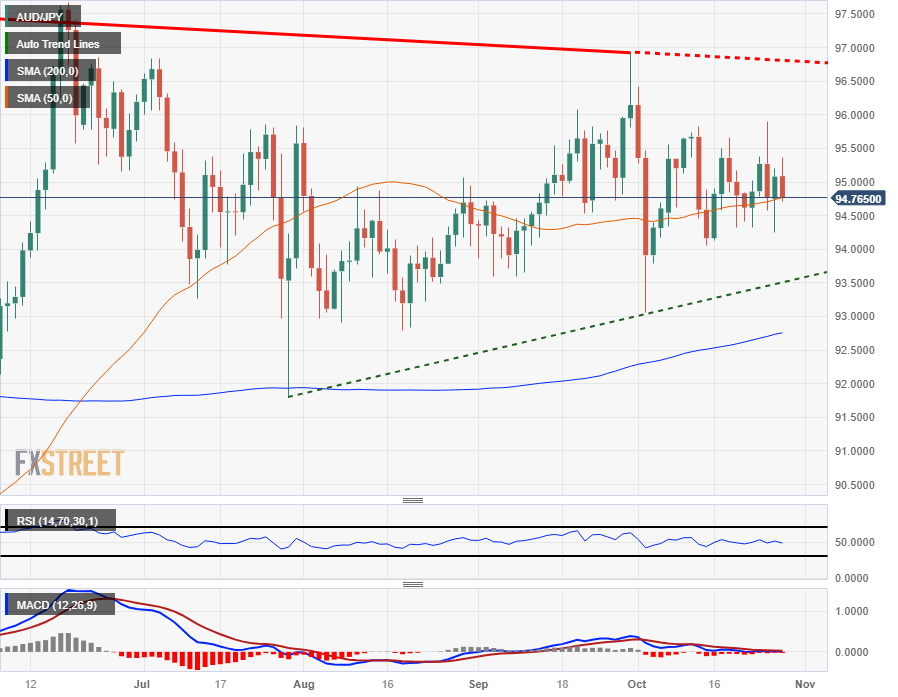
Friday's decline for the Aussie sees the AUD/JPY pushing straight back into the 50-day Simple Moving Average (SMA) as the pair struggles to find momentum in the medium term; long-term support sits at the 200-day SMA just below 93.00 while the current ceiling on any bullish moves sits at late September's high near the 97.00 handle.

The Aussie is still up over 10% from 2023's lows against the beleaguered Yen, but a rebounding JPY could see the AUD/JPY set for a bearish trend formation.

AUD/JPY Daily Chart
AUD/JPY Technical Levels

AUD/JPY

Overview
Today last price94.76
Today Daily Change-0.32
Today Daily Change %-0.34
Today daily open95.08
 
Trends
Daily SMA2094.98
Daily SMA5094.74
Daily SMA10094.87
Daily SMA20092.73
 
Levels
Previous Daily High95.2
Previous Daily Low94.25
Previous Weekly High95.66
Previous Weekly Low94.14
Previous Monthly High96.92
Previous Monthly Low93.59
Daily Fibonacci 38.2%94.84
Daily Fibonacci 61.8%94.61
Daily Pivot Point S194.49
Daily Pivot Point S293.89
Daily Pivot Point S393.53
Daily Pivot Point R195.44
Daily Pivot Point R295.8
Daily Pivot Point R396.4

Author

Joshua Gibson

Joshua joins the FXStreet team as an Economics and Finance double major from Vancouver Island University with twelve years' experience as an independent trader focusing on technical analysis.


More from Joshua Gibson
Share:

Editor's Picks

GBP/USD stays offered near 1.3370

GBP/USD remains on the back foot, slipping back toward the 1.3370 zone on Tuesday. Cable has come under pressure soon after testing the 1.3400 neighbourhood as investors turned more cautious in response to renewed effervescence on the geopolitical front.

EUR/USD slips back to 1.1420, daily lows

EUR/USD now accelerates its daily retracement and revisits the 1.1420 region, or daily troughs. The pair’s decline comes amid the gain of upside momentum in the US Dollar amid renewed tensions in the Strait of Hormuz and a sell-off in Asian technology stocks.

Gold weakens toward $4,100

Gold adds to Monday’s decent pullback and trades close to the $4,100 mark per troy ounce on Tuesday. In the meantime, fresh geopolitical effervescence appear to have reignited inflation concerns, which in turn, limit any recovery attempt from the precious metal.

Bitcoin: BTC struggles despite renewed ETF inflows as Strategy sale impact fades
Bitcoin (BTC) falls below $64,000 on Tuesday, erasing part of the recent gains following six consecutive days of price rises. Institutional demand shows signs of recovery, with spot ETFs recording a second day of inflows through Monday after weeks of outflows.
Bye, forward guidance: How to trade when central banks choose silence
Central banks have spent years telling markets what might come next. Now, traders face the possibility that they say a lot less. From the Federal Reserve to the European Central Bank and the Bank of England, policymakers are pushing back against forward guidance, arguing that the current world demands more flexibility.
Bye, forward guidance: How to trade when central banks choose silence

Central banks have spent years telling markets what might come next. Now, traders face the possibility that they say a lot less. From the Federal Reserve to the European Central Bank and the Bank of England, policymakers are pushing back against forward guidance.















