|

AT&T pushes higher on strong earnings, here are the key resistance levels

AT&T (T) delivered good earnings, and the stock has responded well, pushing more than 5% higher from its pre-earnings levels. Going into the report, the stock had already been under meaningful pressure, trading more than 22% below its previous highs from September. Because of that prior weakness, the post-earnings reaction stands out, and I’ve been closely watching how price behaves as momentum builds.

Before diving deeper into the chart, it’s worth briefly touching on AT&T itself. AT&T is a long-standing telecom company that remains widely followed in the market, and because of that, its earnings reactions tend to attract significant attention. When a stock like this moves decisively after earnings—especially following a prolonged period of downside—it often creates clear technical levels that traders focus on very closely.

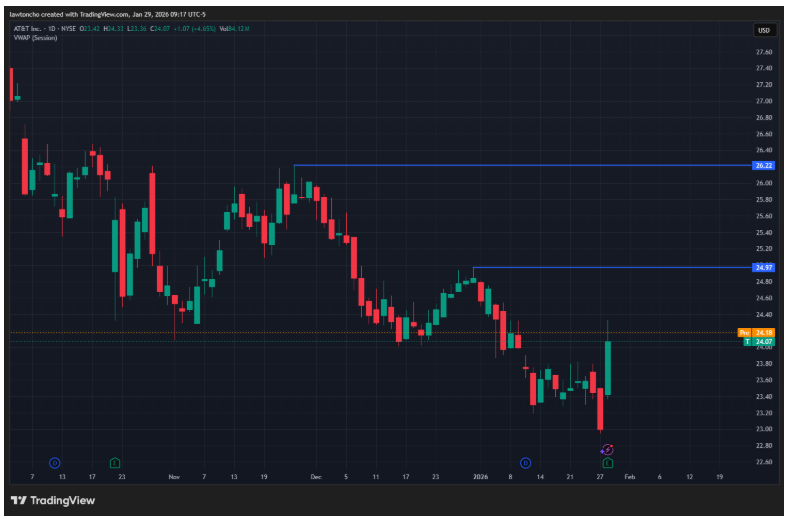
From a technical analysis standpoint, when a stock moves sharply after earnings, my focus immediately shifts to where price may begin to encounter resistance. If this upside momentum continues, the first area I’m watching is the prior pivot highs combined with a gap-fill zone around the $25 level. This area stands out clearly on the chart and represents the first logical spot where buyers may hesitate and sellers may start to step in.

Beyond that, the next level of resistance I see comes in around the $26 mark, which aligns with another pivot high. If price is able to push through the first resistance zone, this secondary level becomes increasingly important from a technicals perspective, as it represents a further test of the stock’s post-earnings strength.

Remember, when trading stocks around earnings-driven moves like this, I stay disciplined with risk management. Earnings volatility can cut both ways, and while momentum can be powerful, it’s critical to respect key technical levels and manage exposure accordingly.
Chart

Author

Lawton Ho

Lawton Ho

Verified Investing

A marketing expert sharing his journey to mastering the charts.

More from Lawton Ho
Share:

Editor's Picks

GBP/USD bounces off lows, back above 1.3200

After bottoming out near 1.3160, GBP/USD manages to regain a bit of shine and reclaim the 1.3200 mark and beyond at the end of the week. Stronger-than-expected UK Retail Sales data seem to be helping the British Pound limit its losses, while the chaotic UK political environment keeps the bulls at bay for now.

EUR/USD looks consolidative around 1.1460

EUR/USD stages a modest rebound after slipping to a three-month low below 1.1420 at the end of the week. That said, the pair now looks to consolidate humble gains just above 1.1460 despite growing uncertainty surrounding the next round of US-Iran negotiations, which keeps the US Dollar’s downside contained.

Gold slips back to six-day lows, targets $4,100

Gold retreats for the third consecutive day on Friday, eroding gains seen in the first half of the week and approaching the key $4,100 mark per troy ounce. Indeed, the precious metal continues to face headwinds from the Fed's hawkish stance and renewed uncertainty surrounding the next round of US-Iran negotiations.

Breaking: Iran closes the Strait of Hormuz amid ceasefire deal violation
Iran says it is closing the Strait of Hormuz after accusing the United States (US) and Israel of violating the ceasefire. According to Iran, the decision came over the continued Israeli strikes in Lebanon. The Iranian Revolutionary Guard Corps Navy issued a warning to all vessels: "Do not approach the Strait of Hormuz; otherwise, your security will be jeopardized."
The Iran war didn't break the US economy, but what happens next?

Nearly four months after the start of the Iran war, the US economy remains remarkably resilient. While the conflict initially triggered a severe disruption to global energy markets and a sharp rise in Oil prices, recent diplomatic progress between Washington and Tehran has eased concerns about a prolonged supply shock.

Regime change: Inside Kevin Warsh's first move to make the Fed unreadable on purpose

The rate did not move. That was the least interesting thing about Kevin Warsh's first meeting in charge of the Fed. The FOMC held its benchmark at 3.50%-3.75% for the fourth straight meeting, exactly as priced, and then the new chair used his first press conference to dismantle the machinery the market has leaned on for a decade.