|

ASML holdings starts new bullish cycle

ASML Holding N.V. (ticker: ASML) is a leading Dutch semiconductor equipment manufacturer. It’s one of the world’s largest suppliers of lithography systems for the semiconductor industry. Established in 1984, ASML has played a crucial role in the advancement of chip-making technology. Its advanced lithography machines enable the production of smaller, faster, and more powerful microchips used in various applications, including smartphones, data centers, artificial intelligence, and autonomous vehicles.

ASML’s lithography systems employ a technology called Extreme Ultraviolet (EUV) lithography. This allows for the creation of ultra-fine circuit patterns on silicon wafers. This technology is critical for semiconductor manufacturers to keep up with Moore’s Law. The Law states that the number of transistors on a chip doubles approximately every two years. This in turns drives the continuous progress of computing power.

The company operates globally, serving major semiconductor manufacturers worldwide. Its customer base includes industry giants such as Intel, Samsung, and TSMC. ASML’s technological leadership, strong intellectual property portfolio, and focus on research and development have positioned it as a key player in the semiconductor equipment industry.

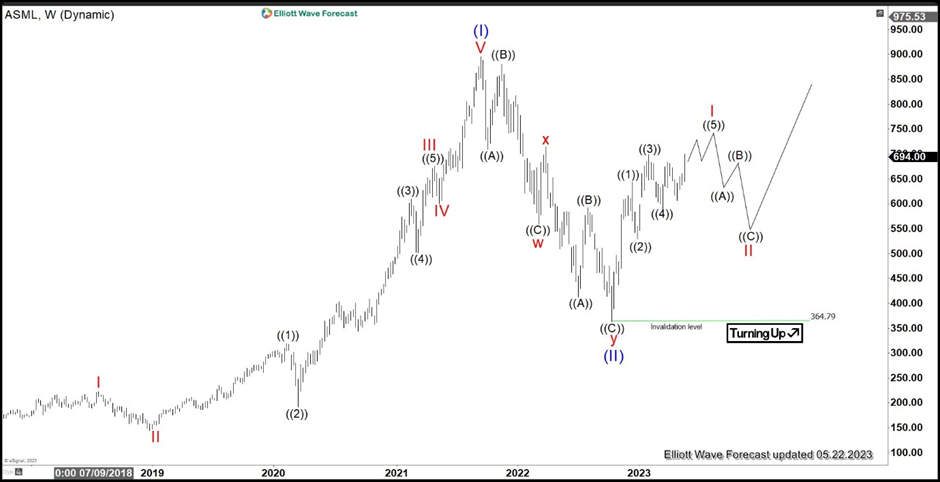
ASML is part of a blue-chip investment option due to the company’s strong market position and its strategic importance in the semiconductor industry. Factors that influence the stock performance includes industry trends, global demand for semiconductors, technological advancements, and macroeconomic conditions. Below we will take a look at the weekly Elliott Wave forecast of the company

ASML weekly Elliott Wave chart
Chart

Author

Elliott Wave Forecast Team

Elliott Wave Forecast Team

ElliottWave-Forecast.com

More from Elliott Wave Forecast Team
Share:

Editor's Picks

EUR/USD tests nine-day EMA support near 1.1850

EUR/USD inches lower during the Asian hours on Monday, trading around 1.1870 at the time of writing. The 14-day Relative Strength Index momentum indicator at 56 stays above the midline, confirming improving momentum. RSI has cooled from prior overbought readings but stabilizes above 50, suggesting dips could stay limited before buyers reassert control.

GBP/USD flat lines as traders await key UK macro data and FOMC minutes

The GBP/USD pair kicks off a new week on a subdued note and oscillates in a narrow range, just below mid-1.3600s, during the Asian session. Moreover, the mixed fundamental backdrop warrants some caution for aggressive traders as the market focus now shifts to this week's important releases from the UK and the US.

Gold slides below $5,000 amid USD uptick and positive risk tone; downside seems limited

Gold attracts fresh sellers at the start of a new week and reverses a part of Friday's strong move up of over $150 from sub-$4,900 levels. The commodity slides back below the $5,000 psychological mark during the Asian session, though the downside potential seems limited amid a combination of supporting factors.

Bitcoin, Ethereum and Ripple consolidate within key ranges as selling pressure eases

Bitcoin and Ethereum prices have been trading sideways within key ranges following the massive correction. Meanwhile, XRP recovers slightly, breaking above the key resistance zone. The top three cryptocurrencies hint at a potential short-term recovery, with momentum indicators showing fading bearish signs.

Global inflation watch: Signs of cooling services inflation

Realized inflation landed close to expectations in January, as negative base effects weighed on the annual rates. Remaining sticky inflation is largely explained by services, while tariff-driven goods inflation remains limited even in the US.

Ripple Price Forecast: XRP potential bottom could be in sight

Ripple edges up above the intraday low of $1.35 at the time of writing on Friday amid mixed price actions across the crypto market. The remittance token failed to hold support at $1.40 the previous day, reflecting risk-off sentiment amid a decline in retail and institutional sentiment.















