Artificial Intelligence Stocks Run Wild: NVDA, PLTR, AI, UPST, GOOGL, MSFT all gain this week
- AI-related stocks are shooting higher this week.
- Upstart has returned 50% in just four days.
- Palantir has now risen more than 20% two weeks in a row.
- Nvidia has the back of some of the biggest family offices on Wall Street.
.jpg)
Artificial intelligence (AI) stocks are the main story this week. While chatter abounds about the significance of the NASDAQ 100 (QQQ) retaining its Golden Cross that formed on March 13 and even bouncing off the 50-day moving average in late April, this week, the market's rally has been spurred largely by smaller AI stocks.
Both Microsoft (MSFT), which owns a chunk of ChatGPT maker OpenAI and Alphabet (GOOGL), which has put forth its own AI chatbot called Bard this spring, made single-digit gains so far this week. Their price performance, however, is, of course, no match for the likes of smaller stocks like Upstart (UPST), Palantir (PLTR), C3.ai (AI). Nvidia (NVDA), viewed as offering the best chips in the AI space, has seen elevated price action for months now.
With Morgan Stanley announcing their belief that the so-called AI revolution will be worth $6 trillion in the future, even skeptical investors are beginning to dip their toes into the space. "We see AI accelerating digital transformation and tech diffusion across the economy," said analyst Brian Nowak. The Morgan Stanley internet analyst said advertising, public cloud, e-commerce and travel would all be greatly affected by the AI revolution this decade.
Artificial intelligence stock performance: Upstart, C3.ai, Palantir and Nvidia
First up is Upstart, the "artificial intelligence lending platform" that has been hurt enormously over the past year and a half by higher interest rates. The stock fell as much as 97% from its pandemic high, but now UPST exploded by 50% in just the past four days. This was greatly helped by Thursday's 15% gain. Upstart is very much a retail trader's play, and the upside this week was helped by the fact that institutional investors have been shorting the stock into oblivion. S3 Partner's list this week of the 12 stocks with the highest Squeeze Scores – those most likely to achieve short squeezes – included Upstart.
C3.ai stock has performed the second best of this lot thus far in the week. Its AI ticker may have helped it achieve a 38.1% gain from Monday through Thursday, but Monday's preliminary announcement on the recently finished quarter improved the market's overall outlook on the stock as well. On Monday, C3.ai management said that the quarter that just ended in April produced between $72.1 million and $72.4 million in revenue. This was above the previous midpoint of $71 million.
Palantir, the big data software maker used by governments and corporations alike, has long been eyed by folks in the AI space. PLTR stock jumped more than 23% this week after last week's 28% surge. On May 8, the firm backed by Peter Thiel reported first-quarter revenue that was about 4% ahead of Wall Street consensus. Additionally, management said it would be profitable every quarter this year. Its customer base grew 41% YoY, and many observers now think the company is poised to benefit greatly from the turn toward AI.
Lastly, we have Nvidia and its 11.8% rise this week. This week's performance is all the more impressive by the fact that NVDA stock has risen 121% year to date. With the release of 13F filings on Monday, the market discovered that family offices linked to Stanley Druckenmiller, David Tepper and Steven Cohen all started large positions or added to existing positions in Nvidia stock. Druckenmiller increased his stake in NVDA by 35% in the first quarter, adding more than 208,000 shares, which made it his second-largest holding. Tepper purchased 150,000 new shares, and Cohen's Point72 family office bought over 980,000 shares of Nvidia stock during the first quarter. The thesis comes from Nvidia's $40,000 H100 GPU chip, which has become the primary tool for crunching the large datasets required to run AI chatbots and other products.
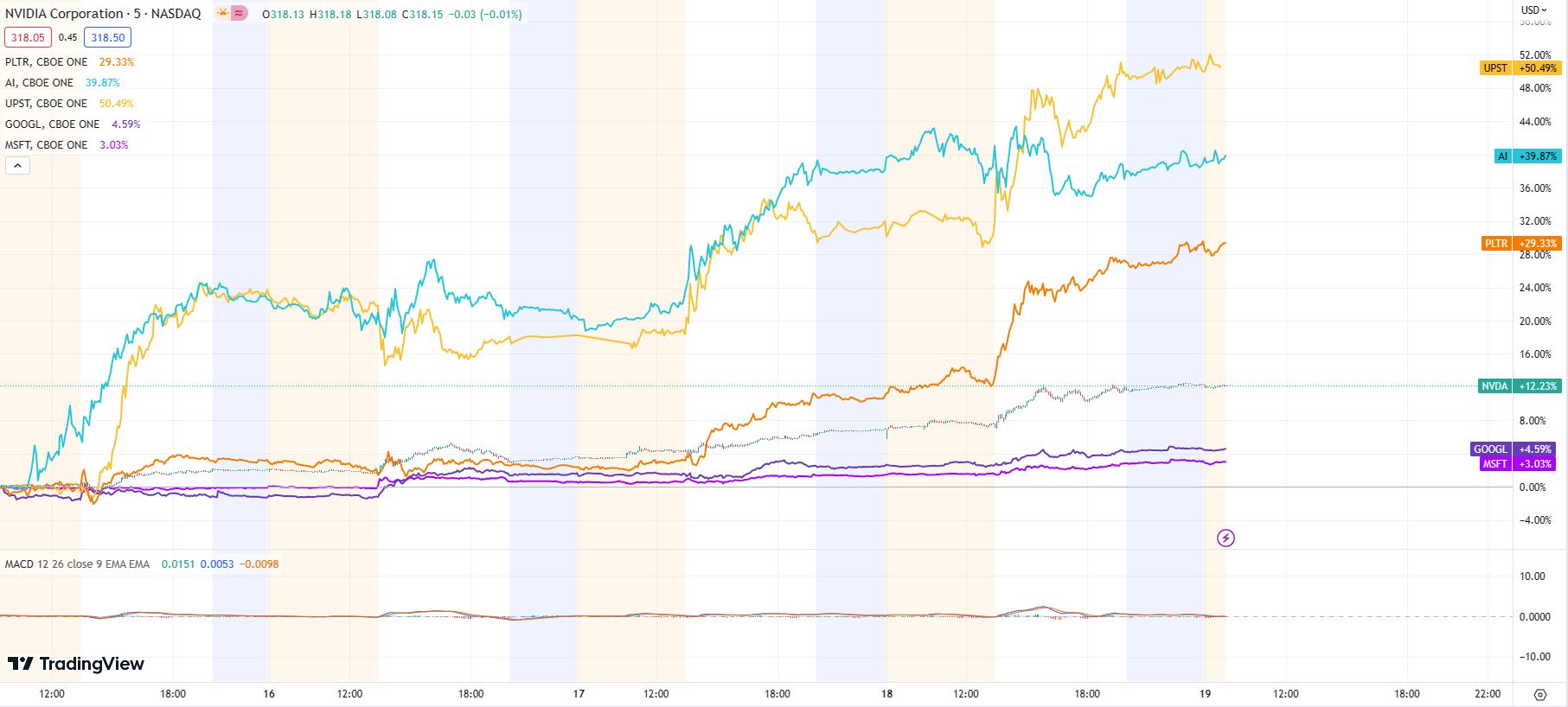
5-minute chart for NVDA, PLTR, AI, UPST, MSFT, GOOGL
Author

Clay Webster
FXStreet
Clay Webster grew up in the US outside Buffalo, New York and Lancaster, Pennsylvania. He began investing after college following the 2008 financial crisis.