Apple stock leads Dow Jones higher after Trump walks back consumer electronic tariffs
- Apple stock surges nearly 7.5% on China tariff partial exemption.
- Trump announced last Friday evening that 145% tariffs on China would be lowered to 20% for consumer electronics.
- Wedbush and KeyBanc react positively but cite consumer spending and future tariff worries.
- Apple might shift a large amount of production out of China to India.
Apple (AAPL) stock responded resoundingly to the Trump administration’s decision to exempt several categories of consumer electronics like computers and smartphones from his 145% China tariffs. Shares of AAPL climbed nearly 7.5% at first before receding to a 3.6% gain in the late morning trade.
Apple was the top gainer in the Dow Jones Industrial Average (DJIA) index as well, helping the latter to advance more than 1.1%. Meanwhile, the tech-focused NASDAQ Composite gained 1.8%.
Apple stock news
Apple management, including CEO Tim Cook, remained mum last week as US President Donald Trump pushed tariffs on Chinese products from an original Liberation Day level of 54% to an astounding 145%. However, most observers believe Cook was making calls in the background.
While analysts fretted that it would cost tens of thousands of dollars to produce iPhones in the United States, Apple quietly shifted a large amount of India-produced iPhones to the US for sale in order to wait out the storm.
When Trump walked back his Liberation Day tariff levels to 10% on Wednesday, April 9, he pushed up the level of his China tariffs so high that the overall trade-weighted tariff level was about the same level overall (~27%) that his earlier plan had called for.
Still, Trump left on the original 20% tariff on China-produced goods that had been in place before the newly announced Liberation Day tariffs, announced on April 2.
"Over the weekend, Trump partially retreated from the retreat, emphasizing that a 20% tax would apply and additional unspecified taxes on technology are coming. This erratic policy making leads to investors questioning the existence of a competent plan," UBS' Paul Donovan said.
While Trump’s turn toward moderation on tariffs is a good sign, investors will remain wary about the coming technology taxes that Trump vaguely mentioned.
KeyBanc analyst Brandon Nispel used the news to change his outlook on Apple stock from Underweight to Sector Weight, arguing that the tariff exemption “takes a big risk off the table”.
However, Nispel noted that “growth expectations remain high looking to FY26” and expects a pullback in consumer spending to place pressure on earnings calls in coming quarters.
Wedbush Securities’ Dan Ives was positive about Apple’s partial tariff exemption but said Tim Cook had “one to two months to plan its supply chain for a tariff component with India likely the biggest focus area for expanded iPhone production.”
Apple stock forecast
The good thing is that AAPL stock is holding above $200, an important psychological level for traders. The bad thing is that Apple stock has been trending lower after hitting its intraday high in the first five minutes of trading on Monday.
This might mean that Apple shares rotate back to retest $196, both the August 5, 2024 crash low and a point of resistance in January 2024. While the short-term outlook is upward, the longer-term outlook is definitely negative.
The 200-day (purple) Simple Moving Average (SMA) has cut below its 50-day counterpart (blue), spelling a bearish Death Cross pattern. With the boisterous nature of Trump's policymaking, another round of mayhem might commence in early July when the 90-day tariff pause ends. Longer-term support sits at $180 and $164.
In order to regain trust, AAPL needs to overtake the 200-day SMA, which is hovering below $230.
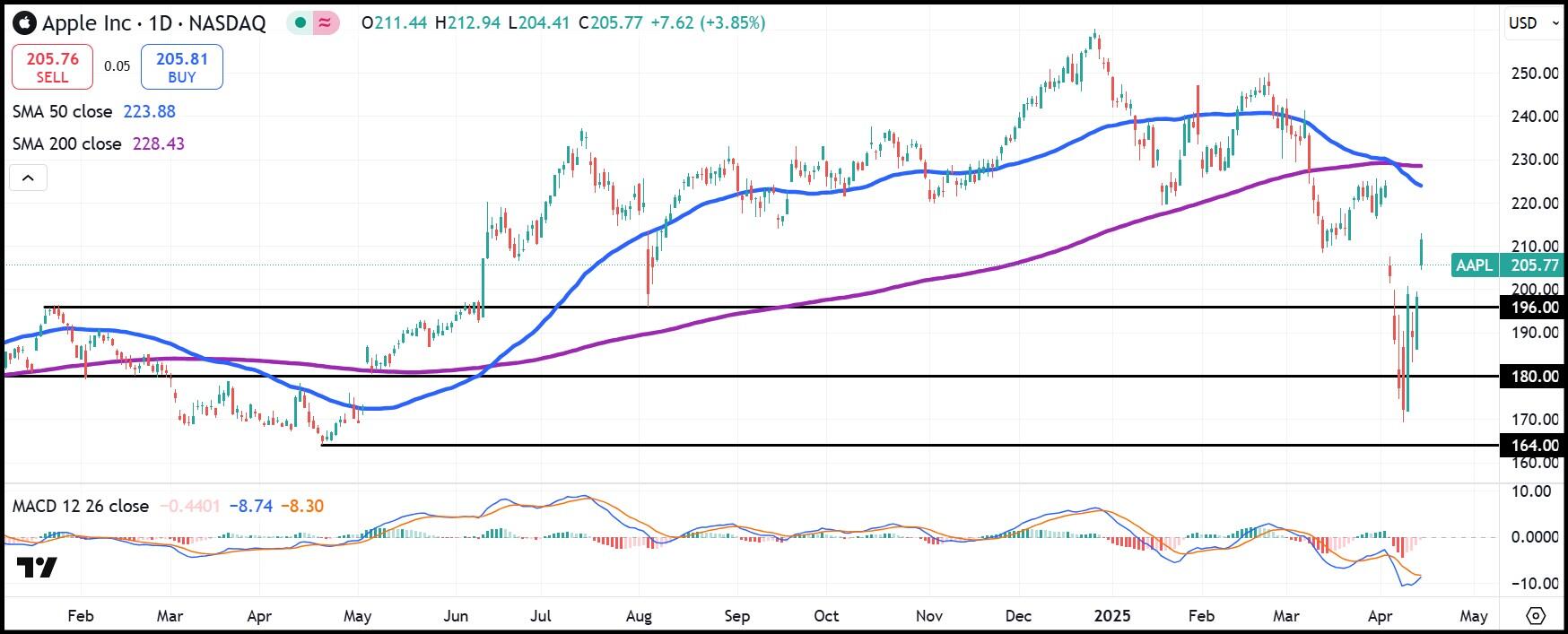
AAPL daily stock chart
Author

Clay Webster
FXStreet
Clay Webster grew up in the US outside Buffalo, New York and Lancaster, Pennsylvania. He began investing after college following the 2008 financial crisis.

















