|

APHA Stock Forecast: Aphria Inc plummets as cannabis sector gets hammered

  • NASDAQ:APHA drops by 6.70% as the broader markets experience a small correction on Thursday.
  • Aphria and Tilray both crash as the cannabis heavyweights prepare for their impending merger.
  • Analysts side with Aphria as Tillray continues to get downgrades from Wall Street.

NASDAQ:APHA has had a stellar 2021 so far like much of the cannabis industry has, but that came to a screeching halt on Thursday as the broader markets hit a minor speed bump. Aphria’s stock fell by 6.70% and closed the bumpy trading session at $19.23, which is still well above its 50-day and 200-day moving averages. The Ontario, Canada-based company has rewarded its investors so far this year returning over 160% even though the stock has fallen since peaking at a 52-week high of $32.29 earlier this month. 

Much of the talk around Aphria this year has revolved around its impending merger with Tilray (NASDAQ:TLRY), one of the leaders of the Canadian cannabis industry. Tilray surprised Wall Street and investors this past week with a better than expected earnings report which included strong fourth-quarter revenues and steadily growing margins. Despite this, several analysts still downgraded Tilray for the long-run, citing that the Nanaimo-based firm may not be strong enough to stand on its own for much longer. The merger with Aphria seems to be happening at just the right time for Tilray, which also saw its stock fall by 14% on Thursday. 

APHA stock price
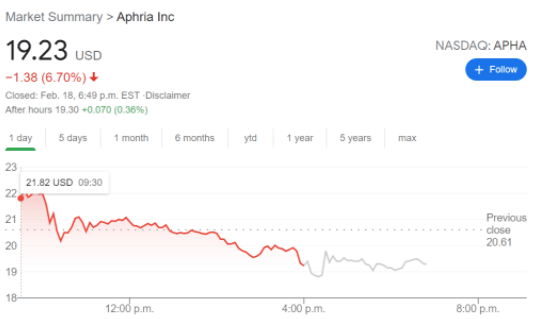
APHA stock price chart

Aphria CEO Irwin Simon will be running the new merger which will still operate under the Aphria brand. Both companies will look to leverage each other as they plan to expand operations into Europe’s medicinal marijuana market once the deal is settled. At this point, with European countries already legalizing cannabis for medical use, the continent may be a more profitable point of entry as the United States still awaits federal legalization. Besides, there are already plenty of American cannabis companies in operation for when that legislation inevitably occurs. 

Author

More from Stocks Reporter
Share:

Editor's Picks

AUD/USD bulls regain control above 0.6950 amid USD retreat

AUD/USD regains traction and extends the previous day's bounce from the weekly low, aiming for 0.7000 in Asia on Friday. The overnight pullback in US bond yields keeps the US Dollar below an 18-month high, which in turn offers some support to the pair. Meanwhile, hawkish RBA expectations also keep the major underpinned.

USD/JPY holds gains near 158.00 after Japan's weak Household Spending data

USD/JPY clings to gains around 158.00 after data showed on Friday that Japan's Household Spending fell for the ninth straight month, undermining the Japanese Yen. Meanwhile, the US Dollar remains depressed as the overnight fall in US bond yields counters a hawkish Fed and geopolitical uncertainties, could cap any downside in the pair.

Gold remains range-bound below $4,200

Gold has given up some ground after an initial bullish attempt to reach weekly highs, returning to below the $4,200 mark per troy ounce on Friday. The US Dollar’s strong upside momentum, combined with rising US Treasury yields across the curve, seems to keep further gains in the yellow metal under scrutiny.

Has Bitcoin really escaped the macro forces it was built to fight?
Over 17 years ago, Satoshi Nakamoto designed Bitcoin (BTC) on the back of a global financial crisis as an alternative to the global monetary system outside the control of central banks, governments and traditional intermediaries. This raises a key question: has Bitcoin really become independent of the macroeconomic forces it was built to challenge?
The Euro is not the sick man of Europe. France's bond market is
EUR/USD remains under pressure, near the 17-month low of 1.1161 reached on Monday. The pair has lost more than 7% since its yearly peak, as concerns over France's public finances increasingly weigh on the single currency. But behind the weakness of the Euro (EUR), the problem does not necessarily lie with the European economy as a whole.
Has Bitcoin really escaped the macro forces it was built to fight?
Over 17 years ago, Satoshi Nakamoto designed Bitcoin (BTC) on the back of a global financial crisis as an alternative to the global monetary system outside the control of central banks, governments and traditional intermediaries. This raises a key question: has Bitcoin really become independent of the macroeconomic forces it was built to challenge?
















