American Express suffers as Bank of America downgrades AXP on slower growth, consumer weakness
- American Express gets uncommon downgrade from BofA Securities.
- AXP stock loses 3.7% on Wednesday despite index gains.
- BofA says that AXP is overvalued based on recent meager growth.
- Investors are excited about Fed Minutes and Jackson Hole Symposium this week.

American Express (AXP) stock was the lowest performing member of the Dow Jones Industrial Average (DJIA) on Wednesday, shedding some 3.7% near lunchtime.
The underperformance coincided with the DJIA gaining ground amid market optimism over the Jackson Hole Economic Symposium that begins on Thursday. But first, the Federal Reserve’s (Fed) Meeting Minutes from its most recent FOMC gathering will also be released later on Wednesday, and these discussions are expected to provide more evidence for an interest rate cut at the September meeting less than a month away.
Dow Jones Industrial Average coils ahead of Jackson Hole
Early in the session, the US Labor Department revised down the Nonfarm Payrolls Benchmark Revision for the 12 months to March 2024 by 818,000 jobs compared with an earlier estimate. The final estimate will come in February 2024, but the new figure tells investors and the Fed that the labor market may be worse than it seems, which is more reason to cut rates.
American Express stock news
Bank of America Securities is feeling the pressure of falling consumer spending and thinks American Express is likely to fall victim to it in the near future. On Wednesday, the sell-side outfit downgraded American Express from Buy to Neutral.
"While we maintain a favorable view of Amex’s execution and strategy long-term, recent commentary from retailers and travel companies suggests the spending backdrop is challenging, even for the high-end consumer," analyst Mihir Bhatia wrote in a client note regarding the downgrade.
In particular, Bhatia said that American Express was trading at too high of a multiple based on its somewhat slower billings growth. AXP stock is trading on Wednesday only slightly above its five-year average at 19 times earnings.
In the most recent quarter, Q2 2024, American Express saw revenue climb 8% YoY and billings slightly less than 6%.
Bhatia said to expect American Express to hit the lower range on earnings per share (EPS) and revenue for the full year as consumer spending pressure increases.
Dow Jones FAQs
The Dow Jones Industrial Average, one of the oldest stock market indices in the world, is compiled of the 30 most traded stocks in the US. The index is price-weighted rather than weighted by capitalization. It is calculated by summing the prices of the constituent stocks and dividing them by a factor, currently 0.152. The index was founded by Charles Dow, who also founded the Wall Street Journal. In later years it has been criticized for not being broadly representative enough because it only tracks 30 conglomerates, unlike broader indices such as the S&P 500.
Many different factors drive the Dow Jones Industrial Average (DJIA). The aggregate performance of the component companies revealed in quarterly company earnings reports is the main one. US and global macroeconomic data also contributes as it impacts on investor sentiment. The level of interest rates, set by the Federal Reserve (Fed), also influences the DJIA as it affects the cost of credit, on which many corporations are heavily reliant. Therefore, inflation can be a major driver as well as other metrics which impact the Fed decisions.
Dow Theory is a method for identifying the primary trend of the stock market developed by Charles Dow. A key step is to compare the direction of the Dow Jones Industrial Average (DJIA) and the Dow Jones Transportation Average (DJTA) and only follow trends where both are moving in the same direction. Volume is a confirmatory criteria. The theory uses elements of peak and trough analysis. Dow’s theory posits three trend phases: accumulation, when smart money starts buying or selling; public participation, when the wider public joins in; and distribution, when the smart money exits.
There are a number of ways to trade the DJIA. One is to use ETFs which allow investors to trade the DJIA as a single security, rather than having to buy shares in all 30 constituent companies. A leading example is the SPDR Dow Jones Industrial Average ETF (DIA). DJIA futures contracts enable traders to speculate on the future value of the index and Options provide the right, but not the obligation, to buy or sell the index at a predetermined price in the future. Mutual funds enable investors to buy a share of a diversified portfolio of DJIA stocks thus providing exposure to the overall index.
American Express stock forecast
American Express stock's recent weakness comes after the stock has had a banner year in 2024. AXP shares are up more than 30% year to date and hover near all-time highs. So a pullback is no surprise, though value investors will want to argue that American Express is notably valued well below both Visa (V) and Mastercard (MA).
AXP shares remain above both the 20-day Simple Moving Average (SMA) near $242 and the 50-day SMA near $238. A break of either of these moving averages will put an immediate end to the uptrend and likely foment further selling. The uptrend already looks over since AXP stock put in a lower high on Monday and Tuesday.
Support now comes near the lower trendline at $226 and then at the lower end of the $220s where AXP saw lows during pullbacks on August 5 and in mid-June.
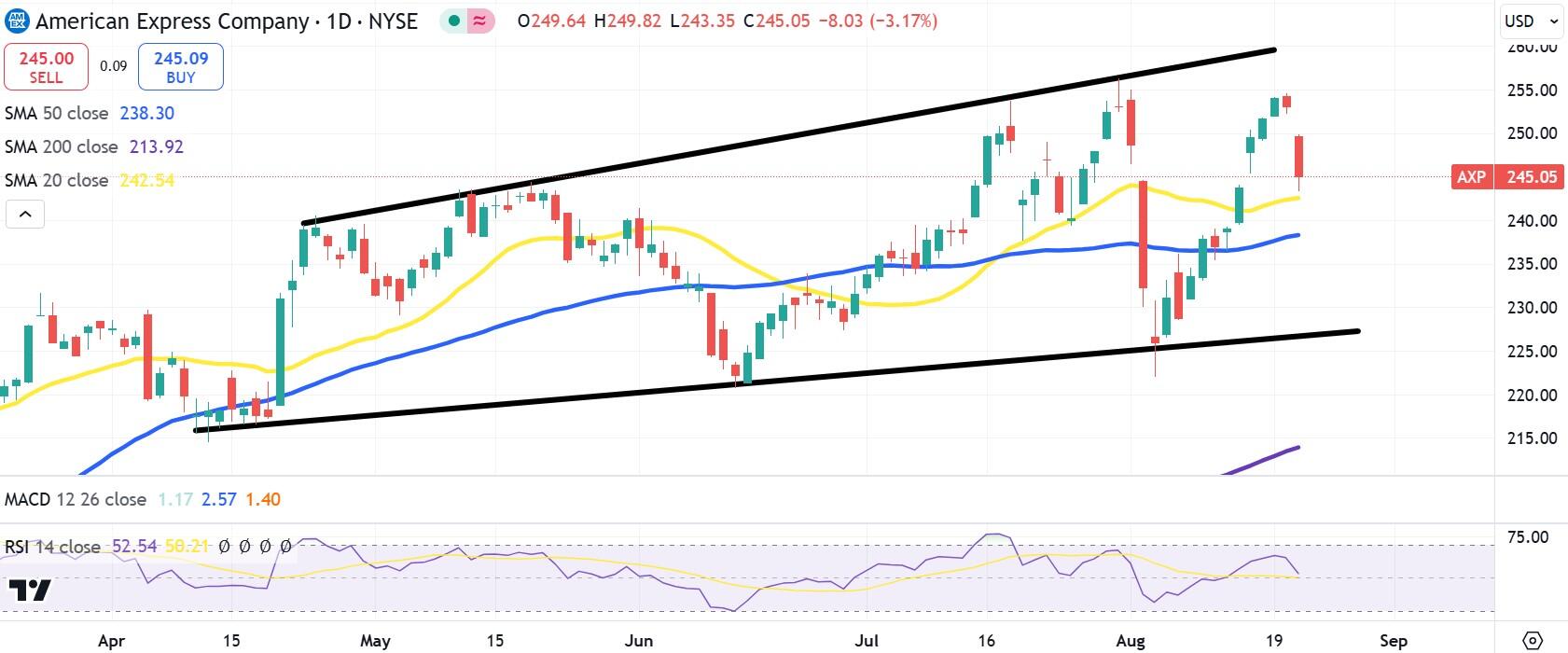
AXP daily stock chart
Author

Clay Webster
FXStreet
Clay Webster grew up in the US outside Buffalo, New York and Lancaster, Pennsylvania. He began investing after college following the 2008 financial crisis.